
Costas Simitis
Greek jurist, economist, academic and politician
About Costas Simitis
Lived 1936 – 2025 (aged 88). Costas Simitis was a Greek politician, economist, university teacher, lawyer, statesperson and jurist.
Konstantinos Simitis (; 23 June 1936 – 5 January 2025) was a Greek politician who led the 'Modernization' movement of Greece. the Greek economy was put in order and became one of the fastest-growing economies in Europe through gradual privatization policies, with an average annual increase of 4.1% of gross domestic product (GDP). The performance of the Greek economy under Simitis sealed the Greek entry into the Euro currency, closing the journey of aligning Greece with the West, which started with Eleftherios Venizelos and continued with Constantine Karamanlis.
The successful completion of the Athens 2004 Summer Olympics also boosted Greece's positive image as a modern state capable of undertaking sophisticated tasks. Moreover, a variety of large-scale infrastructure projects were completed, like the Eleftherios Venizelos airport, the Athens Ring road, Athens Metro, and Rio–Antirrio Bridge. New institutions were also introduced, such as the Greek Ombudsman and several regulatory bodies to supervise market liberalization. In foreign policy, his government's reaction to the Imia crisis in 1996 and the capture of Abdullah Öcalan in 1999 were criticized, but his refusal to intervene in the NATO bombing of Yugoslavia and the invasion of Iraq proved popular. Simitis also succeeded in the Cypriot accession into the EU, a diplomatic priority for Greece, but the Annan Plan, which his government championed, was rejected in a referendum.
After the debt crisis erupted in Greece in 2009, the legacy of Simitis was re-interpreted by critics as insufficient or misleading. However, government institutions under Simitis were developed and strengthened in their capacity to reform, appearing both more 'modern' and 'European.' which he had helped to draft as member of the Amato Group. Though never formally excluded from the party, he kept his distance with the leadership and could not come to terms with Papandreou in time to be a candidate for the 2009 elections, upon which he definitively left his MP seat for Piraeus. Before his departure, he warned of financial mismanagement that would lead to a harsh austerity regime in Greece imposed by the International Monetary Fund, which eventually came the following year. He was taken to a hospital, where he died hours later, aged 88. The government declared four days of official mourning and accorded Simitis a state funeral, which was held at the Metropolitan Cathedral of Athens on 9 January. He was then buried at the First Cemetery of Athens.
Policies and legacy
Social policies
Various social reforms were carried out under Simitis. EKAS, an income-tested pension supplement that restored the link of minimum pension with 20 daily minimum wages, was introduced, while the pension replacement rate was set as 70% of the last five years of salaries. Seniority pensions were also introduced, along with a contributory pension scheme for farmers. Law 2738/1999 on "collective bargaining in the public administration, permanent status for workers employed under open-ended contracts and other provisions" laid down, for the first time, "the right of public servants to negotiate their terms and conditions of employment, excluding pay and pensions, and to conclude collective agreements." Law 2874/2000 on 'Employment regulations and other provisions,' in addition to working time arrangements, " regulates a range of important issues relating to labour relations, such as overtime, redundancies and matters involving leave," while Law 2839/2000 on 'Regulation of matters regarding the Ministry of Foreign Affairs, Public Administration and Decentralisation and other provisions' established a gender quota system in the public sector's various governing councils, administrative boards and collective bodies. In 2003, a substantial level of legislative activity relating to employment, workplace health and safety and social security took place.
Financial policies Simitis is known mainly in Greece for his political philosophy, known as Eksynchronismos ("Modernization"), which focused on extensive public investment and infrastructure works as well as economic and labor reforms. His supporters credit Simitis with overcoming the chronic problems of the Greek economy and thus achieving Greece's admittance into the Eurozone. During his governance, official data presented inflation as having decreased from 15% to 3%, public deficits diminished from 14% to 3%, GDP increased at an annual average of 4%, and factual labor incomes increased at 3% per year. However, the macroeconomic data presented by Simitis' government were called into question by an audit performed by the successor government of New Democracy in 2004.
Many large-scale infrastructure projects were carried out or begun during the so-called 'era of Eksychronismos', such as the new "Eleftherios Venizelos" Athens International Airport, the Rio-Antirio bridge, the Athens Metro and the A2 motorway (Egnatia Odos).
Internal issues
In 2000, Simitis was embroiled in a dispute with the Archbishop of the influential Greek Orthodox Church, Christodoulos of Athens, when the Greek government sought to remove the "Religion" field from the national ID cards carried by Greek citizens on the grounds that the Hellenic Data Protection Authority recommended so; its decision also included the "Nationality" field, but was not implemented following a subsequent EE directive to the contrary. Christodoulos opposed the decision, claiming that the action pursued deviously the religious de-identification of the Greek nation. Faced with the government's robust but unpopular stance, he organized two massive demonstrations in Athens and Thessaloniki alongside a majority of bishops of the Church of Greece. Simitis' attitude gained faint-hearted support even within his party, but he found a surprisingly militant ally in the Eksychronismos opinion makers. Kostas Karamanlis, the opposition leader, signed a petition, organized by the Church of Greece, calling for a referendum on the matter and signed, too, by more than three million citizens. However, the inclusion of religious beliefs on ID cards, even on a voluntary basis, as the Church had asked, was deemed unconstitutional by the Greek courts.
Foreign policy
While PASOK traditionalists disliked his move away from the more traditional/orthodox norms of the Democratic socialism of Andreas Papandreou' policies, and also his relative moderation on issues such as the Cyprus dispute and the Macedonia naming dispute, his supporters saw both of these as positive elements of the "eksynchronismos" movement that Simitis was seen as spearheading.
During January–June 2003, Simitis, as Greek Prime Minister, exercised the presidency of the European Council.
Controversy and criticism In 1996, the appointment of the PASOK-leaning To Vima newspaper editor, Stavros Psycharis, as political administrator of Mount Athos was particularly criticized by the opposition.
Siemens bribery scandal
A significant issue during Simitis' tenure concerned corruption that was endemic in Greek public life (including the Siemens Greek bribery scandal, incidents like Akis Tsochatzopoulos, who later was imprisoned for criminal actions for the purchase of the German type 214 submarines) etc.
Siemens CEO Michalis Christoforakos testified that during his trial in Germany, he bribed (2%) both the two major political parties, ND and PASOK (through Geitonas and Tsoukatos, partner of Kostas Simitis). According to Tsoukatos, the money was put in PASOK's cash desk. As of 2018, Simitis was under prosecutor investigation regarding the Siemens Greek bribery scandal, but was later exonerated.
Validity of statistical data
New Democracy revised the size of the defense expenditures for the years 1997-2003 by changing the regulation for the cost accounting of the defense expenditures from the date of delivery of war material (delivery basis), which was at the time followed by half the countries of the EU, to the payment date of the advance payments (cash basis). Eurostat accepted the change, because of the lack of reliable data for the deliveries of war material. By the revision of the 1999 defense expenditures, the deficit of 1999, the year of the Greek economy's evaluation, amounted to 3.1%. Since 2005, Eurostat changed its rules and records the defense expenditures according to the delivery date for all the countries of the EU, including Greece. Eurostat requested that the member countries to correct their data retroactively. Greece did not proceed to the rectification.
The deficit of 1999, year of the Greek economy's evaluation, is still presented to be 3.1% of the Gross National product (GNP), greater than the Maastricht criterion for a deficit lower than 3% of the GNP. Subsequent revisions of the data show also other countries exceeding the fiscal deficit (government deficit) of 3% during the evaluation period. Thus, in 1997, which is the year of the evaluation of the first countries that became members of the Euro zone, the deficit of France was 3.3%, of Spain 3.4% and of Portugal 3.4%.
Other Other points of criticism included the 1999 Greek stock market crash in the Athens Exchange, such as his handling on the Abdullah Öcalan's capture and the Imia incident regarding the foreign relations with Turkey.
Simitis rejected New Democracy's bills for accountability and transparency with regards to governmental expenditure and decisions, while New Democracy leader Kostas Karamanlis accused Simitis during a parliamentary plenum of being an "archpriest of cronyism", referencing the index of the NGO Transparency International. However, Greece's position has fallen by five places in the same index during the New Democracy government (2004–2009). Four years later Karamanlis himself admitted that he exaggerated and that he never doubted Simitis' personal integrity.
Don’t just read it —
keep it.
Full-length biographies made to live with: read them, listen on the way to work, watch them tonight.
- E-book
- Audio
- Video
Instant download · yours to keep · every purchase keeps this site free
Important facts
People in Costas Simitis's life
Named in this biography and alive at the same time



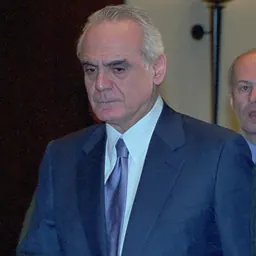

Related people
Same field, nearest in time



Contemporaries
People whose lives overlapped Costas Simitis's



Frequently asked questions
Who was Costas Simitis?
Greek jurist, economist, academic and politician (1936–2025)
When was Costas Simitis born?
Costas Simitis was born on 23 June 1936 in Piraeus.
When did Costas Simitis die?
Costas Simitis died on 5 January 2025 in Corinth General Hospital, Corinth.
What was Costas Simitis's occupation?
Costas Simitis was a politician, economist, university teacher, lawyer, statesperson and jurist.
What nationality was Costas Simitis?
Costas Simitis was Greek.
Sources & further reading
Cite this page
APA: Biography.guide. (2026). Costas Simitis. https://biography.guide/costas-simitis/
MLA: "Costas Simitis." Biography.guide, https://biography.guide/costas-simitis/.
Chicago: "Costas Simitis." Biography.guide. https://biography.guide/costas-simitis/.
Data last updated: 2026-09-20 · Spot an error? Report a correction.
Page generated 2026-09-27 05:29 UTC