
About Cosme García Sáez
Lived 1818 – 1874 (aged 55). Cosme García Sáez was a Spanish luthier and engineer.
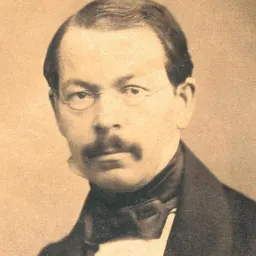
Cosme García Sáez (27 September 1818 in Logroño – 23 June 1874 in Madrid) was a Spanish inventor. He is best known as one of the first Spaniards to develop a submersible, tested in 1860 shortly after Narcís Monturiol's submarine Ictíneo I in 1859 and preceding Monturiol's Ictíneo II in 1865 and Isaac Peral's in 1889. The Spanish Ministry of Defense has recognized García as one of the four "fathers" of the Spanish Navy's Submarine Force.
Biography Early life García was the older son of Andrés García and Andrea Saéz. Little is known about his early life. His father, whose occupation is unknown, died when he was 15 years old, forcing him prematurely into a role as head of his family, supporting his mother and younger brother. At the age of 19, he married Úrsula Parres, the daughter of a tanner, at the Church of Santiago el Real in Logroño on 1837. Their first child, Vicente Benito, was born on 1838 and their second child, Juana, on 1839, with the birth certificates of both children indicating that García's occupation was that of guitar maker. By 1845, the couple had two more sons, Sotero and Enrique. García served in a grenadier company of the National Militia until at least 1843, never rising above the rank of private. It seems unlikely that he pursued higher education or had any formal training in engineering
García was nicknamed "El Pinche" ("The Kitchen Assistant") in Logroño. After he moved to Madrid he acquired the nickname "García el Riojano" ("García the Riojan") there.
Inventions Despite his lack of higher education, García displayed talent as an inventor. His inventions included machines for stamping mail in post offices, improvements in the casting of printing type, and a shotgun and a breech-loading carbine for the Spanish Army. However, he is best known for his invention of a submersible.
Shotgun García had developed an interest in firearms during his time in the National Militia, and on 1856 he filed a patent for a shotgun called the Relámpago (Lightning). It was a multi-shot, rapid-loading shotgun designed to significantly decrease the time required to reload standard infantry and hunting weapons. However, the prototype was prone to frequent backfires and accidental discharges. The Spanish Military Commission rejected it after tests, deeming the shotgun dangerous to its operator.
Postal machine On the same day as the shotgun,
In 1859, García had Garcibuzo transported by ship from Barcelona to Alicante, where he conducted tests of it necessary for it to receive consideration for a patent. The tests were successful, and he applied for a patent for the vehicle in Spain on 1859, calling it an Aparato-Buzo ("Diving Apparatus"). The patent was granted on 1860.
Encouraged by this success, and hoping to improve his personal finances, García patented the carbine in numerous countrie including Norway, Sweden, and the United Kingdom, and he traveled to the United States and patented it there as well. However, the Spanish Army changed its rifle specifications, The A-class submarine was in commission from 1917 to 1931. The United States Navy transferred the submarine USS Bang (SS-385) to Spain in 1972, and she was in commission in the Spanish Navy as Cosme García (S-34) from 1972 to 1980. The S-80 Plus-class submarine is scheduled to be commissioned in 2028.
In 1985, a secondary school named after García opened in Logroño.
In 1993, a committee in La Rioja — the Spanish autonomous community and province in which Logroño lies — attempted through various activities to bring revive García's legacy and bring him out of obscurity.
In January 2012, the Spanish Ministry of Defense identified García as one of the four "fathers" of the Spanish Navy Submarine Force, after which the first four submarines of the S-80 Plus class would be named. The other "fathers" were Narcís Monturiol, Isaac Peral, and Mateo García de los Reyes.
Don’t just read it —
keep it.
Full-length biographies made to live with: read them, listen on the way to work, watch them tonight.
- E-book
- Audio
- Video
Instant download · yours to keep · every purchase keeps this site free
Important facts
People in Cosme García Sáez's life
Named in this biography and alive at the same time

Related people
Same field, nearest in time





Contemporaries
People whose lives overlapped Cosme García Sáez's




Frequently asked questions
Who was Cosme García Sáez?
Spanish engineer (1818-1874)
When was Cosme García Sáez born?
Cosme García Sáez was born on 27 September 1818 in Logroño.
When did Cosme García Sáez die?
Cosme García Sáez died on 23 June 1874 in Madrid.
What was Cosme García Sáez's occupation?
Cosme García Sáez was a luthier and engineer.
What nationality was Cosme García Sáez?
Cosme García Sáez was Spanish.
Sources & further reading
· Wikipedia: Cosme García Sáez
Cite this page
APA: Biography.guide. (2026). Cosme García Sáez. https://biography.guide/cosme-garcia-saez/
MLA: "Cosme García Sáez." Biography.guide, https://biography.guide/cosme-garcia-saez/.
Chicago: "Cosme García Sáez." Biography.guide. https://biography.guide/cosme-garcia-saez/.
Data last updated: 2026-09-26 · Spot an error? Report a correction.
Page generated 2026-09-27 05:16 UTC