
Cornelius Loos
16th century Roman Catholic priest and theologian
About Cornelius Loos
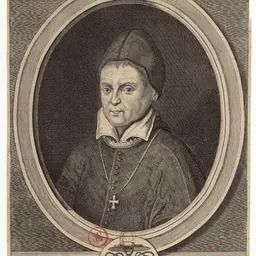
Lived 1546 – 1595 (aged 48–49). Cornelius Loos was a Dutch university teacher, writer, catholic priest and catholic theologian.
Cornelius Loos (1546 – February 3, 1595), also known as Cornelius Losaeus Callidius, was a Roman Catholic priest, theologian, and professor of theology. He was the first Catholic official to write publicly against the witch trials raging throughout Europe from the 1580s to the 1590s. For this, he was imprisoned and forced to recant; his work was confiscated and suppressed by church officials. His manuscript was lost for almost 300 years. It was discovered in the Jesuit Library of Trier in 1886 by an American historian, George Lincoln Burr.
Life Cornelius Loos was born in 1546 in Gouda. He was from a patrician family and studied Philosophy and Theology at what is today known as the Catholic University of Leuven. In 1574, Loos and his family were forced to leave for political reasons (primarily the capture of the city by Protestant/nationalist rebels during the Dutch Revolt). After he was ordained as a priest, he was awarded a Doctor of Theology degree in 1578 at the University of Mainz, where he became a Professor of Theology and a vigorous campaigner against Protestant beliefs.
In the 1580s, Loos published a number of works: a prayer book, polemical theological writings against Protestantism, a political work (by subscription) about the Netherlands rebellion, a survey of German Catholic authors, and a pocket Latin grammar book.
In 1585, he moved to Trier, where he observed the witch trials taking place there. Loos first wrote letters to the city authorities, and, failing in that effort, he sought in 1592 to publish a book protesting against the hunts and questioning some of the beliefs of the witch hunters. The attempted publication of De vera et falsa magia (True and False Magic) offended Petrus Binsfeld, the Suffragan Bishop of Trier and deputy to Johann VI von Schonenberg, one of the highest-ranking officials in the Holy Roman Empire.
Before the book could be printed, the manuscript copy was seized and Loos imprisoned. He was forced to make a public recantation of his errors on his knees before an assembly of church officials, including the Papal Nuncio, in Brussels on March 25, 1593. The manuscript was believed destroyed by the Inquisition and was lost for 300 years.
De vera et falsa magia discovered In 1886, American George Lincoln Burr discovered the manuscript of True and False Magic in the Jesuit Library in Trier (a remnant of the University, which was dissolved in 1798). Although the title page was missing and no author was listed, Burr was able to authenticate the document by comparing the points made in the text with the points recanted in Loos’s confession to the Inquisition. A copy can be found in the rare manuscript collection at Cornell University; the original is held by the Trier Municipal Library.
In the manuscript, Loos argues against the existence of witchcraft and especially against the validity of confessions obtained under torture. (Binsfeld had in 1589 published his own book on witchcraft, in which he supported confessions and denunciations obtained through torture.) In his work, Loos is believed to have been influenced by the arguments of Johann Weyer, a Protestant Dutch physician, who in 1563 put forth a book attacking the persecution of witches while also categorizing kinds of magical demons. After recanting, Loos was under constant watch by religious officials, and was briefly imprisoned several more times, under the accusation that he had relapsed into theological error. This continued persecution was conducted by his nemesis, a priest in the Jesuit order named Martin Del Rio. Loos died February 3, 1595, in Brussels, succumbing to the Plague; Del Rio lamented that Loos had died before Del Rio could have him executed.
Contributions Although, as noted above, Loos was not the first to write against the witch hunts, he was the first Catholic priest and theologian to do so, and the first to specifically question the validity of confessions obtained under torture. Even though his work was lost for 300 years, his opponent Martin Del Rio ensured his continuing fame by publishing a book denouncing him, and by summarizing each of his arguments in the recantation he forced Loos to sign.
Don’t just read it —
keep it.
Full-length biographies made to live with: read them, listen on the way to work, watch them tonight.
- E-book
- Audio
- Video
Instant download · yours to keep · every purchase keeps this site free
Important facts
Related people
Same field, nearest in time



Contemporaries
People whose lives overlapped Cornelius Loos's





Frequently asked questions
Who was Cornelius Loos?
16th century Roman Catholic priest and theologian
When was Cornelius Loos born?
Cornelius Loos was born in 1546 in Gouda.
When did Cornelius Loos die?
Cornelius Loos died in 1595 in Brussels-Capital Region.
What was Cornelius Loos's occupation?
Cornelius Loos was a university teacher, writer, catholic priest and catholic theologian.
What nationality was Cornelius Loos?
Cornelius Loos was Dutch.
Sources & further reading
Cite this page
APA: Biography.guide. (2026). Cornelius Loos. https://biography.guide/cornelius-loos/
MLA: "Cornelius Loos." Biography.guide, https://biography.guide/cornelius-loos/.
Chicago: "Cornelius Loos." Biography.guide. https://biography.guide/cornelius-loos/.
Data last updated: 2026-09-20 · Spot an error? Report a correction.
Page generated 2026-09-27 05:02 UTC