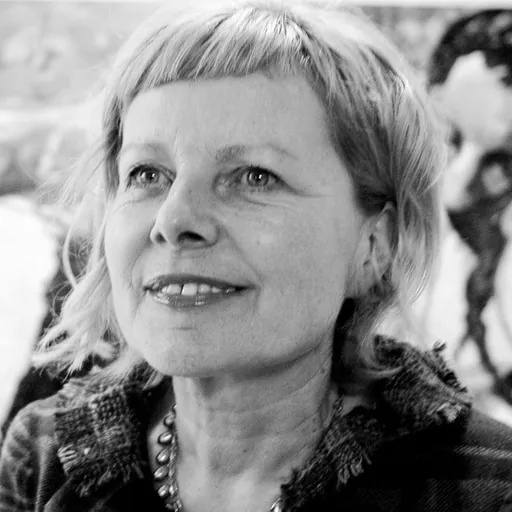
About Cornelia Schleime
Born 1953. Cornelia Schleime is a German painter, filmmaker, singer, writer and visual artist.
Cornelia Schleime (born July 4, 1953) is a German painter, performer, filmmaker and author. Born in East Berlin under the GDR, she studied painting and graphic arts at the Dresden Academy of Fine Arts before becoming a member of the underground art scene.
She was awarded the Hannah Höch Lifetime Achievement Award from the State of Berlin in 2016.
Life Early life in East Berlin
Schleime was born in 1953 in East Berlin, East Germany. She grew up under the dictatorship of a "gesetztes Wir" (predefined collective or "We") she had learned very early to retract from the coercions and imputations of a prescribed happiness. A "Community tames extremes". It would "have smoothened out my fractions. I did not want to change anything here, with the exception of myself. I was fed up with the way people betrayed themselves. I didn't want to grow old that way." Rather early she dreamed of going to Morocco like August Macke, in order to "meet my self in the faraway lands, to dive into the opium of unfettered suns." She always wanted to be a traveller and visit the great museums of the world, these power stations of concentrated energy, to meet the Giottos, Masaccios, van Eycks, Vermeers, Manets and Turners there, and "maybe only to stand only once in front of a small watercolour by William Blake."
In a 1996 interview, Schleime reflects on her life in East Berlin's effect on her work "I believe in general, and here I refer to the time in the East, that the oppression or limitations which I experienced did not influence painting. The painting was or is not for me a processing machine for political or personal emergency. In any case, I suffered more from the provinciality of the GDR than from their politics, so our conversations in the East were so often centered around the "universal." No, I can handle nothing with my painting. My work should be purpose-free, only in this way can I open up new spaces. In the east I had one of the cops, who was standing at the Friedrichstrasse junction, with the umbrella - that was the way to get my frustration, not the brush!"
Both Schleime's parents were of catholic origin, her father is from the Rhineland and her mother from Gdansk (Danzig). They moved to Berlin (East) after the war. Her father, who had been married before, could not marry her mother in church, according to catholic rules. So the grandparents only consented to the partnership under the condition that Schleime be raised strictly catholic. Her experience with Catholicism is a consistent influence to her works. She later worked as a stable-girl at the Dresden Thoroughbred Races and as a nursing assistant for a short time. In a 2016 interview Schleime confronted the comparison of her works to 1970s feminist avant-garde artists Annegret Soltau and Hannah Wilke: "Of course I had heard of these artists. But I wasn’t interested in feminism at all. When I went to the West, the feminists thought they had found a comrade-in-arms. But they were wrong. My actions aren’t directed against men. They’re directed against the fact that they stripped me of the freedom to show my art, and so I got naked and tied myself up. I didn’t do it for sexual reasons. I got naked because I was forced to be naked. The GDR took everything I had. I also did those things where I enveloped myself in barbed wire. It was more about vulnerability, about being at someone’s mercy, about Christ with the crown of thorns. I am closer to Arnulf Rainer than to the feminists. He speaks of the negation of all extravagance. Everything that is excessive is negated. He tried to reduce everything and overpainted his works until only a bleating mouth peeped out."
Türenausstellung
In her undergraduate days, Schleime belonged to a group of young artists who formed a counter-movement to official GDR art policy. The artists pursued new experimental paths and devised alternative presentation formats in studios and private homes. Schleime began her exploration of performance art with works such as a "Raum des Dichters" (Room of the Poet) in the autumn of 1979 as part of this.
Her participation in this exhibition, her broad definition of art and her unconventional works and shows resulted in an exhibition ban for her in 1981. In an interview in 2017 she explains that she planning an exhibition that was prevented. "The exhibition manager told me that the culture ministry had imposed a ban on my work. I started working with the pseudonym CMP [Cornelia Monica Petra, Schleime’s full name] so that they wouldn’t know it was me... I was never an enemy of the state or anything like that, I just had a different visual concept. I was told, for instance, that a woman I’d painted, with her head hanging down in a melancholy, surreal expression, didn’t look as she should according to socialism."
Zwitschermaschine
Cornelia Schleime and Ralf Kerbach met at the Dresden University of Fine Arts and created the art-punk band Zwitschermaschine, or "Twittering". After a failed art exhibition in the Radeburg Heimatmuseum, organized by Michael Rom, they decided to make music together. The band lasted from 1979 to 1983, when they managed to release a split album with Schleim-Keim with the title DDR von unten (GDR from below). Ralf Kerbach, inspired by the Sex Pistols and the Stranglers, was guitarist. Schleime was the vocalist and was accompanied by Matthias Zeidler on bass and Wolfgang Grossmann on drums. The band name resulted either from Ralf Kerbach's predilection for Paul Klee's homonymous picture, or from a performance of Luis Buñuel's film An Andalusian dog. They performed in studios, In the drama school Ernst Busch and in the Erfurt "gallery in the hall". Some concerts were canceled by the state power. Musically, they were characterised as New Music, the dilettantism of the opening days led to a sort of Dadaist concept, which was located somewhere in the intersection of sophisticated music and three-chord punk. Schleime later learned that one of their friends had been recruited to spy on them. She said in a 2017 interview that "the punk band actually wasn’t an act of rebellion, it was just a way of expressing myself since I wasn’t allowed to exhibit art." Almost her entire body of works up to that date remained in the GDR and has disappeared. on a DAAD scholarship. She states in her 2016 interview that "Through the USA I had finally acclimated myself to the West, had finally arrived. It took me a long time, as a woman without work. I had to start from scratch again in the West." Also around this time she began her ongoing series with the conceptual theme of braids, the most recent being in 2015. On the inception of this she says "There was a text in my Stasi file that read as follows: “Beyond these investigations, the ABV had no other information because Schleime behaved very inconspicuously.” So I thought: I'll satirize that. I bought a wig, wove hemp into it and lengthened it to four meters or so, attached a pram to the back and found out where Sascha Anderson's commanding officer's house was. Then I walked back and forth in front of the house with the baby carriage. A ZDF television team was there. I saw that the curtains moved and he was of course scared stiff." ' When the pictures learned to run Body painting (Hüppstedt 1981) Mouth On Nose (1982) Hölderlin Performance in WDR, Experimental film festival Kino Eiszeit, Berlin (together with Michael Wildenhain) (1984) Experimental Film Festival, Osnabrück (1987) International Forum of Super 8, Exit Art Gallery, New York, USA (1988) My Chrysler (1989) Self-production with Braid (1993) Die Stasiserie (1993) Counter-images. Filmische Subversion in the GDR 1976–89, Filmmuseum Potsdam (1996) Germany pictures, artist videos, artist films, experimental films, cinemas in Martin-Gropius-Bau, Berlin (1997) ICESTORM, International Inc., University of Massachusetts, GDR Underground Films, Massachusetts, USA (2000) Concrete Emotions: Personal Spaces and Urban Landscapes,'' Tate Modern and Goethe Institute, London / England (2009) 19th Cottbus Film Festival - Eastern European Film Festival, Cottbus (2009)
Don’t just read it —
keep it.
Full-length biographies made to live with: read them, listen on the way to work, watch them tonight.
- E-book
- Audio
- Video
Instant download · yours to keep · every purchase keeps this site free
Important facts
People in Cornelia Schleime's life
Named in this biography and alive at the same time







Related people
Same field, nearest in time

Contemporaries
People whose lives overlapped Cornelia Schleime's

Frequently asked questions
Who is Cornelia Schleime?
German artist (born 1953)
When was Cornelia Schleime born?
Cornelia Schleime was born on 4 July 1953 in Berlin.
What is Cornelia Schleime's occupation?
Cornelia Schleime is a painter, filmmaker, singer, writer and visual artist.
What nationality is Cornelia Schleime?
Cornelia Schleime is German.
Sources & further reading
· Wikipedia: Cornelia Schleime
Cite this page
APA: Biography.guide. (2026). Cornelia Schleime. https://biography.guide/cornelia-schleime/
MLA: "Cornelia Schleime." Biography.guide, https://biography.guide/cornelia-schleime/.
Chicago: "Cornelia Schleime." Biography.guide. https://biography.guide/cornelia-schleime/.
Data last updated: 2026-09-22 · Spot an error? Report a correction.
Portrait: Wikimedia Commons · author & licence
Page generated 2026-09-27 05:02 UTC