
About Conrad of Piacenza
Lived 1290 – 1351 (aged 60–61). Conrad of Piacenza was a catholic priest.
Conrad Confalonieri of Piacenza, TOSF (, 1290 [or 1284 ] – 19 February 1351), was an Italian hermit of the Third Order of St. Francis, who is venerated as a saint.
The Church of Calendasco with the castle where St. Conrad was born in the background (left)
Biography
Little is known of Conrad's life. He seems to have been born Corrado Confalonieri, into one of the foremost families of Piacenza, in Calendasco, a fiefdom of his family, who owned the Castle of Calendasco. His date of birth is uncertain. He apparently married an aristocratic young lady, Ephrosyne, when he too was quite young.
There is no question that Conrad was a Franciscan tertiary. The new Roman Martyrology acknowledges his forty years as a hermit, and a life marked by prayer and acts of penance.
Veneration
Pope Leo X beatified Conrad on 12 July 1515, and sanctioned his feast day being celebrated in Netum. On 30 October 1544, Pope Paul III extended permission to the whole island. On 2 June 1625, he was canonised by Cardinal Odoardo Farnese, who was the Duke of Parma and Piacenza. This was at a solemn ceremony at Piacenza Cathedral, where his feast day was declared obligatory.
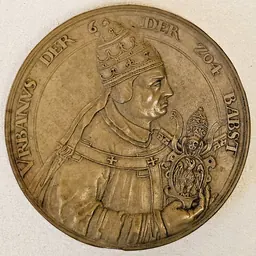
On 12 September 1625, Pope Urban VIII allowed the Franciscans to use dedicated propers for the Divine Office and Mass on the saint’s feast day. Nowadays, this particular liturgical form is limited to the Franciscan tertiaries, to which Conrad had belonged.
On his feast day, the parish church of San Corrado in Noto celebrates him by the distributing blessed bread. It is suggested that one day, Conrad had been out hunting within his family's domain, as was his custom. To flush out some game, he had ordered some brushwood be set alight. The prevailing wind, it is said, caused the flames to spread rapidly to surrounding fields and forest. A peasant discovered near where the fire is alleged to have begun was accused of starting the blaze, then imprisoned, tortured to confess, and condemned to death. As the innocent man was being led to his execution, a remorseful Conrad publicly admitted his fault to the Signoria of the city. As punishment and reparation for the devastation he had caused, the Signoria supposedly seized all his assets, sparing his life only because of his noble birth. Thus, reduced to poverty, and seeking penance for his act of cowardice, Conrad and his wife had apparently seen the hand of God in the turn of events.
In this story, the couple duly separated in 1315. Conrad is said to have retired to a hermitage near the town of Calendasco, joining a community of hermits, Franciscan tertiaries. His wife had meanwhile apparently become a Poor Clare in the city. For the next two years, Conrad is said to have cared for the sick at the Hospital of Saint Martin in Netum. He had lived in a hermitage attached to the Church of the Crucified Christ. At that time, apparently, the hermitage had also been occupied by Blessed William Buccheri, a former equerry to King Frederick III of Sicily said to have also taken up a life of solitude and prayer. Tradition has it from time to time, Conrad would return to his grotto for silent prayer. His fame had been such that by 1348 the Bishop of Syracuse, Giacomo Guidone de Franchis, had visited Conrad at his hermitage, requesting his prayers to end a famine afflicting Sicily.
Conrad died on 19 February 1351. It is said that he had foreseen this, and had died while in prayer kneeling before a crucifix. He was buried at the principal church in Netum. When the town was abandoned, his remains were translated to Saint Nicholas’ Cathedral.
With a reputation for miracles, Conrad continues to be invoked particularly for the relief of hernia. O.P., who was himself to testify having witnessed the Miracle of the Bread. As part of the process, Conrad's body was exhumed for examination. It was reported to be incorrupt, and enshrined in a silver casing for public veneration.
Don’t just read it —
keep it.
Full-length biographies made to live with: read them, listen on the way to work, watch them tonight.
- E-book
- Audio
- Video
Instant download · yours to keep · every purchase keeps this site free
Important facts
Related people
Same field, nearest in time


Contemporaries
People whose lives overlapped Conrad of Piacenza's
Frequently asked questions
Who was Conrad of Piacenza?
Italian Franciscan tertiary and hermit
When was Conrad of Piacenza born?
Conrad of Piacenza was born in 1290 in Calendasco.
When did Conrad of Piacenza die?
Conrad of Piacenza died on 19 February 1351 in Noto.
What was Conrad of Piacenza's occupation?
Conrad of Piacenza was a catholic priest.
Sources & further reading
· Wikipedia: Conrad of Piacenza
Cite this page
APA: Biography.guide. (2026). Conrad of Piacenza. https://biography.guide/conrad-of-piacenza/
MLA: "Conrad of Piacenza." Biography.guide, https://biography.guide/conrad-of-piacenza/.
Chicago: "Conrad of Piacenza." Biography.guide. https://biography.guide/conrad-of-piacenza/.
Data last updated: 2026-09-20 · Spot an error? Report a correction.
Page generated 2026-09-27 05:19 UTC