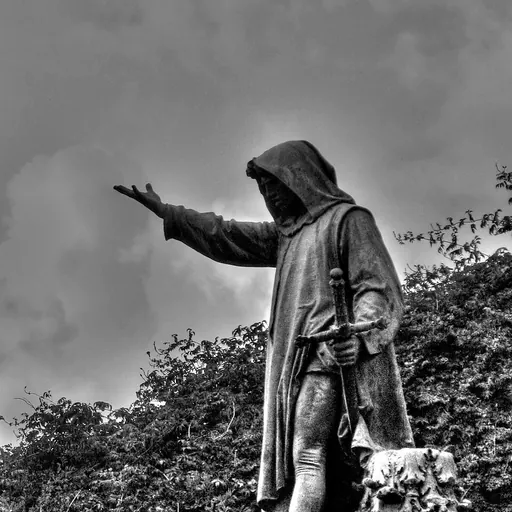
About Cola di Rienzo
Lived 1313 – 1354 (aged 40–41). Cola di Rienzo was an Italian politician and humanist.
Nicola di Lorenzo Gabrini (1313 8 October 1354), commonly known as Cola di Rienzo or Rienzi, was an Italian politician and leader, who styled himself as the "tribune of the Roman people".
During his lifetime, he advocated for the unification of Italy. This led to Cola's re-emergence in the 19th century as an iconic figure among leaders of liberal nationalism, who adopted him as a precursor of the 19th-century Risorgimento.
Biography Early life and career
Nicola was born in Rome of humble origins. He claimed to be the natural child of Henry VII, the Holy Roman Emperor, but he was, in fact, born to a washerwoman and a tavern-keeper named Lorenzo Gabrini. Nicola's father's forename was shortened to Rienzo, and his name was shortened to Cola; hence, Cola di Rienzo, or Rienzi, by which he is generally known.
He spent his early years at Anagni, where he devoted much of his time to the study of Latin writers, historians, orators and poets. After having nourished his mind with stories of the glories and the power of ancient Rome, he turned his thoughts to restoring his native city. Knowing Rome was suffering from degradation and wretchedness, Cola sought to restore the city to not only good order but to pristine greatness. His zeal for this work was quickened by the desire to avenge his brother, who had been killed by a noble. and a person of some importance in the city and was sent in 1343 on a public errand to Pope Clement VI at Avignon. He discharged his duties with ability and success. Although he boldly denounced the aristocratic rulers of Rome, he won the favour and esteem of the Pope, who gave him an official position at his court. A new series of laws was published and accepted with acclaim, and unlimited authority and power was given to the author of the revolution. thumb The so-called Casa di Rienzi still in its urban context before the opening of the Via del Mare in a watercolour by Ettore Roesler Franz (about 1880).Ironically one of Rienzo's descendants, Gioacchino Vincenzo Raffaele Luigi Pecci, went on to become Pope Leo XIII.
Cola di Rienzo's life and fate have formed the subject of a novel Rienzi by Edward Bulwer-Lytton (1835), tragic plays by Gustave Drouineau (1826), Mary Russell Mitford (1828), Julius Mosen (1837), and Friedrich Engels (1841), and also of some verses of Childe Harold's Pilgrimage (1818) by Lord Byron.
Richard Wagner's first successful opera, Rienzi (Dresden, 1842), based on Bulwer-Lytton's novel, took Cola for a central figure, and at the same time, unaware of the Dresden production, Giuseppe Verdi, an ardent and anti-clerical patriot of the Risorgimento, contemplated a Cola di Rienzo. thumb
In 1873 – only three years after the new Kingdom of Italy wrested the city of Rome from papal forces – the rione Prati was laid out, with the new quarter's main street being "Via Cola di Rienzo" and a conspicuous square, Piazza Cola di Rienzo. Pointedly, the name was bestowed precisely on the street connecting the Tiber with the Vatican – at the time, headquarters of a Catholic Church still far from reconciled to the loss of its temporal power. To further drive home the point, the Piazza del Risorgimento was located at the Via Cola di Rienzo's western end, directly touching upon the Church's headquarters.
In 1877 a statue of the tribune by Girolamo Masini, was erected at the foot of Rome's Capitoline Hill. In Rome, in rione Ripa, near the Bocca della Verità there still exists a brick-decorated house of the Middle Ages, distinguished by the appellation of "The House of Pilate", but also traditionally known as Cola di Rienzo's house (in fact it belonged to the patrician Crescenzi family).
Irish poet and playwright John Todhunter wrote a drama in 1881 entitled The True Tragedy Of Rienzi Tribune Of Rome. Shakespearean in style, it is largely historically accurate. Plays about Cola di Rienzo were also written by Polish late 19th century authors Adam Asnyk and Stefan Żeromski, who drew similarities between Rienzo's uprising and the Polish struggle for independence.
His letters, edited by A. Gabrielli, were published in vol. vi. of the Fonti per la storia d’Italia (Rome, 1890).
For his demagogic rhetoric, popular appeal and anti-establishment (as nobility) sentiment, some sources consider him an earlier populist and a proto-fascist figure.
Don’t just read it —
keep it.
Full-length biographies made to live with: read them, listen on the way to work, watch them tonight.
- E-book
- Audio
- Video
Instant download · yours to keep · every purchase keeps this site free
Important facts
Related people
Same field, nearest in time


Contemporaries
People whose lives overlapped Cola di Rienzo's

Frequently asked questions
Who was Cola di Rienzo?
Italian politician
When was Cola di Rienzo born?
Cola di Rienzo was born in 1313 in Rome.
When did Cola di Rienzo die?
Cola di Rienzo died on 8 October 1354 in Rome.
What was Cola di Rienzo's occupation?
Cola di Rienzo was a politician and humanist.
What nationality was Cola di Rienzo?
Cola di Rienzo was Italian.
Sources & further reading
Cite this page
APA: Biography.guide. (2026). Cola di Rienzo. https://biography.guide/cola-di-rienzo/
MLA: "Cola di Rienzo." Biography.guide, https://biography.guide/cola-di-rienzo/.
Chicago: "Cola di Rienzo." Biography.guide. https://biography.guide/cola-di-rienzo/.
Data last updated: 2026-09-22 · Spot an error? Report a correction.
Portrait: Wikimedia Commons · author & licence
Page generated 2026-09-27 05:03 UTC