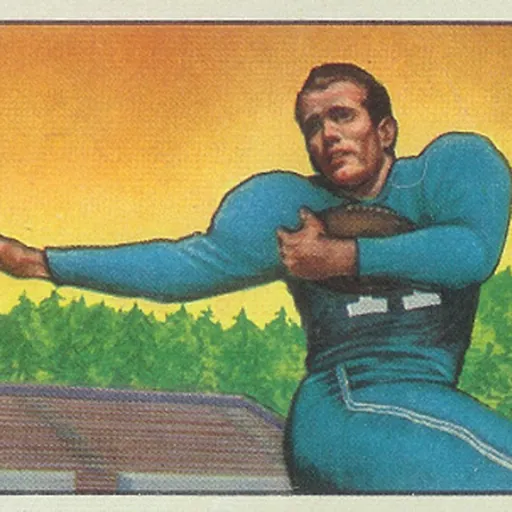
About Cloyce Box
Lived 1923 – 1993 (aged 70). Cloyce Box was an American american football player.
Cloyce Kennedy Box (August 24, 1923 – October 27, 1993) was an American professional football player and businessman. He played five years in the National Football League (NFL) with the Detroit Lions, was a member of NFL championship teams in 1952 and 1953, was selected as a second-team All-Pro in 1950 and a first-team All-Pro in 1952, and played in the 1951 and 1953 Pro Bowl games. On December 3, 1950, he set Detroit team records with 12 catches, four touchdown receptions, 24 points, and 302 receiving yards. He later became successful in the oil and gas business in Texas.
Early life Box was born in 1923 in Hamilton, Texas. From 1938 to 1942, he attended Jonesboro High School in Jonesboro, Texas, where he and his twin brother Boyce Box were both star athletes. He never saw a game of football until he was 18 years old, having played basketball throughout his youth.
College career Box and his brother Boyce attended West Texas A&M University on basketball scholarships and helped the Buffaloes win a Border Conference championship in 1943 before being inducted into the United States Marine Corps. He attained the rank of captain during World War II. Box also attended Louisiana Tech University as part of the V-12 Navy College Training Program. When he returned from the Marine Corps in 1946, the West Texas A&M basketball program slumped, and Box ended up playing college football as a quarterback and halfback for the West Texas A&M Buffaloes football team from 1946 to 1948.
Professional career Box played professional football at the end and halfback positions in the National Football League (NFL) for five seasons with the Detroit Lions from 1949 to 1950 and 1952 to 1954.
In 1950, Box's second year in the NFL, Detroit's coaches sought to take advantage of Box's speed and converted him into an end. His 302 receiving yards against the Colts was the second highest in NFL history at the time and currently ranks fifth in league history. After the 1950 season, Box was selected by the Associated Press (AP) as a second-team end on its All-Pro team.
In February 1951, with the Korean War ongoing, Box was recalled from inactive reserve status by the United States Marine Corps. He missed the entire 1951 season due to military service.
In June 1952, after being discharged from the Marine Corps, Box returned to the Lions. Box was the leading receiver on the 1952 Lions team that won the NFL championship, recording 15 touchdowns on 42 receptions for 924 yards. Box scored three touchdowns in three different games that season; no Lions player would do so again until 2025. On October 19, 1952, he led a comeback victory over the Los Angeles Rams, with touchdown catches covering 64 and 10 yards. He led the NFL with 15 receiving touchdowns, ranked second in the league with 90 points scored, and again ranked among the league leaders with 924 receiving yards (fourth), 22.0 yards per reception (fourth), and 924 yards from scrimmage (sixth). In the 1952 NFL Championship Game, a 17–7 victory over the Cleveland Browns, Box was used mainly as a decoy but was credited with a key block on Doak Walker's 67-yard touchdown run. After the 1952 season, Box was selected by the AP as a first-team All Pro player and was selected to play in the 1953 Pro Bowl. In the 1953 NFL Championship Game, he had four receptions for 54 yards. ) to construct a modern, 1 million ton per-year Portland cement production plant in Midlothian, Texas just south of the Dallas-Fort Worth metroplex. The Midlothian plant is currently owned and operated by LafargeHolcim and has since expanded to produce over 2 million tons of cement per year.
Box also served as chairman of the board of regents for West Texas State University and the Texas Board of Penal Corrections. His Cloyce Box Ranch was used as the original Southfork Ranch for the mini-series that became the first season of the television series Dallas.
In 1982, Box hosted a reunion for his 1952 Lions teammates at the site of Super Bowl XVI. At the time, the 1952 Lions were the last championship team that had not received a ring, so Box presented each of his teammates with championship rings that he paid for personally. That same winter, he established a trust fund for the purpose of helping former NFL players experiencing financial difficulty by contributing $1 million ($2.7 million in 2020) of his own money. At his funeral, Frank Gifford gave Box's eulogy while Kathie Lee Gifford sang at the service.
NFL career statistics Legend Won NFL championship Led the league Bold Career high
Regular season Year Team Games Receiving GP GS Rec Yds Avg Lng TD 1949 DET 10 4 15 276 18.4 43 4 1950 DET 12 11 50 1,009 20.2 82 11 1952 DET 12 8 42 924 22.0 77 15 1953 DET 12 11 16 403 25.2 97 2 1954 DET 11 0 6 53 8.8 14 0 Career 57 34 129 2,665 20.7 97 32
Don’t just read it —
keep it.
Full-length biographies made to live with: read them, listen on the way to work, watch them tonight.
- E-book
- Audio
- Video
Instant download · yours to keep · every purchase keeps this site free
Important facts
People in Cloyce Box's life
Named in this biography and alive at the same time



Related people
Same field, nearest in time



Contemporaries
People whose lives overlapped Cloyce Box's

Frequently asked questions
Who was Cloyce Box?
American football player (1923-1993)
When was Cloyce Box born?
Cloyce Box was born on 24 August 1923 in Hamilton.
When did Cloyce Box die?
Cloyce Box died on 27 October 1993 in Frisco.
What was Cloyce Box's occupation?
Cloyce Box was an american football player.
What nationality was Cloyce Box?
Cloyce Box was American.
Sources & further reading
Cite this page
APA: Biography.guide. (2026). Cloyce Box. https://biography.guide/cloyce-box/
MLA: "Cloyce Box." Biography.guide, https://biography.guide/cloyce-box/.
Chicago: "Cloyce Box." Biography.guide. https://biography.guide/cloyce-box/.
Data last updated: 2026-09-20 · Spot an error? Report a correction.
Portrait: Wikimedia Commons · author & licence
Page generated 2026-09-27 04:58 UTC