Clonycavan Man
Irish bog body from the 4th/5th century
About Clonycavan Man
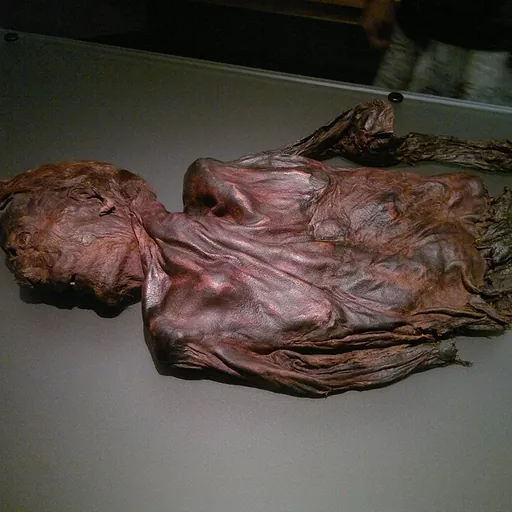
Clonycavan Man is an Iron Age bog body discovered in 2003 in Clonycavan, near Ballivor, County Meath, Ireland. Radiocarbon dating indicates that he died between 392 and 201 BCE. Although his lower body was destroyed by modern peat-harvesting machinery before recovery, his head and upper torso remain exceptionally well preserved, retaining skin, soft tissue and an elaborate hairstyle.
Clonycavan Man is one of the best-known Irish bog bodies. His discovery, followed three months later by that of Old Croghan Man, prompted the National Museum of Ireland to establish the multidisciplinary Bog Bodies Research Project, which transformed the scientific study of Irish bog bodies through archaeological, forensic and medical analyses. Discovery The individual who became known as Clonycavan Man was discovered on 21 February 2003 during commercial peat harvesting at Bord na Móna's Ballivor Works in the townland of Clonycavan, near Ballivor, County Meath. His remains were carried through the peat-processing system after a mechanical excavator removed a block of peat from an active production field. Workers spotted his remains on a tramp screen, a metal grate that removes large debris from harvested peat, and reported the discovery to the authorities.
One week later, on 28 February 2003, archaeologists inspected the probable find spot after Bord na Móna identified the section of bog from which the peat had been excavated. More than five months later, on 12 August 2003, they returned to excavate a 100 m section of the bog but found no additional human remains or associated artefacts. Archaeologists concluded that peat-harvesting machinery had probably disturbed and displaced his body before workers uncovered it.
Condition Only Clonycavan Man's head and torso are preserved.
Scientific study The scientific study of Clonycavan Man's hair has shed light on his diet in the years leading up to his death. His diet was rich in vegetables and protein, suggesting he may have been killed during the warmer summer months. Clonycavan Man was also fairly young at the time of his death; he is believed to have been in his early twenties. of plant oil and pine resin, imported from south-western France or northern Spain. His body also shows no signs of physical labour, reinforcing the idea he was a man of wealth. The hairstyle was possibly a way to make the man appear taller, as examination of his remains suggests that he was only five feet two inches tall (157.48 cm). during the Iron Age of western Europe, making his remains around 2,300 years old.
Cause of death
Clonycavan Man is believed to have been murdered, based on an examination of the evidence found on his body by the Garda Technical Bureau (Irish Police Forensic Division). His skull looks to have been split open by a sharp implement. His nipples and other body parts that consist of fragile tissue were missing, which could be from natural decomposition or possibly mutilation. |display=title
Don’t just read it —
keep it.
Full-length biographies made to live with: read them, listen on the way to work, watch them tonight.
- E-book
- Audio
- Video
Instant download · yours to keep · every purchase keeps this site free
Frequently asked questions
Who was Clonycavan Man?
Irish bog body from the 4th/5th century
Sources & further reading
Cite this page
APA: Biography.guide. (2026). Clonycavan Man. https://biography.guide/clonycavan-man/
MLA: "Clonycavan Man." Biography.guide, https://biography.guide/clonycavan-man/.
Chicago: "Clonycavan Man." Biography.guide. https://biography.guide/clonycavan-man/.
Data last updated: 2026-09-22 · Spot an error? Report a correction.
Portrait: Wikimedia Commons · author & licence
Page generated 2026-09-27 05:04 UTC