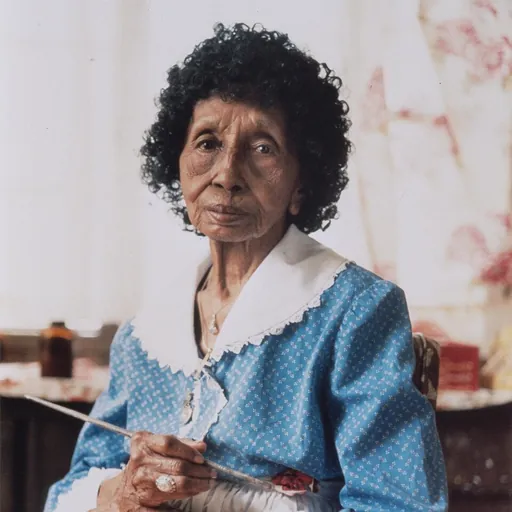
About Clementine Hunter
Lived 1886 – 1988 (aged 101–102). Clementine Hunter was an American painter and artist.
Clementine Hunter (pronounced Clementeen; late December 1886 or early January 1887 – January 1, 1988) was a self-taught Black folk artist from the Cane River region of Louisiana, who lived and worked on Melrose Plantation.
Hunter was born into a Louisiana Creole family at Hidden Hill Plantation near Cloutierville, in Natchitoches Parish, Louisiana. She started working as a farm laborer when she was young and never learned to read or write. In her fifties, she began to sell her paintings, which soon gained local and national attention for their complexity in depicting Black Southern life in the early 20th century.
Initially she sold her first paintings for as little as 25 cents, but by the end of her life, her work was being exhibited in museums and sold by dealers for thousands of dollars. She produced an estimated 5,000 to 10,000 paintings in her lifetime. Hunter was granted an honorary Doctor of Fine Arts degree by Northwestern State University of Louisiana in 1986, and she was the first African-American artist to have a solo exhibition at the New Orleans Museum of Art. In 2013, director Robert Wilson presented a new opera about her, entitled Zinnias: The Life of Clementine Hunter, at Montclair State University in New Jersey.
Early life
Clementine Hunter's exact birth date is unknown; she was born in late December 1886 or early January 1887 at Hidden Hill Plantation, near Cloutierville in Natchitoches Parish, Louisiana. Hunter's maternal grandmother Idole, an enslaved Black and Native American woman, was born in Virginia and brought to Louisiana. Her family called her by the nickname Tébé, the French for "little baby," a nickname she carried into adulthood. Her mother died in 1905 at Melrose. Hunter was known for her talents at adapting traditional Creole recipes, sewing intricate clothes and dolls, and tending to the house's vegetable garden. Although she was first recognized for her painting skills in 1939, Hunter related that she had been painting long before then. Her most famous work features brightly colored depictions of important events like funerals, baptisms, and weddings, as well as scenes of plantation labor and domestic chores. However, Hunter's paintings vary in subject and style, including abstracts and still lifes. However, Hunter was already producing narrative and expressionist work in textiles, including intricately detailed quilts. During Cammie Henry's ownership, this building served as a residence for artists. In 1949, Clementine Hunter's first show in the Cane River Valley was hosted by Mignon in the upstairs area of the African House. Additionally, Hunter would frequently thin out her supply of paint with turpentine, creating more of a watercolor effect, which caused many scholars to mistakenly believe she had a watercolor experimental phase. Beginning in the 1950s, her painting style was altered by arthritis in her hands.
Quiltmaking Hunter grew up in communities of Black sharecroppers and tenant farmers, where she learned sewing, quilting, lace-making, and basket-weaving. François Mignon recognized Hunter's talents with fabrics before he saw any of her painted works. On December 19, 1939, Mignon recorded in his journals that Hunter first showed him dolls she created with embroidered features.
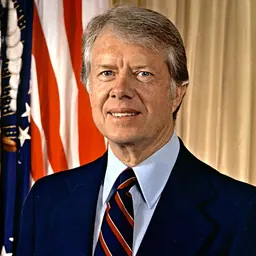
Hunter made several quilts that are more abstract in style. One chevron quilt (1951) is at the New Orleans Museum of Art. Some of the squares of chevron are alternating solid colors, while other squares are constructed with scraps of patterned cloth. alt=Inscription on gravestone reads. Distinctive signature, backwards C interlocking with H. Clementine Hunter, Born Natchitoches Parish, Died January 1, 1988, Age 101 Years. In 1955, Hunter was the first African-American artist to have a solo exhibition at the Delgado Museum (now the New Orleans Museum of Art). In February 1985, the museum hosted A New Orleans Salute to Clementine Hunter's Centennial, an exhibit in honor of her one-hundredth birthday. She achieved significant recognition during her lifetime, including an invitation to the White House from U.S. President Jimmy Carter and letters from both President Ronald Reagan and U.S. Senator J. Bennett Johnston, Jr.
Radcliffe College included Hunter in its Black Women Oral History Project, published in 1980. In the Mildred H. Bailey Collection of Interviews at Northwestern State University of Louisiana, there are digitized interviews with Hunter and those closest to her.
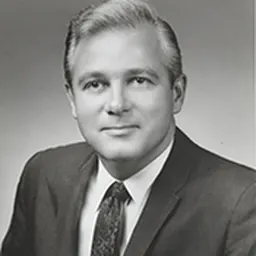
Northwestern State University of Louisiana granted her an honorary Doctor of Fine Arts degree in 1986. The following year, Louisiana governor Edwin Edwards designated her as an honorary colonel, a state honor, and aide-de-camp.
Hunter's work can be found in numerous museums such as the Dallas Museum of Fine Art, the American Folk Art Museum, Minneapolis Institute of Arts, the Ogden Museum of Southern Art, the New Orleans Museum of Art, and the Louisiana State Museum.
Clementine Hunter's World is a 2017 documentary directed by noted Hunter scholar Art Shiver. The film celebrates Hunter's life and artwork through the lens of photographs, oral histories, and the newly resorted African House Murals. According to Smithsonian American Art curator Tuliza Fleming, the 22 works by Hunter is the largest collection by a single artist at the museum. Loletta Jones-Wynder, the director of the Creole Heritage Center at Northwestern State University of Louisiana, created the resolution to honor Hunter's legacy and impact on the State of Louisiana. Although there were many Hunter fakes, William and Beryl Toye were the most prolific. Both William and Beryl Toye were sentenced to two years probation and a $426,393 fine for the cost of the fakes sold. Untitled, 1981, National Museum of Women in the Arts, Washington, D.C. Melrose Quilt, ca. 1960, Smithsonian American Art Museum, Washington, D.C. The Wash, ca. 1950s, Minneapolis Institute of Art, Minneapolis, MN Picking Cotton, ca. 1950s, Minneapolis Institute of Art, Minneapolis, MN The Annunciation and the Adoration of the Wise Men, 1957, Museum of Fine Arts, Boston, MA Cotton Pickin', 1948, American Folk Art Museum, New York, NY Saturday Night, 1965, American Folk Art Museum, New York, NY Baptism, 1950–1956, Abby Aldrich Rockefeller Folk Art Museum at Colonial Williamsburg, Williamsburg, VA Funeral, 1957, Muscarelle Museum of Art, Williamsburg, VA Sugar Cane Syrup Makin', 1979, Muscarelle Museum of Art, Williamsburg, VA Baptism, Late 1950s, Muscarelle Museum of Art, Williamsburg, VA Window Shade, 1950s, National Museum of African American History and Culture, Washington, D.C. ca. 1950s, Pérez Art Museum Miami, FL
Studies and other related books
Mildred Hart Bailey, Four Women of Cane River (1980) Shelby R. Gilley, Painting by Heart: The Life and Art of Clementine Hunter, Louisiana Folk Artist (2000), St. Emma Press Clementine Hunter, Clementine Hunter: A Sketchbook (2014), University of New Orleans Press. Mary E. Lyons, Talking with Tebé (1998), Houghton Mifflin. Art Shiver, Tom Whitehead (editors), Clementine Hunter: The African House Murals (2005), Northwestern State University of Louisiana Press. Art Shiver, Tom Whitehead (co-authors), Clementine Hunter Her Life and Art (2012), LSU Press. James Register, illustrated by Clementine Hunter, The Joyous Coast (1971), Mid-South Press, Shreveport, Louisiana James Wilson, Clementine Hunter: American Folk Artist (1990), Pelican Publishing Company
Don’t just read it —
keep it.
Full-length biographies made to live with: read them, listen on the way to work, watch them tonight.
- E-book
- Audio
- Video
Instant download · yours to keep · every purchase keeps this site free
Important facts
People in Clementine Hunter's life
Named in this biography and alive at the same time




Related people
Same field, nearest in time


Contemporaries
People whose lives overlapped Clementine Hunter's


Frequently asked questions
Who was Clementine Hunter?
American folk artist (1889-1988)
When was Clementine Hunter born?
Clementine Hunter was born in 1886 in Louisiana, Cloutierville.
When did Clementine Hunter die?
Clementine Hunter died on 1 January 1988 in Natchitoches Parish, Natchitoches.
What was Clementine Hunter's occupation?
Clementine Hunter was a painter and artist.
What nationality was Clementine Hunter?
Clementine Hunter was American.
Sources & further reading
· Wikipedia: Clementine Hunter
Cite this page
APA: Biography.guide. (2026). Clementine Hunter. https://biography.guide/clementine-hunter/
MLA: "Clementine Hunter." Biography.guide, https://biography.guide/clementine-hunter/.
Chicago: "Clementine Hunter." Biography.guide. https://biography.guide/clementine-hunter/.
Data last updated: 2026-09-23 · Spot an error? Report a correction.
Portrait: Wikimedia Commons · author & licence
Page generated 2026-09-27 05:06 UTC