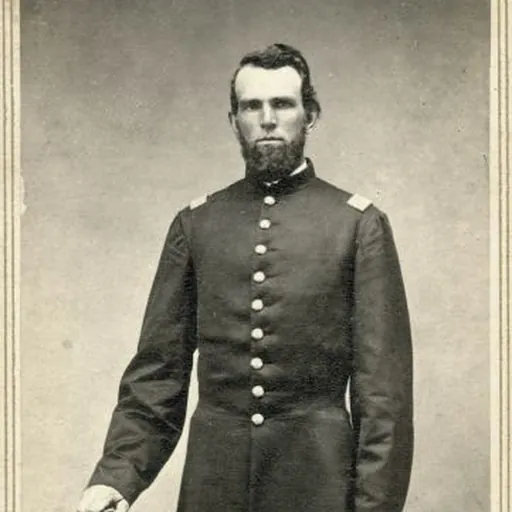
About Clement Warner
Lived 1836 – 1916 (aged 80). Clement Warner was an American politician and farmer.
Clement Edson Warner (February 23, 1836 – May 20, 1916) was an American farmer, Republican politician, and Union Army officer in the American Civil War. He served with the 36th Wisconsin Infantry Regiment and commanded the regiment near the end of the war. He later served in the Wisconsin State Senate (1867–1869) and the Assembly (1883–1885), representing Dane County. In historical documents, his name is frequently abbreviated as C. E. Warner.
Early life and education Warner was born in Batavia, New York, on February 23, 1836. In 1852, he came west with his parents, settling near the town of Windsor, in Dane County, Wisconsin. He was educated in public schools in New York, and then at the Sun Prairie Seminary. He enrolled at the University of Wisconsin in 1857 and taught school for a number of years, but he enjoyed farming and chose to make that his primary occupation. In 1864, he determined that he had made sufficient preparations and accepted a commission from Governor James T. Lewis to assist in raising men for the new 36th Wisconsin Infantry Regiment. Warner recruited a company of volunteers and was appointed captain of Company B, 36th Wisconsin Infantry, under the command of Colonel Frank A. Haskell—a veteran of Gettysburg. They mustered into service on March 23, 1864, and were ordered to proceed to Washington, D.C., for operations in the eastern theater of the war.
Overland campaign (Summer 1864) They arrived in the midst of General Ulysses S. Grant's Overland Campaign and were directed to proceed to join the Army of the Potomac at Spotsylvania County, Virginia. They arrived on May 18, one of the last days of the Battle of Spotsylvania Court House, and, on May 19, were attached to the 1st Brigade, 2nd Division, II Corps. The next day, they marched with II Corps for the North Anna River, arriving on the night of May 23. They participated in skirmishing in the Battle of North Anna, then accompanied II Corps across the Pamunkey River to take position at the Battle of Totopotomoy Creek, where they received fire, but did not engage in fighting.
On June 1, a severe engagement began on the far left of the Union line, in the initial fighting of the Battle of Cold Harbor. It was noted that Confederate forces on the Union right were beginning to withdraw from their positions to proceed south to reinforce their comrades and concentrate their forces. Warner's brigade, located near the right end of the Union line, was directed to make a demonstration against the enemy in an attempt to compel them to remain in position.
Appomattox campaign (1865) Grant's orders for the final attack on Petersburg arrived on March 25; in accordance with the orders, on March 29, II Corps began to advance west of Petersburg, forcing the Confederates to further extend their flank. They did not participate in the Battle of Lewis's Farm, but in the aftermath managed to occupy Confederate trenches approaching Petersburg. They received shelling over the next several days, but continued to advance and take prisoners. On April 2, they learned the Confederates had abandoned Petersburg.
Following the surrender, they returned to Washington on June 14, and participated in the Grand Review of the Armies on June 17. They were mustered out of service on July 12, 1865, and arrived back in Madison, Wisconsin, two days later, where the men were disbanded. He also served on the committees on roads, bridges, and ferries, on railroads, and on benevolent institutions during the 1868 session. He did not run for a second two-year term in 1868.
He made another run for office in 1873 in Dane County's 2nd Assembly district, which then comprised the towns of Blooming Grove, Burke, Dunn and Windsor, and the city of Madison, but was defeated by the Reform Party candidate, Philo Dunning. 1873 was the high-water mark of the political power of the Reform Party, a short-lived coalition of Democrats, reform and Liberal Republicans, and Grangers.
Warner remained active in the Republican Party of Wisconsin and was a political ally of Madison power-broker Elisha W. Keyes. With his support, in 1877, Warner was elected Superintendent of the Poor by the Dane County Board of Supervisors for a three year term.
Following the 1881 redistricting, Warner made another run for Wisconsin State Assembly in the redrawn Dane County 2nd Assembly district, which now comprised the towns of Bristol, Burke, Cottage Grove, Deerfield, Medina, Sun Prairie, Vienna, Windsor and York. He was narrowly elected, defeating Democrat A. L. Durfey by just 35 votes. In the Assembly, he was assigned to the joint committee on charitable and penal institutions.
The eldest son of Clement Warner was Ernest Noble Warner, who also went on to serve in the Wisconsin State Assembly in 1905.
Don’t just read it —
keep it.
Full-length biographies made to live with: read them, listen on the way to work, watch them tonight.
- E-book
- Audio
- Video
Instant download · yours to keep · every purchase keeps this site free
Important facts
Family & relationships
People in Clement Warner's life
Named in this biography and alive at the same time

Related people
Same field, nearest in time




Contemporaries
People whose lives overlapped Clement Warner's





Frequently asked questions
Who was Clement Warner?
American politician (1836-1916)
When was Clement Warner born?
Clement Warner was born on 23 February 1836 in Batavia.
When did Clement Warner die?
Clement Warner died on 20 May 1916 in Windsor (town), Wisconsin, Wisconsin.
What was Clement Warner's occupation?
Clement Warner was a politician and farmer.
What nationality was Clement Warner?
Clement Warner was American.
Sources & further reading
Cite this page
APA: Biography.guide. (2026). Clement Warner. https://biography.guide/clement-warner/
MLA: "Clement Warner." Biography.guide, https://biography.guide/clement-warner/.
Chicago: "Clement Warner." Biography.guide. https://biography.guide/clement-warner/.
Data last updated: 2026-09-20 · Spot an error? Report a correction.
Page generated 2026-09-27 05:10 UTC