
About Claudius of Turin
Lived 750 – 827 (aged 76–77). Claudius of Turin was a theologian and writer.
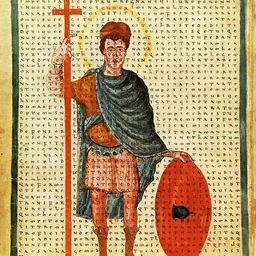
Louis the Pious, Holy Roman Emperor and for a time a chief patron of Claudius.
Claudius of Turin (or Claude) (fl. 810–827) was the Catholic bishop of Turin from 817 until his death. He was a courtier of Louis the Pious and was a writer during the Carolingian Renaissance. He is most noted for teaching iconoclasm, He was attacked as a heretic in written works by Saint Dungal and Jonas of Orléans.
Early career and the imperial court (until 817) Claudius is thought to have been from Spain. This belief may have its origins in the accusations of Jonas of Orléans, who claimed Claudius was a disciple of Felix of Urgel. Felix was a bishop in the foothills of the Spanish Pyrenees whom Claudius may have known personally. The bishop had been condemned by Alcuin at the Council of Frankfurt in 794 for teaching adoptionism. It is now certain that Claudius was not a disciple of Felix. It was probably Leidrad and, as Claudius himself tells it, his schoolmates and the future emperor Louis the Pious who convinced Claudius to study exegesis and concentrate on certain portions of Scripture. Claudius was a member of an elite circle of secular and ecclesiastic politicians and authorities and a creatura della corte di Aquisgrana ("creature of the court of Aachen"). Bernard rebelled against his uncle with the support of Bishop Theodulf of Orléans. The rebellion was put down, but the event reduced the emperor's prestige amongst the Frankish nobility and it became important that the bishop of Turin be a man who was loyal to the emperor.
Episcopate (817–827) As bishop of Turin, Claudius found that men were often directed to go on pilgrimage to Rome for penance and that worshippers were accustomed to venerate Christ and the saints by bowing before images and relics. Claudius, coming from an educated background, was not greatly exposed to such provincial modes of worship. He made attacks on the use of images, relics, and crosses, he opposed pilgrimages to obtain absolution, and he had little regard for the authority of the pope due to his belief that all bishops were equal.
Claudius also wrote commentaries on the books of Leviticus, the historical books of the Old Testament, the Gospel of Matthew, and all Pauline epistles, of which the commentary on the Epistle to Galatians shows some of his views prefigure those expressed by both the Waldensians and Protestants centuries later. It was once thought that he had in fact founded the Waldensians,
Claudius introduced the "organic metaphor" of the state in his commentary on 1 Corinthians. He proposed that, as the church was the body of Christ, so the state was the body of the emperor. The imperial court would have been familiar with the work because Claudius later wrote that it had been well-received despite the attempts of his former friend, Theodemir of Nismes, to have it condemned as heretical. None of Claudius' works were ever condemned and he tried unsuccessfully to regain Theodemir's approval, but eventually had to pen a well known apology directed against Theodemir's persistent attacks.
Between 814 and 816, Claudius also wrote a Chronicle. It begins with a letter to a priest named Ado. This is followed by a diagram of the genealogy of Jesus going back to Adam, accompanied by commentary. A final section, which was in fact composed first, chronicles the Six Ages of the World based mainly on Bede. Claudius expends much effort in dating the events of the Old Testament according to the Christian calendar.
In 1950, Claudius was identified by P. Bellet as the author of some works previously attributed to Pseudo-Eucherius.
Iconoclasm Claudius found that Italian churches were full of images and "picture worshippers", though being told that people did not venerate the images themselves, but the saints they represent, Claudius still saw it as a heathenish practice and claimed that Pagans used similar arguments for image veneration. He saw the veneration of saints and claimed images as Pelagian, he argued that people need to only worship the creator and not the creation.
Claudius also opposed the veneration of the cross, Claudius claimed that we need to "bear our own cross (Matt 16:24)" instead of adoring the cross.
Don’t just read it —
keep it.
Full-length biographies made to live with: read them, listen on the way to work, watch them tonight.
- E-book
- Audio
- Video
Instant download · yours to keep · every purchase keeps this site free
Important facts
People in Claudius of Turin's life
Named in this biography and alive at the same time

Related people
Same field, nearest in time



Contemporaries
People whose lives overlapped Claudius of Turin's





Frequently asked questions
Who was Claudius of Turin?
bishop of Turin
When was Claudius of Turin born?
Claudius of Turin was born in 750 in Catalonia.
When did Claudius of Turin die?
Claudius of Turin died in 827 in Turin.
What was Claudius of Turin's occupation?
Claudius of Turin was a theologian and writer.
What nationality was Claudius of Turin?
Claudius of Turin's recorded nationality: Carolingian Empire.
Sources & further reading
· Wikipedia: Claudius of Turin
Cite this page
APA: Biography.guide. (2026). Claudius of Turin. https://biography.guide/claudius-of-turin/
MLA: "Claudius of Turin." Biography.guide, https://biography.guide/claudius-of-turin/.
Chicago: "Claudius of Turin." Biography.guide. https://biography.guide/claudius-of-turin/.
Data last updated: 2026-09-20 · Spot an error? Report a correction.
Page generated 2026-09-27 05:05 UTC