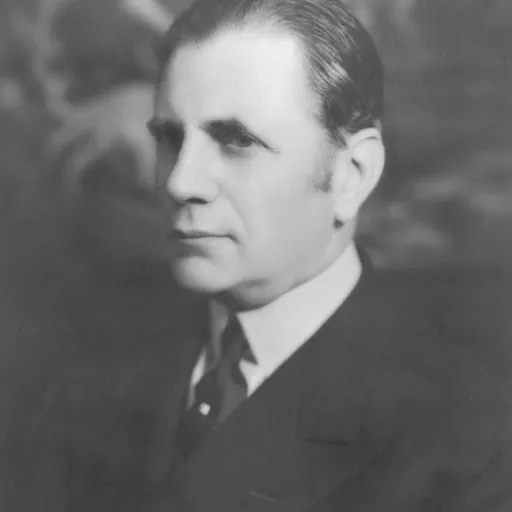
Claude de Bernales
Australian mining entrepreneur
About Claude de Bernales
Lived 1876 – 1963 (aged 87). Claude de Bernales was a British and Australian.
Claude Albo de Bernales (31 May 1876 – 9 December 1963) was a British-born Western Australian mining entrepreneur whose business activities and marketing did much to stimulate investment in Western Australia during the early years of the twentieth century. During the 1930s gold production in the State increased from £1,600,000 to £11,800,000 and employment in the industry quadrupled due in considerable part to de Bernales' marketing of the goldfields to overseas investors.
De Bernales accumulated immense wealth through complex and elaborate schemes by which he acquired many mining companies and attracted overseas investment and personal support. In the latter part of his life however, financial difficulties and ill-health saw him live as a recluse in Selsey, Sussex, United Kingdom.
Early life
De Bernales was born in Brixton, London, the son of a Syracuse, New York-born Basque, Manuel Edgar Albo de Bernales, and his American wife Emma Jane, née Belden. in Rutland in the East Midlands of England, and later at Neuenheim College (now called Heidelberg College) in Heidelberg in the Rhineland, Germany.
In 1897 de Bernales emigrated to the Western Australian goldfields, drawn like many other European immigrants to the lure of the gold rush of the region. a Federation Queen Anne style house in Cottesloe, renaming it Overton Lodge after the house in Brixton, London, where he was born. In 1938 he redeveloped it into an ostentatious Inter-war Spanish Mission style mansion. The house and its grounds are now the Cottesloe Civic Centre. In 1912 he became a director of foundry operators Hoskins & Co, Ltd in Perth.
During this time, he developed his forté as a mining promoter while acquiring leases through defaults by some of his clients at Kalgoorlie and Wiluna. These leases were eventually used to form the Wiluna Gold Mines company which he owned jointly with several overseas companies including Consolidated Gold Fields of South Africa.
In 1926 he went to London and raised £1 million to develop the Wiluna leases. A later issue of promissory notes for £300,000 was backed by the State government, after de Bernales fostered a close alliance with the Governor of Western Australia, Colonel Sir William Campion. Campion would later become a close business associate and took chairmanship roles of a number of de Bernales' companies including Anglo-Australian Gold Development Co. and Commonwealth Mining and Finance Co. Ltd.
Following Bessie's death in 1927, de Bernales married Helen Florence Berry (née Pincknie - the war widow of his first wife's brother, mining engineer James Webster Berry), in Colombo in January 1928, then later on 5 February 1930 at St Phillips, Cottesloe.
Using London capital, the Wiluna mines were expanded and by 1934, 10,000 people had settled there and gold worth £3 million had been extracted. The Wiluna mine ultimately earned £12 million and provided an impetus for other mines in the region.
With the onset of the Great Depression, de Bernales campaigned for government support of the gold mining industry, arguing that investment would enable the industry to continue to operate throughout the depression as unemployment rose to 25%. He devised a gold bonus campaign, where the Federal government would pay a 'bounty' of £1 an ounce on gold produced in excess of the 1928-30 average. Not surprisingly, the idea had widespread support from his fellow entrepreneurs and state government politicians. De Bernales led several delegations to the eastern states to lobby for the scheme which was known as the 'Gold Bounty Acts', but by the time it became law in 1930 and 1931, the exchange rate had collapsed and price of gold had risen to well above the rate of the bounty paid. Following the depression, in 1933 the state government granted temporary reserves over prospective gold areas in the eastern and northern goldfields to encourage new investment in gold development, primarily to Western Mining Corporation and to companies associated with de Bernales. His second wife Helen Florence died there on 27 May 1956. De Bernales died at the Chelsea, London home of one of his daughters, on 9 December 1963,
Don’t just read it —
keep it.
Full-length biographies made to live with: read them, listen on the way to work, watch them tonight.
- E-book
- Audio
- Video
Instant download · yours to keep · every purchase keeps this site free
Important facts
People in Claude de Bernales's life
Named in this biography and alive at the same time

Contemporaries
People whose lives overlapped Claude de Bernales's

Frequently asked questions
Who was Claude de Bernales?
Australian mining entrepreneur
When was Claude de Bernales born?
Claude de Bernales was born on 31 May 1876 in Brixton.
When did Claude de Bernales die?
Claude de Bernales died on 9 December 1963 in Chelsea.
What nationality was Claude de Bernales?
Claude de Bernales was British and Australian.
Sources & further reading
· Wikipedia: Claude de Bernales
Cite this page
APA: Biography.guide. (2026). Claude de Bernales. https://biography.guide/claude-de-bernales/
MLA: "Claude de Bernales." Biography.guide, https://biography.guide/claude-de-bernales/.
Chicago: "Claude de Bernales." Biography.guide. https://biography.guide/claude-de-bernales/.
Data last updated: 2026-09-22 · Spot an error? Report a correction.
Portrait: Wikimedia Commons · author & licence
Page generated 2026-09-27 04:58 UTC