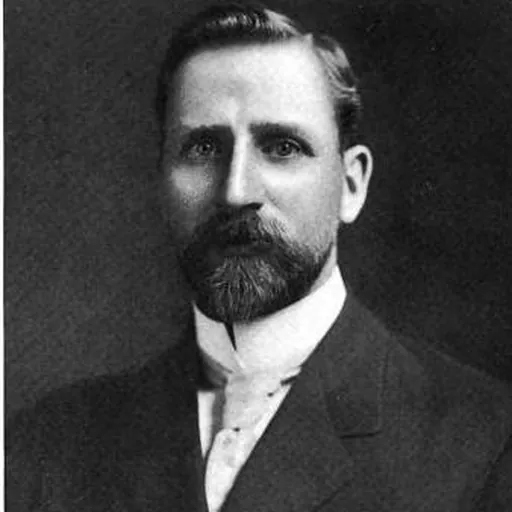
Clarence Ussher
Physician and American missionary in the Van region during the Armenian Genocide
About Clarence Ussher
Lived 1870 – 1955 (aged 85). Clarence Ussher was an American missionary, physician and writer.
Clarence Douglas Ussher (September 9, 1870 – September 20, 1955) was an American physician and missionary in the Van region during the Armenian genocide, where he reported that 55,000 Armenians had been killed. In 1917 Ussher published a memoir regarding his experience in Van, titled An American Physician in Turkey: A Narrative of Adventures in Peace and War. It is considered one of the most detailed eyewitness accounts of the events. Ussher openly blamed the Ottoman government for the systematic massacres of Armenians. He was the husband of Elizabeth Barrows Ussher, who was also a witness of the genocide.
Early life and work Clarence Douglas Ussher was born on September 9, 1870, in Aurora, Illinois. His father became the Bishop of Canada and eventually moved with the family to Montreal. In Montreal, Ussher received his early education; he continued his studies at the Reformed Episcopal Seminary in West Philadelphia, Pennsylvania. to Harput, Ottoman Empire, where he was also to pursue his career as a practicing physician. Turkish sensitivities to the Armenian Question became evident to Ussher at the Ottoman border, where his dictionary was confiscated because it contained the words "liberty" and "revolution"—forbidden in Turkey at this time to Armenian and Turk alike; the customs officers also demanded the removal of maps from Ussher's Bible because they contained the word "Armenia". A group of destitute Armenians—photo from Dr. Ussher's collection Ussher remained in Harput for a year, after which he was sent to Van because the village required a physician. When he arrived in Van, he noticed that the village was still heavily damaged from the Hamidian massacre and the population still traumatized. Ussher immediately began his work in orphanages where hundreds of Armenian orphans of the Hamidian massacres were being housed. Ussher distrusted the 1908 governor of Van, opining that he "used every means in his power to incite Armenians to revolt in order to have a pretext for massacring them".
Genocide witness
Background
In the First Balkan War of 1912–1913, the Ottoman Empire had lost its Balkan possessions to Christian uprisings, intensifying fears in the Turkish homeland that the Empire's increasingly restive Armenian Christian minority—with the assistance or encouragement of Western governments—might also attempt to establish an independent state, resulting in the breakup of Turkey itself. As a result of the wars, at least half a million Muslim Ottomans' from the former Balkan possessions of the Empire sought refuge in Turkey, sparking a desire for revenge among many Turks. Distrust and suspicion of Armenians reached a peak following the outbreak of World War I, when a successful advance of Russian troops across the Turkish border into the heavily Armenian-populated vilayet of Van in early 1915 was blamed on Armenian disloyalty, leading the Turkish government to adopt a set of extreme measures which would culminate in the Armenian genocide.
Van "reign of terror" As Ussher relates in his memoir An American Physician in Turkey: A Narrative of Adventures in Peace and War, he was stationed in the American hospital in Van when in February 1915, the "strong and liberal-minded" governor or vali of the province was replaced with Cevdet Bey, brother-in-law of the Turkish Commander-in-Chief, Enver Pasha. The new vali was unable to travel to Van until late March, when he arrived "accompanied by several thousand soldiers and Kurdish and Circassian irregulars".
At the time of Cevdet's arrival in the Van vilayet, volunteer Armenian units ahead of the advancing Russians were employing guerrilla tactics in the Turkish rear, while substantial numbers of Turkish deserters in the province had turned to brigandage, and Turkish commanders believed both groups were receiving support from Van's Armenian populace. Ussher himself later treated the survivors of this attack: "[The irregulars] were mounted, armed with daggers, automatic pistols, and modern repeating rifles ... they would gallop into a crowd of fleeing women and children, draw their daggers, and rip up the unfortunate creatures. I forbear to describe the wounds brought to me for repair."
After this, Cevdet again demanded that 4,000 Armenian men "give themselves up to the military", releasing a couple of Armenian leaders as a goodwill gesture, but the Armenians, by now convinced of Cevdet's hostile intentions, delayed giving a reply. Meanwhile, Ussher and the Italian Consular Agent, Signor Sbordini, continued negotiating with Cevdet, attempting to persuade him that his actions were inflaming rather than calming the situation, but Cevdet had by this time chosen another course. On 19 April, he had a secret order issued to his forces in the vilayet:
Ussher reports that on the following day, Monday 20 April, units under Cevdet's command attacked Armenian villages throughout the vilayet. At Arjish, the second largest town, the commander assembled the town's leaders and its 2,500 men and had them marched to a nearby river where they were slain "in groups of fifty", after which "the women and children and property were divided among the Turks". The village of Shadakh, previously mentioned, proved "unconquerable", and another, Moks, was effectively protected by a Kurdish chief, but while some other villages were able to mount a degree of resistance, most had no means of doing so; Ussher estimates that some 55,000 Armenians were consequently slaughtered during Cevdet Bey's "reign of terror".
Defense of Van in 1915
While Cevdet Bey was able to quickly conquer most of the smaller Armenian population centres, the vilayet's largest city, Van, and several other localities, proved a different proposition. Ussher was at this time still stationed in the American hospital in Van and was able to give a firsthand account of the defence of the city.
Ussher states that the Armenians had long planned for a resistance, but those plans had been disrupted by the Turkish general mobilization order of 1914, which deprived Van of many of its able-bodied men, and by the discovery and confiscation of many of its hidden caches of ammunition and weapons. According to Ussher, the city was left by the time of the siege with only 300 men armed with modern rifles, plus another 1,000 armed with pistols and "antique weapons"; this force would however prove sufficient to keep Cevdet's much larger and better equipped force at bay for several weeks. Ammunition was also a constant problem for the defenders, but the city's metalworkers were able to manufacture about 2000 rounds of small-arms ammunition a day, from scrap metal and Turkish shrapnel, for the duration of the siege.
The attack on Van began with a small skirmish on 20 April, which quickly developed into "a general fusillade" and artillery barrage by the Turks. This was followed by a charge of Turkish infantry accompanied by a "Turkish mob" which was readily repulsed with small arms fire. After this, Turkish forces burned the houses of the Armenian districts that had been left outside the Armenian defensive perimeter, and settled in for a siege.
The Armenians over the course of time developed interior routes between houses, and reinforced walls to resist Turkish bombardments. The lines between the opposing forces were frequently no further apart than the opposite sides of a street, and Armenian boys would sometimes be employed in throwing smoke bombs to force the Turks out of their positions. Ussher reports that both sides attempted to tunnel beneath the enemy's defences, but the Armenians alone were successful in these endeavours, by which means they destroyed several Turkish strongholds, including the police station, a military barracks, and the British Consulate.
On 25 April, a group of several hundred Armenian refugees were able to enter the city through the road to Shushantz, kept open by Armenian fighters; later Cevdet Bey began to deliberately send refugees to the city in the hope of exhausting the city's food supply; in all, about 15,000 refugees, mostly women and children, were to arrive during the siege. Some of these needed urgent medical treatment, which Ussher himself supplied. Later, Cevdet employed some of his forces to take Shushantz and some of the other outlying villages which up until then had resisted capture; Ussher states that "from our window we could plainly see Shushantz afire on its mountain-top and Varak Monastery, with its priceless store of ancient manuscripts, going up in smoke." City of Van and its neighborhoods. The "Garden City" or Aikesdan in Armenian was the Armenian quarter which was besieged by Turkish troops during the siege. By mid-May, the defenders were becoming concerned about their dwindling food supply; on 14 May, however, the Turkish forces unexpectedly retreated. One of Cevdet's last acts before the retreat was to order the shelling of the American compound, a violation of diplomatic immunity that Ussher suggests was made from Cevdet's conviction that the Americans had aided the city's defence. The cause of Cevdet's retreat became evident on 18 May, when elements of a Russo-Armenian regiment arrived, the vanguard of the Russian Army which arrived some hours later.
In reoccupying the outlying districts of Van, the defenders discovered "many ... with their throats cut, and wells filled with mutilated bodies"—those Armenians who had been unable to retreat to the defensive perimeter at the onset of the siege. It also became apparent that Cevdet's forces had slaughtered all their Armenian and Russian prisoners before retreating. Armenian fighters now sought revenge, killing every Turk in the city they could find, other than the women and children. Of this period, Ussher states:
Though Cevdet Bey's own forces had been brutal in their treatment of Armenians, Ussher notes that many Armenians were saved during Cevdet's occupation by their Kurdish neighbours, who hid them at great risk to themselves and their own families.
Aftermath
With the siege lifted, and the Russians continuing their advance, the Armenians of Van were "for the first time in 700 years" in a position to govern themselves, and the Armenian Provisional Government was briefly formed. In June, a typhus epidemic swept the city, and both Ussher and his wife Elizabeth fell ill; Elizabeth succumbed to the disease on 14 July and was buried the next day in the city.
Ussher himself remained ill for many weeks, during which time the Russian forces in Turkey suffered reverses and were ordered to retreat, abandoning Van once again to the advancing Turks. Thousands of Armenians fled the city rather than fall once more into Turkish hands, fleeing across the border to the relative safety of the Russian Caucasus. Ussher and the other Americans—about 14 in number—also decided to flee; as Ussher was still much too ill to walk, he was placed on a litter suspended between two horses. Near Pergri, while passing through a narrow gorge, the refugee column came under fire from Turkish and Kurdish forces above; Ussher states that the bones of about 7,000 victims of the fusillade were later found in the gorge. Nonetheless, more than 270,000 refugees were able to make their escape over the border during this period.
In his memoir, Ussher reflected on responsibility for the genocide:
Later life
After the war, Ussher made plans to have the deported Armenian refugees return to their homes. In 1919 he traveled to Constantinople to gain support for his plans from the Ottoman government;
Works Ussher was the author of many works, including:
(with Grace H. Knapp) (24 pp.) (12 pp.) (16 pp.)
Ararat Bruce Greenwood's role in the drama film Ararat was influenced by Clarence Ussher's eyewitness accounts during the defense of Van in 1915.
Don’t just read it —
keep it.
Full-length biographies made to live with: read them, listen on the way to work, watch them tonight.
- E-book
- Audio
- Video
Instant download · yours to keep · every purchase keeps this site free
Important facts
People in Clarence Ussher's life
Named in this biography and alive at the same time

Related people
Same field, nearest in time


Contemporaries
People whose lives overlapped Clarence Ussher's


Frequently asked questions
Who was Clarence Ussher?
physician and American missionary in the Van region during the Armenian Genocide
When was Clarence Ussher born?
Clarence Ussher was born on 9 September 1870 in Aurora.
When did Clarence Ussher die?
Clarence Ussher died on 20 September 1955 in Los Angeles.
What was Clarence Ussher's occupation?
Clarence Ussher was a missionary, physician and writer.
What nationality was Clarence Ussher?
Clarence Ussher was American.
Sources & further reading
Cite this page
APA: Biography.guide. (2026). Clarence Ussher. https://biography.guide/clarence-ussher/
MLA: "Clarence Ussher." Biography.guide, https://biography.guide/clarence-ussher/.
Chicago: "Clarence Ussher." Biography.guide. https://biography.guide/clarence-ussher/.
Data last updated: 2026-09-23 · Spot an error? Report a correction.
Portrait: Wikimedia Commons · author & licence
Page generated 2026-09-27 05:06 UTC