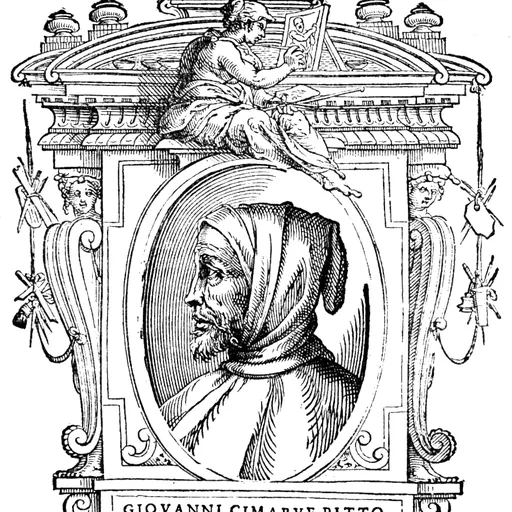
About Cimabue
Lived 1240 – 1302 (aged 61–62). Cimabue was an Italian painter.
Giovanni Cimabue ( , ; – 1302), also known as Cenni di Pepo or Cenni di Pepi, was an Italian painter and designer of mosaics from Florence.
Although heavily influenced by Byzantine models, Cimabue is generally regarded as one of the first great Italian painters to break from the Italo-Byzantine style. Compared with the norms of medieval art, his works have more lifelike figural proportions and a more sophisticated use of shading to suggest volume. According to Italian painter and historian Giorgio Vasari, Cimabue was the teacher of Giotto,
Life
Little is known about Cimabue's early life. One source that recounts his career is Vasari's Lives of the Most Excellent Painters, Sculptors, and Architects, but its accuracy is uncertain.
He was born in Florence and died in Pisa. Hayden Maginnis speculates that he could have trained in Florence under masters who were culturally connected to Byzantine art. The art historian Pietro Toesca attributed the Crucifixion in the church of San Domenico in Arezzo to Cimabue, dating around 1270, making it the earliest known attributed work that departs from the Byzantine style. Cimabue's Christ is bent, and the clothes have the golden striations that were introduced by Coppo di Marcovaldo.
Around 1272, Cimabue is documented as being present in Rome, and a little later he made another Crucifix for the Florentine church of Santa Croce. Now restored, after having been damaged by the 1966 Arno River flood, the work was larger and more advanced than the one in Arezzo, with traces of naturalism perhaps inspired by the works of Nicola Pisano.
According to Vasari, Cimabue, while travelling from Florence to Vespignano, came upon the 10-year-old Giotto (c. 1277) drawing his sheep with a rough rock upon a smooth stone. He asked if Giotto would like to come and stay with him, which the child accepted with his father's permission. Many scholars now discount Vasari's claim that he took Giotto as his pupil, citing earlier sources that suggest otherwise. This work established a style that was followed subsequently by numerous artists, including Duccio di Buoninsegna in his Rucellai Madonna (in the past, wrongly attributed to Cimabue) as well as Giotto. Other works from the period, which were said to have heavily influenced Giotto, include a Flagellation (Frick Collection), mosaics for the Baptistery of Florence (now largely restored), the Maestà at the Santa Maria dei Servi in Bologna and the Madonna in the Pinacoteca of Castelfiorentino. A workshop painting, perhaps assignable to a slightly later period, is the Maestà with Saints Francis and Dominic now in the Uffizi.
During the pontificate of Pope Nicholas IV, the first Franciscan pope, Cimabue worked in Assisi. At Assisi, in the transept of the Lower Basilica of San Francesco, he created a fresco named Madonna with Child Enthroned, Four Angels and St Francis. The left portion of this fresco is lost, but it may have shown St Anthony of Padua (the authorship of the painting has been recently disputed for technical and stylistic reasons).
Cimabue spent the last period of his life, 1301 to 1302, in Pisa. There, he was commissioned to finish a mosaic of Christ Enthroned, originally begun by Maestro Francesco, in the apse of the city's cathedral. Cimabue was to create the part of the mosaic depicting St John the Evangelist, which remains the sole surviving work documented as being by the artist. Cimabue died around 1302.
Character According to Vasari, quoting a contemporary of Cimabue, "Cimabue of Florence was a painter who lived during the author's own time, a nobler man than anyone knew but he was as a result so haughty and proud that if someone pointed out to him any mistake or defect in his work, or if he had noted any himself ... he would immediately destroy the work, no matter how precious it might be."
The nickname Cimabue translates as "ox-head" but also possibly as "one who crushes the views of others", from the Italian verb cimare, meaning "to top", "to shear", and "to blunt". The conclusion for the second meaning is drawn from similar commentaries on Dante, who was also known "for being contemptuous of criticism".
Legacy History has long regarded Cimabue as the last of an era that was overshadowed by the Italian Renaissance. As early as 1543, Vasari wrote of Cimabue, "Cimabue was, in one sense, the principal cause of the renewal of painting," with the qualification that, "Giotto truly eclipsed Cimabue's fame just as a great light eclipses a much smaller one." Cimabue himself does not appear in Purgatorio, but is mentioned by Oderisi, who is also repenting for his pride. The artist serves to represent the fleeting nature of fame in contrast with the Enduring God.
Market On 27 October 2019, The Mocking of Christ, was sold for €24m (£20m; $26.6m), a price the auctioneers described as a new world record for a medieval painting. The picture had been located in the kitchen of a home in northern France, and its owner had been unaware of its value.
List of works While none of Cimabue’s works are signed or securely dated, art historians have attributed several to him, with varying degrees of certainty. Many works in major collections have been erroneously attributed to Cimabue. Virgin and Child with Angels and St. FrancisFrescoLower Basilica, Saint Francis of Assisiframeless Vision of St. John on PatmosFrescoUpper Basilica, Saint Francis of Assisiframeless St. Michael and the Dragon (now lost)FrescoUpper Basilica, Saint Francis of Assisiframeless Martyrdom of St. PeterFrescoUpper Basilica, Saint Francis of Assisiframeless Martyrdom of St. PaulFrescoUpper Basilica, Saint Francis of Assisiframeless St. Paul Healing the Crippled ManFrescoUpper Basilica, Saint Francis of Assisiframeless St. Paul Expelling DemonsFrescoUpper Basilica, Saint Francis of Assisiframeless
Don’t just read it —
keep it.
Full-length biographies made to live with: read them, listen on the way to work, watch them tonight.
- E-book
- Audio
- Video
Instant download · yours to keep · every purchase keeps this site free
Important facts
more
Cenni de Pepo Cimabue, Benciviene di Pepo, Cenni Di Pepi, Jean Cimabué, Jean Cimabue, Ciamb`u, Cenni Benciviene de Pepo, Giovanni Gualtieri, Cenni Di Pepo Cimabue, CimabuéPeople in Cimabue's life
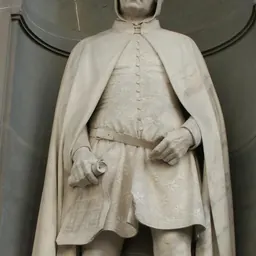
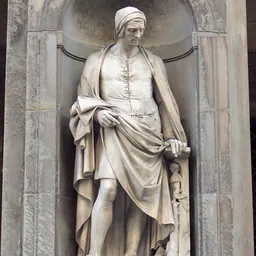
Named in this biography and alive at the same time


Related people
Same field, nearest in time

Contemporaries
People whose lives overlapped Cimabue's




Frequently asked questions
Who was Cimabue?
Italian artist (1240–1302)
When was Cimabue born?
Cimabue was born in 1240 in Florence.
When did Cimabue die?
Cimabue died in 1302 in Pisa.
What was Cimabue's occupation?
Cimabue was a painter.
What nationality was Cimabue?
Cimabue was Italian.
Sources & further reading
Cite this page
APA: Biography.guide. (2026). Cimabue. https://biography.guide/cimabue/
MLA: "Cimabue." Biography.guide, https://biography.guide/cimabue/.
Chicago: "Cimabue." Biography.guide. https://biography.guide/cimabue/.
Data last updated: 2026-09-23 · Spot an error? Report a correction.
Portrait: Wikimedia Commons · author & licence
Page generated 2026-09-27 05:07 UTC