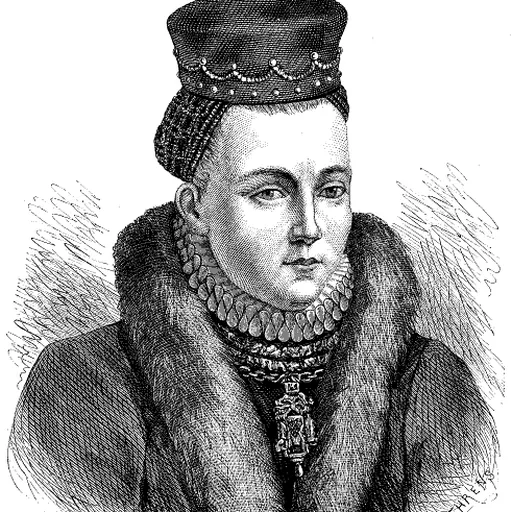
Christina Gyllenstierna
Noblewoman of Sweden and leader of resistance to Christian II of Denmark
About Christina Gyllenstierna
Lived 1494 – 1559 (aged 64–65). Christina Gyllenstierna was a Swedish politician.
Christina Nilsdotter Gyllenstierna of Fogelvik (Swedish: Kristina or Kerstin: 1494 – January 1559) was a Swedish noblewoman. She was married to the Swedish regent Sten Sture the Younger and led the Swedish resistance against Christian II of Denmark after the death of her spouse. In her own lifetime, she was simply referred to as Fru Kristina ('Lady Christina'), but she has become known in history as Kristina Gyllenstierna because of the noble family to which she belonged.
Early life Christina Gyllenstierna was born to riksråd Nils Eriksson (Gyllenstierna), Lord of Tullgarn (also written with the Danish spelling Niels Eriksen, and surnamed "Gyllenstjerna" by later historians) and Sigrid Eskilsdotter (Banér) of Venngarn, Heir of Lindholm. She was a great-granddaughter of King Charles VIII of Sweden through her paternal grandmother princess Christina Karlsdotter Bonde (1432–1493/1500), heir of Fogelvik, after whom she was named. Her grandfather Erik Eriksen of Demstrup ("Gyldenstjerne") originated from Denmark, but during the power struggle between Denmark and Sweden, two formally united parts of the Kalmar Union, he allied with the Swedish claimant, Charles VIII, who made him his son-in-law and High Steward of Charles' court. By the first marriage of her mother, Christina was the half-sister of Cecilia Månsdotter of Eka and thereby the maternal aunt of the future king Gustav I.
Christina was first engaged to Nils Gädda (d. 1508), governor of Kalmar and Lycka, but the marriage never took place due to his death. On 16 November 1511 in Stockholm, she married the son of the Swedish regent Svante and the nephew of her former betrothed, Sten Sture the Younger. She had six children during her marriage, but only one of them survived to mature adulthood: Nils (1512–1527 or 1528), died in adolescence Iliana (1514–1521), died in early childhood Magdalena (1516–1521), died in early childhood Svante Stensson Sture (1517–1567) Anna (1518–1521), died in early childhood Gustav (1519–1520), died in early childhood
Reign of Sten Sture In 1512, Sten Sture succeeded his father as elected regent of Sweden upon his death. During this period, Denmark, Norway and Sweden were formally part of the Kalmar Union through a personal union under the King of Denmark, but in reality, Sweden had been a de facto independent kingdom under "regents" (Sw. riksföreståndare) native high nobles elected to rule the country.
Sten Sture's election as regent was not without opposition. At the death of his father, Sten was only 18 years old, and High Councillor Eric Trolle, who supported the union with Denmark, was initially chosen as regent by the council. However, Sten utilized the castles and troops granted to him by his late father and took power in a coup: after having promised to continue negotiations with Denmark, the High Council accepted him as regent instead of Trolle. In reality, Lord Sten's purpose was to keep Sweden independent from Denmark. He took the Sture name, a heritage from his great-grandmother, because it symbolized the independence of Sweden as a reminder of Sten Sture the Elder, his father's third cousin.
Regent Sten had already in 1504 been proposed as a candidate in the election of a new king of Sweden as a replacement for John, King of Denmark, who had been elected King of Sweden in 1497 but who was ousted from there in 1502. Upon the death of John in 1513, it was again proposed to elect regent Sten as King of Sweden rather than the son of John, Christian II of Denmark, and Sten was making preparations to arrange an election, including seeking support for it from the pope.
It is considered likely that Christina participated in state affairs and acted as the political adviser to her spouse, given her later role. In reality, Sten and Christina already functioned as king and queen of Sweden: by 1519, Peder Månsson, Bishop of Västerås, expressed his surprise in a letter from Rome to Abbess Anna Germundsdotter of Vadstena Abbey that Sten had not yet been crowned, This resulted in the infamous Stockholm Bloodbath upon the followers of Sten Sture.
Christina's brothers Erik Nilsson, Lord of Tullgarn and Eskil Nilsson, her maternal uncle and her brother-in-law were executed by beheading, as were many other Swedish Sture party followers. Her husband's remains were exhumed and burned publicly at the stake as a heretic, as were those of her youngest son Gustav. Her mother Sigrid became the only woman sentenced to be executed: she was sentenced to be drowned, but avoided execution by ceding her property to the king. Christina herself was not executed. King Christian called upon her and asked her to choose which method of execution she preferred, being burned at the stake or being buried alive. Confronted with this choice, she was unable to reply and fainted with horror. Christian was advised to spare her life and neither of these alternatives was carried out. To save her life, she ceded a large part of her property to Christian. The king stated that she "is now dead to the world, for she is judged as the others for heresy". after which her children, mother, and finally herself were all transferred to the infamous Blåtårn ("Blue Tower") of Copenhagen Castle along with a large number of other women and children related to the executed of the Stockholm Bloodbath, among them her half sister Cecilia and nieces Emerentia and Margareta. Christina herself and her daughters joined them there in September.
On 20 July 1525, however, the rebellion was crushed when Nils, the son of Christina, was taken prisoner by King Gustav after his victory at the Siege of Kalmar. Gustav defeated the rebels, and Daljunkern fled to Norway and then Germany, where he was arrested in Rostock. In August 1528, King Gustav had Christina issue an official statement that Daljunkern was not her son. Preserved documents show that the first version of Christina's letter was written carefully and only asked the authorities in Rostock to send the person claiming to be Nils to Sweden for questioning: in the final version of the letter, which was eventually sent, however, she called him a thief and impostor and demanded that he be executed on the spot. It is considered likely that she wrote the letter under pressure.
Later life The relationship between Christina and King Gustav was described as somewhat tense. After the death of her mother in 1527, Christina and Gustav came to be involved in a conflict over her inheritance after her mother, which was not solved until 1550. During the Westrogothian rebellion in 1529, Christina was given the task by the king to negotiate with her rebellious brother-in-law Jöran Turesson (Tre Rosor). During the Dacke War, the king ordered her that she should prevent any rebels who reached Nyköping to acquire supplies and imprison them.
Her second son Svante was, according to tradition, engaged to her relative Margaret Leijonhufvud, who however was arranged to marry the king in 1536. After the marriage of Margaret to the king, Christina and other relatives of the new queen were granted some privileges, such as the right to some of the money from the fines paid to the crown. It is noted that she evidently attended court during the tenure of Margaret as queen, as she, alongside Margaret's mother Ebba Eriksdotter Vasa, is often listed to have occupied the best rooms next to the queen. Whether she was ever given a court office is unknown. It is confirmed that she was briefly made responsible for the court of the royal children between the death of queen Margaret in 1551 and the king's marriage to queen Katarina Stenbock in 1552. Christina died in January 1559 at Hörningsholm Castle.
Don’t just read it —
keep it.
Full-length biographies made to live with: read them, listen on the way to work, watch them tonight.
- E-book
- Audio
- Video
Instant download · yours to keep · every purchase keeps this site free
Important facts
Family & relationships
People in Christina Gyllenstierna's life
Named in this biography and alive at the same time




Related people
Same field, nearest in time


Contemporaries
People whose lives overlapped Christina Gyllenstierna's




Frequently asked questions
Who was Christina Gyllenstierna?
Noblewoman of Sweden and leader of resistance to Christian II of Denmark (1494-1559)
When was Christina Gyllenstierna born?
Christina Gyllenstierna was born in 1494.
When did Christina Gyllenstierna die?
Christina Gyllenstierna died on 5 January 1559 in Hörningsholm Castle.
What was Christina Gyllenstierna's occupation?
Christina Gyllenstierna was a politician.
What nationality was Christina Gyllenstierna?
Christina Gyllenstierna was Swedish.
Sources & further reading
· Wikipedia: Christina Gyllenstierna
· DBpedia: Christina Gyllenstierna
Cite this page
APA: Biography.guide. (2026). Christina Gyllenstierna. https://biography.guide/christina-gyllenstierna/
MLA: "Christina Gyllenstierna." Biography.guide, https://biography.guide/christina-gyllenstierna/.
Chicago: "Christina Gyllenstierna." Biography.guide. https://biography.guide/christina-gyllenstierna/.
Data last updated: 2026-09-23 · Spot an error? Report a correction.
Portrait: Wikimedia Commons · author & licence
Page generated 2026-09-27 05:07 UTC