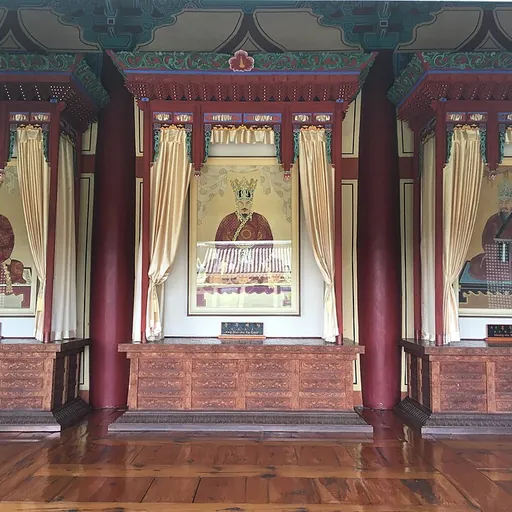
About Chŏng Mun-bu
Lived 1565 – 1624 (aged 58–59). Chŏng Mun-bu was a Korean military leader.
Chŏng Munbu (; 19th day, 2nd month of 1565 – 29th day, 11th month of 1624 ) was a Korean scholar-official and military leader of the mid-Joseon period. He is remembered for his role as a commander of a righteous army (civilian militia) during the 1592–1598 Imjin War.
Born in 1565 in Hansŏng, he passed the state civil service examination in 1588 and entered government service as a civil official. In 1591, he relocated to Hamgyong Province, where he worked in a military administration position.
With the outbreak of the Imjin War in 1592 and the subsequent advance of Japanese forces into Hamgyong Province, Chŏng organized and led a righteous army against the Japanese forces and their local Korean collaborators. He ran several successful campaigns against Japanese forces that ultimately resulted in their expulsion from Hamgyong Province. Despite these accomplishments, Chŏng did not receive significant official recognition, owing to a false report on his activities submitted to the royal court by another politician, Yun T'agyŏn.
After the war, Chŏng served in various government positions. In 1615, he resigned from his post as Magistrate of Kilju and withdrew from public life. In 1623, he was appointed Mayor of Jeonju. In 1624, Chŏng was falsely accused of being involved in a plot against King Injo and was arrested. He died from torture during his imprisonment.
In 1665, Chŏng was posthumously exonerated and granted various ceremonial titles and positions. Shrines such as Ch'angnyŏlsa in Ŏrang and Hyŏnch'ungsa in Kyŏngsŏng were established in his honor. In 1709, the Pukkwan Victory Monument was erected in Kilju to commemorate his military achievements.
Early life Chŏng Munbu was born on the 19th day, 2nd month of 1565 , in Namso-dong, Hansŏng, Joseon. He was the second son of Chŏng Sin and a lady of the Gangneung Kim clan. His paternal lineage was the , a distinguished family noted for producing successive generations of high-ranking officials. Both his grandfather, , and his father had passed the state civil service examinations and served in various official capacities.
From an early age, Chŏng Munbu was considered to possess exceptional literary talent. At the age of seven, he composed a five-character poem titled "The Beauty of Jade Cannot Compare to the Cold Hue of the Crow" . At age eight, he authored the poem "Crescent" , a work that garnered widespread acclaim. At age fourteen, he attained first place in the Preliminary Civil Service Examination with his poem "In the Bright Moonlight, Flowers Fall and Dusk Returns" . This work, along with that of , was later introduced to the Ming dynasty of China as an examplary specimen of Joseon examination poetry.
In 1585, Chŏng passed both the Classics Licentiate Examination and Literary Licentiate Examination Saganwŏn Fourth Censor 1590 Sahŏnbu Fourth Inspector 5A 1591 Hamgyong Assistant Commander 6A
Chŏng began his career in 1588 as an Assistant Proofreader at the Office of Diplomatic Correspondence . He then advanced rapidly through the ranks: in November of the same year, he was promoted to Proofreader , and in the 12th month, he received further appointment as an Adjutant Officer at the Hansŏng Magistracy . In 1589, he was promoted to Sixth Counselor at the Office of Special Advisors and subsequently held dual positions as Fourth Censor at the Office of the Censor-General and the First-tier Confucian Instructor at the Office of the Inspector-General.
In the 8th month of 1591, Chŏng was appointed Assistant Military Commander of Hamgyong Province, a position ranked at the sixth senior grade. Although the post was of a lower rank than his previous office as a Fourth Inspector, it carried significant authority over regional military administration. Chŏng voluntarily accepted the transfer, seeking to overcome the obstacles to his advancement in the central government that stemmed from the political repercussions associated with his grandfather Chŏng Ŏn'gak's involvement in the 1547 Chŏngmi Purge.
Imjin War
Service in Hamgyong and outbreak of the Imjin War As Assistant Military Commander of Hamgyong Province, Chŏng Munbu primarily assisted the Provincial Military Commander in matters of defense. He undertook regular inspections of the , overseeing troop training, military infrastructure, and supply stockpiles in preparation for potential Jurchen incursions. Beyond military affairs, Chŏng also focused on local governance. He provided Confucian education to provincial students and actively worked to eliminate administrative abuses, thereby earning the trust and support of the local population.
In 1592, following the outbreak of the Imjin War and the advance of the Japanese Second Division under Katō Kiyomasa into Hamgyong Province, Chŏng Munbu, serving as Assistant Military Commander, coordinated the defense of the region alongside Han Kŭkham, the Provincial Military Commander of Hamgyong. However, on the 18th day, 7th month, their forces were defeated at the Battle of Haejŏngch'ang and Chŏng retreated to Haech'on in Kyŏngsŏng. On the 24th day, 7th month, Prince Imhae and Prince Sunhwa, who had been dispatched to mobilize royal reinforcements, were captured by Japanese forces following an internal revolt by Kuk Kyŏngin.
Formation of a righteous army In response, Chŏng Munbu pledged to raise a righteous army (civilian militia) in collaboration with former provincial governor Yi Sŏngim . They joined forces with local officials, including Magistrate of Kyŏngwŏn O Ŭngt'ae , and Na Chŏngŏn , Magistrate of Kyŏnghŭng, and advanced toward Kyŏngsŏng. However, their campaign was thwarted by Japanese collaborator , resulting in their defeat and subsequent disbandment.
At the time, many indigenous inhabitants of Hamgyong Province collaborated with the Japanese (they were dubbed ). They frequently captured and delivered local officials to the Japanese. To evade such dangers, Chŏng Munbu sought refuge at the residence of a shaman named Han In'gan . Later, Chŏng relocated to the residence of his disciple Chi Tarwŏn in Kyŏngsŏng. In the 8th month, Chŏng was convinced by Chi Tarwŏn and Ch'oe Paech'ŏn to organize a righteous army again. Together, they devised plans to form a righteous army at the home of Yi Pungsu in Kyŏngsŏng, where several commanders, including Kang Munu and Chŏng Hyŏllyong, assembled to offer their support.
Chŏng Munbu sought to appoint Chŏng Hyŏllyong—his senior in official rank—as the leader of the righteous army. However, Chŏng Hyŏllyong declined, stating that he was unfit to shoulder such a heavy responsibility. ) took the lead in executing this policy; after O's arrest, Sin mobilized armed men and assassinated Kuk Kyŏngin. In Myŏngch'ŏn, a failed uprising against Chŏng Malsu was later succeeded by forces under Ku Hwang and Kang Munu, who were dispatched by Chŏng. Upon regaining Myŏngch'ŏn, Chŏng ordered the execution of Kuk Sep'il and remaining collaborators, thereby eliminating internal resistance across Hamgyong Province.
Following the consolidation of control, Chŏng reorganized his forces into three main divisions—central, left, and right—under the respective command of Chŏng Hyŏllyong, Yu Kyŏngch'ŏn , and O Ŭngt'ae. Smaller ambush units were also positioned under Wŏn Ch'ungsŏ to maximize tactical mobility. On the 30th day, 10th month, Wŏn executed a successful ambush against a Japanese unit returning from a massacre in Myŏngch'ŏn, forcing them to retreat to the mountain Changdŏksan . The righteous army secured the summit and launched a coordinated assault, driving the Japanese into a valley where they were trapped. ) of Hamgyong.
Yun, having assumed command over the province's military affairs on the 10th day, 7th month of 1592, expected that Chŏng would operate under his supervision. However, from Chŏng Munbu's perspective reportedly, Yun's repeated interference not only undermined morale among the righteous army but also attempted to appropriate the achievements of the righteous army. Therefore, Chŏng bypassed Yun when submitting official reports and independently exercised military and administrative functions, including granting rewards and pardons—actions which Yun regarded as exceeding his authority and violating bureaucratic protocol. Viewing Chŏng's autonomous operations as insubordinate, Yun formally censured him on four occasions. The deteriorating relationship ultimately culminated in Chŏng's forced resignation as commander of the righteous army on the 21st day, 11th month, when Yun appointed Chŏng Hyŏllyong as his successor.
Reappointment and late battles in 1593 Following his resignation, Chŏng Munbu resumed his duties as Assistant Military Commander, focusing on the defense of the northern frontier against Jurchen incursions. Although the position of righteous army commander was initially handed over to Chŏng Hyŏllyong and later to O Ŭngt'ae, both successors failed to command the same respect and cohesion among the volunteers. Discontent grew within the ranks, with many soldiers voicing dissatisfaction and defecting. In response to the mounting instability and erosion of morale, Chŏng was reinstated as commander of the righteous army on the 13th day, 1st month of 1593.
On the 22nd day, 1st month of 1593, Chŏng Munbu responded to a request for assistance from Kang Ch'an , the magistrate of Tanchon, by dispatching 200 troops under four commanders, including Ku Hwang. Using a decoy maneuver at Macheollyeong, Chŏng's forces ambushed a 900-man Japanese garrison, killing approximately 170 without sustaining casualties. Later that month, as Katō Kiyomasa led a massive force to relieve besieged Japanese troops in Kilju, Chŏng strategically lay in ambush and engaged the Japanese at Paekt'apkyo on the 28th day, 1st month. Although his forces inflicted heavy losses on the enemy, they also suffered significant casualties and retreated to Myŏngch'ŏn for reorganization. That night, Katō's forces, having reunited with the isolated Japanese garrison in Kilju, withdrew toward Anbyŏn. With this retreat, Chŏng Munbu and the righteous army completed the recapture of Hamgyong Province.
After the Pukkwan campaign Despite his pivotal role in the successful recapture of Hamgyong Province, Chŏng Munbu's contributions were not fully acknowledged by the central government. This was because Provincial Governor Yun T'agyŏn did not accurately report Chŏng's achievements. Instead, the court attributed the victory primarily to Chŏng Hyŏllyong and appointed him as Provincial Military Commander. Chŏng Munbu was instead granted the lesser post of Magistrate of Yŏnghŭng on the 9th day, 4th month, 1593, in recognition only of his efforts in suppressing internal collaborators, rather than for his leadership in liberating the province.
He continued to serve in key administrative roles within the province, including appointments as Magistrate of Onsŏng and Magistrate of Kilju. In the 11th month of 1596, amid rising concerns over a potential second Japanese invasion, he was reassigned to the strategically important position of Magistrate of Gongju.
Post-war career +Chŏng Munbu's official careers after war Year Office Post Rank Ref.
Changyewŏn Chief Judge
Hojo Third Minister 1600 Yongyangwi Assistant Protector 4B 1601 Yejo Second Minister
1603
Associate Director 1604 Associate Councillor 3A ) of the Bureau of Slaves . He was subsequently promoted to Third Minister of Taxation, and in 1600, appointed Assistant Military Protector of the Rites, a senior second-rank position.
In 1603, Chŏng was appointed Associate Director of the Privy Council . The following year, however, he was demoted to Associate Councillor . In the 8th month of 1603, he left office upon the death of his father and observed the traditional mourning period for two years in Songsan. After completing mourning on the 4th day, 11th month of 1606, he was appointed Magistrate of Changdan.
Gwanghaegun period and resignation In 1610, the year after King Gwanghaegun's accession, Chŏng was selected as Envoy for Gratitude Missions ( On the 20th day, 4th month of 1612, he was named Second Minister of Law Enforcement , but he requested reassignment to an external post in order to care for his aging mother.
Amid intensifying factional strife in 1613, Chŏng withdrew from office and returned to private life. Dividing his time between Songsan and Seoul, he lived in seclusion, avoiding entanglement with powerful elites. Although he was later nominated for high posts such as Second Minister of Military Affairs (
Reappointment and Injo period On the 5th day, 7th month of 1618, under growing pressure from the ruling faction, Chŏng reluctantly accepted the post of Magistrate of Ch'angwŏn. During his tenure, he fostered Confucian scholarship, constructed the pavilion Samijŏng , and restored , where he pursued literary leisure and composed ten poems on historical subjects.
Following the enthronement of King Injo in 1623, Chŏng was appointed Mayor of Jeonju in the 4th month. However, in the 7th month of that year, upon the death of his mother, he returned to Songsan for mourning. During this period, his health deteriorated significantly, and he developed a severe abscess. In the 1st month of 1624, following the outbreak of Yi Kwal's Rebellion, King Injo appointed Chŏng, despite being in mourning, as Deputy Commander and ordered him to return to government service on the recommendation of Chief State Councillor . However, due to severe abscess, he was unable to comply with the appointment.
Final years
Pak Honggu's treason conspiracy In the 11th month of 1624, Chŏng Munbu was arrested on suspicion of involvement in a treason conspiracy led by . The conspirators, including Pak Yunjang and Pak Naejang , plotted to enthrone and restore the deposed King Gwanghaegun as King Emeritus (T'aesangwang). As part of their plans, they discussed appointing Chŏng as the vanguard commander of the rebel forces. To gauge Chŏng's willingness to participate, they sought to approach him through Yi Taegŏm , an acupuncturist who had been treating Chŏng for an abscess. Through this intermediary, the conspirators intended to probe Chŏng's stance.
The plot was uncovered on the 8th day, 11th month, and during subsequent interrogations on the 11th day, 11th month, testimony emerged indicating that Chŏng had been designated as a prospective commander. As a result, he was subjected to official investigation. During interrogation, Chŏng Munbu consistently maintained his innocence. Yi Taegŏm testified that he had never mentioned the conspiracy to Chŏng, thereby confirming Chŏng's noninvolvement. On the 17th day, 11th month, Left State Councillor submitted a report concluding that there was no evidence that Chŏng had accepted the treasonous proposal.
Poem about King Huai of Chu
Nevertheless, the Censorate officials raised issue with a poem about King Huai of Chu Chŏng had composed during his tenure as magistrate of Ch'angwŏn. They accused the poem of implicitly denying the legitimacy of King Injo, who had ascended the throne after the deposition of Gwanghaegun, and of expressing seditious intent.
The poem had actually been composed in 1618, five years before Injo's rise to power through the 1623 Injo Coup, making it chronologically impossible for the poem to target Injo. Moreover, its content was a historical elegy referencing Chinese dynastic precedent, not a political commentary on the Joseon succession. Despite these facts, the Censorate officials did not properly examine the context and subjected Chŏng to severe torture.
Death
Despite severe torture, Chŏng Munbu maintained his innocence. He died of his injuries on the 19th day, 11th month of 1624, at the age of 59. He was buried near his father's grave at Songsan in Yangju, present-day Uijeongbu.
Legacy
Exoneration and posthumous titles Chŏng Munbu was officially exonerated in 1665, 41 years after his death. Chief State Councillor and Hŏ Chŏk convinced King Hyeonjong that Chŏng Munbu's death had been unjust and that he had accomplished much for the state. Hyeonjong agreed that the controversial poem contained no seditious elements and cleared Chŏng Munbu's reputation.
Subsequently, Hamgyong Governor and Assistant Military Commander recommended posthumous honors for key contributors to the Pukkwan campaign. Chŏng Munbu was posthumously appointed Right Associate State Councilor of the State Council. In 1713, during the reign of King Sukjong, Chŏng was further honored with the posthumous title "Ch'ungŭi", meaning "Loyal and Resolute", in recognition of his distinguished service.
Memorials
Shrines In 1664, the shrine Ch'angnyŏlsa , which was established by Ch'oe Paech'ŏn.
Pukkwan Victory Monument
In 1700, the Assistant Military Commander of Hamgyong Province Ch'oe Ch'angdae realized that the province had no monuments that commemorated victories in the Imjin War. By contrast, Haengju and Yŏnan had such monuments. Ch'oe ordered that one be created for Chŏng. In 1703, Ch'oe composed the inscription, and in 1709, the Pukkwan Victory Monument was erected in Immyŏng-myeŏn, Kilju County, North Hamgyong Province. The monument is of the dimensions . On both its front and back surfaces, more than 1,500 characters are inscribed, chronicling Chŏng's exploits and the righteous army under his command.
Don’t just read it —
keep it.
Full-length biographies made to live with: read them, listen on the way to work, watch them tonight.
- E-book
- Audio
- Video
Instant download · yours to keep · every purchase keeps this site free
Important facts
People in Chŏng Mun-bu's life
Named in this biography and alive at the same time



Related people
Same field, nearest in time


Contemporaries
People whose lives overlapped Chŏng Mun-bu's




Frequently asked questions
Who was Chŏng Mun-bu?
Korean military leader
When was Chŏng Mun-bu born?
Chŏng Mun-bu was born in 1565.
When did Chŏng Mun-bu die?
Chŏng Mun-bu died in 1624.
What was Chŏng Mun-bu's occupation?
Chŏng Mun-bu was a military leader.
What nationality was Chŏng Mun-bu?
Chŏng Mun-bu was Korean.
Sources & further reading
Cite this page
APA: Biography.guide. (2026). Chŏng Mun-bu. https://biography.guide/chong-mun-bu/
MLA: "Chŏng Mun-bu." Biography.guide, https://biography.guide/chong-mun-bu/.
Chicago: "Chŏng Mun-bu." Biography.guide. https://biography.guide/chong-mun-bu/.
Data last updated: 2026-09-21 · Spot an error? Report a correction.
Portrait: Wikimedia Commons · author & licence
Page generated 2026-09-27 04:58 UTC