
About Charlotte Mardyn
Born 1789. Charlotte Mardyn was a British actor.
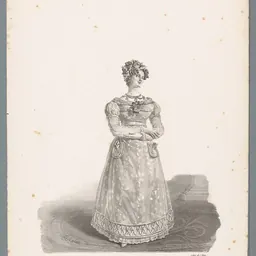
Charlotte Mardyn (after 1844) was an English actress of Irish descent of the early 19th century who was rumoured to have been the mistress of Lord Byron.
Early life Little is known of her early life or origins owing to her telling various conflicting stories about herself, with William Oxberry recounting that he had heard five different versions. According to one version she was born in Chichester in 1789 (according to Mardyn in about 1795) as Charlotte Ingram of Irish parents. According to another version she was born in Ireland as Charlotte Eldred and moved to Chichester when young. He met the attractive 16 year-old Charlotte Mardyn; she being ambitious for a better life and wishing to escape the drudgery of the kitchen the two quickly married and she joined the Portsmouth Company. In 1808, at the theatre in Portsmouth, she made her first appearance, opposite her husband in the farce The Jew and the Doctor. Being illiterate, her parts had to be taught to her. Lacking in experience and confidence, she experienced stage fright at first, and she was not a success. She played walk-on roles and appeared in crowd scenes and did a little dancing. At this time, a critic wrote "Her beauty of face, and symmetry of form were well adapted for it; but alas! when she had to open her mouth, all the illusion was destroyed." While her husband turned more to drink Charlotte Mardyn set about improving her education and her grammar and pronunciation and she separated from her husband. By 1810 she had at least one child.
Success at Drury Lane Mrs. Mardyn as Amelia in Lovers' Vows (1816) - George Cruikshank Mardyn made her début at the Theatre Royal, Drury Lane in 1816 as Amelia Wildenhaim in Lovers' Vows, in which she made a great success. Next she was Albina Mandeville in Reynold's The Will before playing Miss Peggy in Garrick's The Country Girl and Miss Hoyden in A Trip to Scarborough. At this time, her estranged husband reappeared on the scene demanding her salary, so she refused to go on stage. Eventually she agreed to pay him £2 per week to be rid of him on the condition that he did not come within 100 miles of her. However, her husband's brother later sent her a letter stating that her husband had died and requested money to cover the funeral costs. Having sent the money a week later, she found her supposedly dead husband drunkenly staggering toward her home with the intention of causing trouble. Mardyn appeared in Tamerlane, The Quaker, Revenge, and Twenty Per Cent (1815). She was Zuleika with Edmund Kean in The Bride of Abydos (1818) adapted from Byron's poem of the same name and played Sylvia in Farquhar's The Recruiting Officer (1819). In 1816, rumours circulated that Lady Byron had discovered Mardyn at her dining table and had fled the marital home in a carriage, believing that Mrs. Mardyn was another of her husband's mistresses and that she had caught the couple in the act. As a result, Mardyn was described as "An actress at Drury-Lane of unsavoury reputation rumoured to have eloped with Byron in 1815".
An alternative and innocent (but possibly less likely) version of the incident was that, as a leading member of the Committee of Management of the Theatre Royal, Drury Lane Byron had been visited at his home by Mrs. Mardyn who was anxious to prevent a rival actress from gaining a coveted role. A violent storm erupting as Mardyn was about to leave Byron's home he was about to send her home in his own carriage when Lady Byron appeared on the scene and cancelled the order for the carriage with the servants. On Lord Byron then calling for his wife's carriage to be got ready instead his wife told the servants "Go, and tell your master that Mrs Mardyn will never ride in a carriage belonging to me." Byron is then said to have responded that as Mrs. Mardyn was unable to obtain a conveyance to take her home then she should stay for dinner. When Lady Byron entered the room Byron introduced Mrs Mardyn to her; Lady Byron made some caustic comments about the character of the actress and left her home never to return. Byron, being innocent was stung by his wife's accusation and being too proud to defend himself against untruths was forced to see his wife leave. Despite Byron's protestations of innocence, Mardyn was after booed off the stage when playing the Widow Brady in The Irish Widow Despite the scandal Mardyn remained at Drury Lane through Autumn 1818-1819 at a salary of £20 a week.
Marriage and retirement
In his later years, Mardyn's husband earned pennies by singing in the streets of London
In 1834 Byron's historical tragedy in blank verse Sardanapalus (1821) was performed at the Theatre Royal, Drury Lane with Macready taking the title role. Byron had intended his play as a closet piece, writing that it was "expressly written not for the theatre" and his wish was respected during his lifetime. It was said at the time that Byron had written the part of Myrrha for Mardyn because of his relationship with her, but as he had not written it to be performed this claim is unlikely and her proposed casting in the role in 1834 was probably a hoax perpetrated by the playwright William Dimond. The part went to Ellen Tree.
A portrait of Mardyn by Thomas Charles Wageman (1787-1863) is in the Royal Collection.
Don’t just read it —
keep it.
Full-length biographies made to live with: read them, listen on the way to work, watch them tonight.
- E-book
- Audio
- Video
Instant download · yours to keep · every purchase keeps this site free
Important facts
Related people
Same field, nearest in time



Frequently asked questions
Who was Charlotte Mardyn?
British 19th-century actress
When was Charlotte Mardyn born?
Charlotte Mardyn was born in 1789 in Ireland.
What was Charlotte Mardyn's occupation?
Charlotte Mardyn was an actor.
What nationality was Charlotte Mardyn?
Charlotte Mardyn was British.
Sources & further reading
Cite this page
APA: Biography.guide. (2026). Charlotte Mardyn. https://biography.guide/charlotte-mardyn/
MLA: "Charlotte Mardyn." Biography.guide, https://biography.guide/charlotte-mardyn/.
Chicago: "Charlotte Mardyn." Biography.guide. https://biography.guide/charlotte-mardyn/.
Data last updated: 2026-09-25 · Spot an error? Report a correction.
Page generated 2026-09-27 05:12 UTC