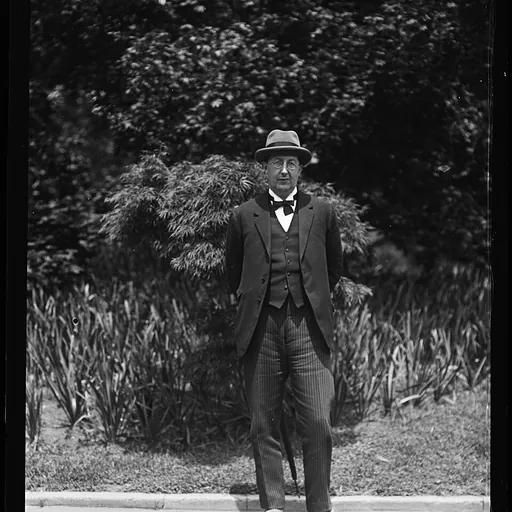
About Charles Webster
Lived 1886 – 1961 (aged 75). Charles Webster was an Indian diplomat and historian.
Sir Charles Kingsley Webster (25 July 1886 – August 1961) was a British diplomat and historian. He was educated at Merchant Taylors' School, Crosby and King's College, Cambridge. After leaving Cambridge University, he went on to become a professor at Harvard, Oxford, and the London School of Economics (LSE). He also served as President of the British Academy from 1950 to 1954.
In addition to his career in academia, Webster worked extensively in the Foreign Office, especially in the United States, and was a leading supporter of the new United Nations, as he had been of the League of Nations.
Life After studying at Cambridge, Webster became professor of international relations at the University of Wales, Aberystwyth where he wrote his two major books on the foreign policy of Lord Castlereagh, the first (published in 1925) covering the period 1815–1822, the second (published in 1931) that from 1812 to 1815. In 1932 Webster moved to the newly established Stevenson chair of international relations at the LSE.
During World War II, he worked extensively in the Foreign Office, especially in the United States, and was a leading supporter of the new United Nations, as he had been of the League of Nations. He was involved in the drafting of the UN Charter.
He attended the first meetings of both the General Assembly and the Security Council in January 1946 and the final meeting of the League of Nations in April. He was made a Knight Commander of the Order of St Michael and St George in the new year's honours list of 1946.
Career In 1948, Webster gave the Ford Lectures at Oxford University. In 1951, his biography of Henry John Temple, 3rd Viscount Palmerston was finally published. He was President of the British Academy in 1950. He was awarded honorary degrees from Oxford, Cambridge, Wales, Rome, and Williams College, Massachusetts, and was made an honorary fellow of King's College, Cambridge. He retired from his chair at the LSE in 1953.
Professor of Modern History, Liverpool University, 1914–1922 Subaltern in the Royal Army Service Corps, 1915–1917 General Staff of the War Office, 1917–1918 Secretary, Military Section, British Delegation to the Conference of Paris, 1918–1919 Wilson Professor of International Politics, University of Wales, 1922–1932 Außerordentlicher (=Associate) Professor, University of Vienna, 1926 Nobel Lecturer, Oslo, 1926 Reader, University of Calcutta, India, 1927 Professor of History, Harvard University, USA, 1928–1932 Stevenson Professor of International History, London School of Economics and Political Science, 1932–1953 Foreign Research and Press Service, 1939–1941 Director, British School of Information, New York, 1941–1942 Foreign Office, 1943–1946 Member of British Delegation, Dumbarton Oaks and San Francisco Conferences, 1944–1945 Member, Preparatory Commission and General Assembly, United Nations, 1945–1946 Ford Lecturer, Oxford University, 1948 President, 1950–1954, and Foreign Secretary, 1955–1958, British Academy
Works The Congress of Vienna, 1814–1815, London: Foreign Office Historical Section, 1919 The Congress of Vienna, Oxford University Press, 1919 (with copyedit instructions, 1934), online at Internet Archive British diplomacy, 1813–1815 : select documents dealing with the reconstruction of Europe, 1921, 409p, online at Internet Archive The pacification of Europe, 1813–1815, 1922 The Congress of Vienna, 1814–15, and the Conference of Paris, 1919, London, 1923 The Foreign Policy of Castlereagh (1815–1822) Britain and the European Alliance, London: G. Bell and Sons, 1925, online at Internet Archive The European alliance, 1815–1825, University of Calcutta, 1929 What the world owes to President Wilson, London: League of Nations Union, 1930 The League of Nations in theory and practice, London: Allen and Unwin, 1933 Palmerston, Metternich and the European system, 1830–1841, London: Humphrey Milford, London, 1934 Editor of British diplomatic representatives, 1789–1852, London, 1934 Editor of Britain and the independence of Latin America, 1812–1830, London: Ibero-American Institute of Great Britain, 1938 Some problems of international organisation, University of Leeds, 1943 Editor of Some letters of the Duke of Wellington to his brother, William Wellesley-Pole, London, 1948 The Foreign Policy of Palmerston, 1830–1841: Britain, the Liberal Movement, and the Eastern Question, 1951, online edition of vol 2 The art and practice of diplomacy, London School of Economics, 1952, online British Foreign Policy since the Second World War The founder of the national home, Weizmann Science Press of Israel, 1955 Sanctions: the use of force in an international organisation, London, 1956 The strategic air offensive against Germany, 1939–1945, London, Her Majesty's Stationery Office, 1961, coauthor, 3 volumes, official history
Don’t just read it —
keep it.
Full-length biographies made to live with: read them, listen on the way to work, watch them tonight.
- E-book
- Audio
- Video
Instant download · yours to keep · every purchase keeps this site free
Important facts
People in Charles Webster's life
Named in this biography and alive at the same time


Related people
Same field, nearest in time

Contemporaries
People whose lives overlapped Charles Webster's





Frequently asked questions
Who was Charles Webster?
British historian (1886-1961)
When was Charles Webster born?
Charles Webster was born on 25 July 1886 in United Kingdom.
When did Charles Webster die?
Charles Webster died on 21 August 1961 in London.
What was Charles Webster's occupation?
Charles Webster was a diplomat and historian.
What nationality was Charles Webster?
Charles Webster was Indian.
Sources & further reading
· DBpedia: Charles Webster (historian)
Cite this page
APA: Biography.guide. (2026). Charles Webster. https://biography.guide/charles-webster-diplomat/
MLA: "Charles Webster." Biography.guide, https://biography.guide/charles-webster-diplomat/.
Chicago: "Charles Webster." Biography.guide. https://biography.guide/charles-webster-diplomat/.
Data last updated: 2026-09-23 · Spot an error? Report a correction.
Portrait: Wikimedia Commons · author & licence
Page generated 2026-09-27 05:05 UTC