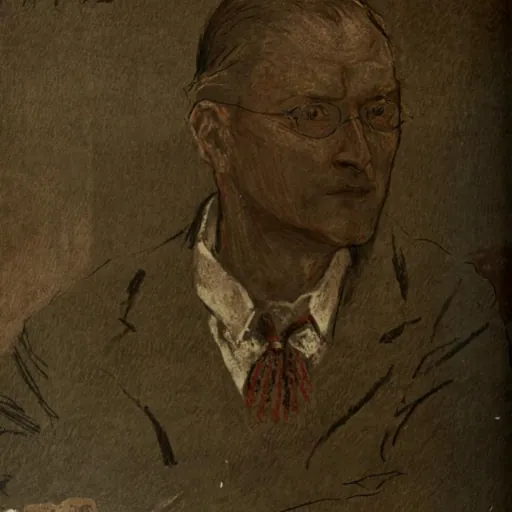
About Charles Voysey
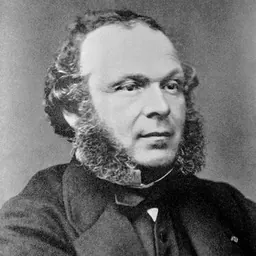
Lived 1857 – 1941 (aged 83). Charles Voysey was a British architect, textile designer and designer.
Charles Francis Annesley Voysey (28 May 1857 – 12 February 1941) was an English architect and furniture and textile designer. while waiting for architectural commissions to come in. He joined the Art-Workers' Guild in 1884, and displayed both printed textiles and wallpapers at the inaugural Arts and Crafts Exhibition Society show at the New Gallery in 1888. In 1893 he began designing wallpapers for Essex & Co., for whom he executed several hundred patterns.
Examples of his completed architectural works are: Perrycroft, Colwall, Herefordshire 1893; Annesley Lodge, Hampstead, London, 1896; An artist's cottage (14 South Parade), Chiswick, London C.1890; Merlshanger (later Greyfriars), Hog's Back, Puttenham near Guildford, 1896; Norney Grange, Shackleford, 1897; Spade House, Sandgate, Kent (the home of the writer H. G. Wells); Voysey House (a Sanderson wallpaper factory, now offices), Chiswick 1902; The Pastures, North Luffenham, Rutland 1903; The Orchard, Chorleywood, 1900, which he designed for himself; Voysey designed the Malvern Wells War Memorial in Malvern Wells, Worcestershire. It was unveiled in 1920 and is topped by a sculpture of a pelican.
There are several examples of Voysey's design near Bowness-on-Windermere, Cumbria, with roughcast walls and massive rendered stacks on sweeping slate roofs. Architectural historian Nikolaus Pevsner greatly admired the Orchard, and identified Broad Leys as Voysey's masterpiece, seeing in them seeds of the modernist movement.
In fact, Voysey himself, who was Master of the Art-Workers Guild in 1924, had a strong dislike of modern architecture, and was irritated by Pevsner's identification of his work with the movement. and featured in the film The French Lieutenant's Woman. It is the only Voysey house in which the public are allowed to stay.
Voysey died in Winchester in 1941. "the conscientious core of the Arts and Crafts Movement", being elected to the position of Master in 1924.
His furniture designs were simple and functional, and only sparingly decorated. He particularly advocated that wood should be left with its natural finish, contrary to the popular techniques which covered wood with paint and stain. He eschewed the complexities identified with late Victorian design.
Many modest houses built in Britain in the 1920s and 1930s were inspired by Voysey's simple vernacular country houses, although Voysey himself built no houses after 1918.
The Victoria and Albert Museum has an extensive collection of Voysey's work, including design drawings, fabrics, carpets, and wallpapers.
2011 saw the formation of the C. F .A. Voysey Society, dedicated to his life and work.
Don’t just read it —
keep it.
Full-length biographies made to live with: read them, listen on the way to work, watch them tonight.
- E-book
- Audio
- Video
Instant download · yours to keep · every purchase keeps this site free
Important facts
People in Charles Voysey's life
Named in this biography and alive at the same time



Related people
Same field, nearest in time




Contemporaries
People whose lives overlapped Charles Voysey's

Frequently asked questions
Who was Charles Voysey?
British architect and designer (1857–1941)
When was Charles Voysey born?
Charles Voysey was born on 28 May 1857 in Hessle.
When did Charles Voysey die?
Charles Voysey died on 12 February 1941 in Winchester.
What was Charles Voysey's occupation?
Charles Voysey was an architect, textile designer and designer.
What nationality was Charles Voysey?
Charles Voysey was British.
Sources & further reading
Cite this page
APA: Biography.guide. (2026). Charles Voysey. https://biography.guide/charles-voysey-architect/
MLA: "Charles Voysey." Biography.guide, https://biography.guide/charles-voysey-architect/.
Chicago: "Charles Voysey." Biography.guide. https://biography.guide/charles-voysey-architect/.
Data last updated: 2026-09-22 · Spot an error? Report a correction.
Portrait: Wikimedia Commons · author & licence
Page generated 2026-09-27 05:03 UTC