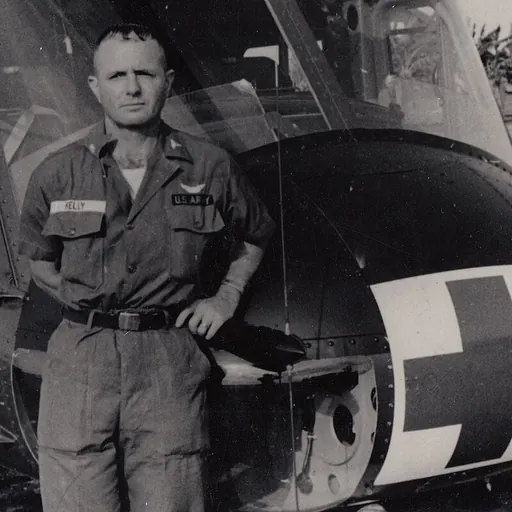
Charles L. Kelly
Recipient of the Purple Heart medal
About Charles L. Kelly
Lived 1925 – 1964 (aged 38–39). Charles L. Kelly was an American and Vietnamese helicopter pilot.
Major Charles Livingston Kelly (10 April 1925 – 1 July 1964) was a United States Army helicopter pilot and medical evacuation unit commander during the Vietnam War. Because of the central role he played in the development of early battlefield evacuation techniques during the war—and the central role his death on the battlefield played in cementing those techniques in Army doctrine at a time they were being questioned by line commanders—he earned the sobriquet "The Father of Dustoff".
Early life Charles Livingston Kelly was born on 10 April 1925 in Wadley, Georgia, the eldest of three sons born to Charlton L. Kelly and Ruth Amelia Moore Kelly. His father died when he was six years old, and his mother never remarried. He was raised in Sylvania, Georgia.
World War II ID Card used by Charles L. Kelly during his enlisted service in World War II Kelly dropped out of high school and lied about his age in order to enlist in the Army at the age of 15. He used a birth date of 22 December 1922 and enlisted under the name "Charles L. Kelley". He reported for active duty at Fort Screven, Georgia, on 25 February 1941 for 1 year of service as an army medic. As enlistment contracts at that time included an "or duration plus six months" clause, Kelly left the service as a corporal on 3 August 1945. He served overseas with the 30th Infantry Division and, although he was listed as a medic as late as May 1944, he was serving as an infantryman when he was wounded by an artillery shell fragment during the battle for Aachen, Germany. Kelly's injury was a severe one, a compound fracture of the fibula which kept him hospitalized for treatment and recovery from the time he was wounded in October 1944 until June 1945. Patrick Henry Brady, who served under Kelly in South Vietnam, said that Kelly's experience as a wounded infantryman was what would later drive him to become a medical evacuation pilot.
Post-war activities After his discharge from the Army, Kelly returned to Sylvania, Georgia. He completed his education at the Sylvania High School, participating in the senior play and graduating in 1947 as the class President. He was also active in the Sylvania Junior Chamber of Commerce, where he served as Secretary-Treasurer, and in the George Alexander Post of the American Legion. It was also during this time that he courted, and married, Jessie Hillis of Sylvania. They had a son, Charles Kelly Jr., and two daughters, Carol and Barbara.
Following his graduation from high school, Kelly enrolled in the Georgia Teachers College in Statesboro, Georgia, graduating with a Bachelor of Science in 1950. He then followed that by obtaining a Master of Arts in geology from the George Peabody College in Nashville, Tennessee. Kelly was severely wounded in the right leg
Temperelli was replaced on 26 February 1963 by Major Lloyd E. Spencer.
Although unit callsigns at the time were rotated periodically to preserve operations security, it was determined that having a fixed callsign for medical evacuation—and a fixed frequency—would be more advantageous for medical evacuation operations, and so the 57th's callsign was not changed as it normally would have been at the end of the period for the Signal Operations Instructions.
One of the earliest arriving Army Medical Department units in theater, the 57th was also the longest serving, leaving theater on 9 March 1973, less than three weeks before the final exit of U.S. troops, for its new home at Fort Bragg, North Carolina, where it would remain until it was inactivated in the mid-2000s. Its service qualified it for 17 of the 18 campaigns of the Vietnam Service Medal, and the detachment was awarded the Presidential Unit Citation, five Meritorious Unit Citations, and the Gallantry Cross with Palm.
Command of the 57th Medical Detachment (Helicopter Ambulance) Kelly logged his first flight hours in Vietnam on 6 January 1964 and assumed command of the 57th Medical Detachment (Helicopter Ambulance) at Tan Son Nhut Air Base on 11 January 1964.
Although the number of Vietnamese casualties rose in 1963, the South Vietnamese military refused to set up its own aeromedical evacuation unit. The VNAF response to requests for medical evacuation depended on aircraft availability, the security of the landing zone, and the mood and temperament of the VNAF pilots. If the South Vietnamese had no on-duty or standby aircraft ready to fly a medical evacuation mission, they passed the request on to the 57th. Even when they accepted the mission themselves, their response usually suffered from a lack of leadership and poor organization. Since South Vietnamese air mission commanders rarely flew with their flights, the persons responsible for deciding whether to abort a mission often lacked the requisite experience. As a MACV summary said: "Usually the decision was made to abort, and the air mission commander could do nothing about it. When an aggressive pilot was in the lead ship, the aircraft came through despite the firing. American advisers reported that on two occasions only the first one or two helicopters landed; the rest hovered out of reach of the wounded who needed to get aboard."
With more and more fighting occurring in the Delta and around Saigon, the 57th could not always honor every evacuation request. U.S. Army helicopter assault companies were forced to keep some of their aircraft on evacuation standby, but without a medical corpsman or medical equipment. Because of the shortage of Army aviators and the priority of armed combat support, the Medical Service Corps did not have enough pilots to staff another Dustoff unit in Vietnam. Most Army aeromedical evacuation units elsewhere already worked with less than their permitted number of pilots. Although Army aviation in Vietnam had grown considerably since 1961, by the summer of 1964 its resources fell short of what it needed to perform its missions, especially medical evacuation.
Kelly was returned to Sylvania on 14 July 1964 and was interred at the Screven County Memorial Cemetery, Sylvania, Georgia on 15 July 1964 following a memorial service at the Sylvania First Baptist Church. The Army provided an honor guard, a military escort, and a chaplain, and "full military honors" were provided at the graveside. Flags in the city were flown at half staff on the 14th and the 15th, draped with a black mourning stripe until after the completion of the funeral. All city offices in Sylvania were closed on the 14th and 15th, although no official proclamation of mourning was issued. As Sylvania's mayor, Ed Overstreet said, "We made no proclamation of mourning. We in Sylvania all knew Major Kelly personally and we want only to enter his funeral personally. We will let the military handle the official part."
Several young war correspondents for major American wire services, news magazines, and newspapers had been prowling the Delta in 1964 looking for stories. One of them, future Pulitzer Prize winning journalist Peter Arnett had made friends with Kelly and his crews in Soc Trang, figuring that Dustoff would make a good story for his employer, the Associated Press. Instead, he ended up writing what became, in essence, Kelly's obituary, which was carried nationally on the day Kelly was buried, many with a photo of Kelly at the controls of his Dustoff aircraft. Another, unnamed author wrote a story for Time magazine which ran nationally on 10 July.
Long-term legacy The official history of the Army Medical Service Corps perhaps sums up Kelly's contributions to army aeromedical evacuation best, when it stated that:
"Kelly became a legend, revered for his aggressive leadership and fearlessness in evacuating casualties. Ironically, his loss ensured that the Army's aeromedical operations would use his mold, one characterized by unarmed single ships operated without escort aircraft by aviators who, like Kelly, were experienced in night flying. In fact, the flying skills of Dustoff crews were such that some general aviation pilots believed there was a special school to teach their flying techniques. Kelly was posthumously awarded the Distinguished Service Cross, and in 1967 General Heaton dedicated the Kelly Heliport at Fort Sam Houston, Texas."
Awards, decorations and honors Distinguished Service Cross
Citation: The President of the United States of America, authorized by Act of Congress, July 9, 1918 (amended by act of July 25, 1963), takes pride in presenting the Distinguished Service Cross (Posthumously) to Major (Medical Corps) Charles L. Kelly (ASN: 0-70399), United States Army, for extraordinary heroism in connection with military operations involving conflict with an armed hostile force in the Republic of Vietnam, while serving as an Aircraft Commander of the 57th Medical Detachment, on 1 July 1964. Major Kelly demonstrated exceptional courage, strong determination, and complete disregard for his own personal safety while participating in an aerial medical mission to evacuate wounded soldiers from an area under heavy attack by hostile forces. With unique professional skill and full knowledge of the intense ground fire and the immediate proximity of the enemy, he landed the unarmed helicopter ambulance close to the wounded men in the exposed area. Although the ground advisor warned him of the grave danger and recommended departure, Major Kelly refused to leave without the wounded soldiers and succeeded in loading them aboard the helicopter moments before he was mortally wounded by hostile gun fire. Major Kelly's extraordinary heroic actions, valiant efforts, and deep concern for his fellow man are in the highest traditions of the United States Army and reflect great credit upon himself and the United States Army Medical Service, and the armed forces of his country.
Silver Star
Citation: The President of the United States of America, authorized by Act of Congress July 9, 1918 (amended by an act of July 25, 1963), takes pride in presenting the Silver Star (Posthumously) to Major (Medical Corps) Charles L. Kelly (ASN: 0-70399), United States Army, for gallantry in action in connection with military operations involving conflict with an armed hostile force in the Republic of Vietnam, while serving as an Aircraft Commander of the 57th Medical Detachment, on 19 June 1964. Major Kelly displayed professional skill, fortitude, and determination while participating in an aerial medical mission to evacuate several critically wounded Vietnamese troops. Although his first attempt to land the helicopter ambulance was prevented by intense enemy action, he returned within the hour and succeeded in maneuvering the aircraft into the area. As the small arms, automatic weapons fire, and mortar rounds fell near the aircraft, he exposed himself to the danger while assisting the wounded men on board the helicopter ambulance. When a round of ammunition hit the main fuel drain valve of the aircraft during the evacuation operations, he quickly assessed the situation and, through his decision that the patients on board be flown out immediately for medical treatment, the helicopter landed at a medical facility with a few minutes of fuel to spare. Through his courageous and unselfish actions the wounded men received timely medical aid and many lives were saved. Major Kelly's conspicuous gallantry is in the highest traditions of the United States Army and reflects great credit upon himself and the military service.
Distinguished Flying Cross
Citation The President of the United States of America, authorized by Act of Congress, July 2, 1926, takes pride in presenting the Distinguished Flying Cross (Posthumously) to Major (Medical Corps) Charles L. Kelly (ASN: 0-70399), United States Army, for heroism while participating in aerial flight. Major Kelly distinguished himself by heroism while participating in aerial flight in action against a hostile force on 2 April 1964 in the Republic of Vietnam. Major Kelly was the aircraft commander of a helicopter ambulance on a combat support mission. He received information that an American helicopter had been hit by ground fire and was forced to land in hostile territory. He immediately flew to the area arriving just as the helicopter touched down. Disregarding his own personal safety, with full knowledge that the enemy forces had begun to attack the crew of the downed aircraft, Major Kelly landed in the middle of the enemy ground forces. Heavy fire was received during the approach and while on the ground, but Major Kelly never wavered in his efforts and determination to save the downed crew from possible death and almost certain capture. Major Kelly's efforts resulted in the downed aircraft being flown to safety. Major Kelly's actions were in keeping with the highest traditions of the military service and reflect great credit upon himself and the United States Army.
Distinguished Flying Cross (First Oak Leaf Cluster)
Citation The President of the United States of America, authorized by Act of Congress, July 2, 1926, takes pride in presenting a Bronze Oak Leaf Cluster in lieu of a Second Award of the Distinguished Flying Cross (Posthumously) to Major (Medical Corps) Charles L. Kelly (ASN: 0-70399), United States Army, for heroism while participating in aerial flight in action against a hostile force on 9 April 1964 in the Republic of Vietnam. Major Kelly was the aircraft commander of a helicopter ambulance on a combat support mission. Upon receiving information of a crashed Republic of Vietnam Air Force T-28, Major Kelly immediately flew to the crash site and began a low aerial search for the downed aircraft. At this time a United States Army helicopter in the immediate area declared an emergency and was forced down into an area surrounded by Viet Cong forces. Disregarding his own personal safety, Major Kelly was determined to save the crew of the downed aircraft. Upon making his approach, Major Kelly received heavy fire from all sides, with one round passing through the cock-pit. Despite the dangers involved, Major Kelly continued into the area and landed near the downed aircraft. Upon landing, he and his aircraft crew became engaged in a heavy fire fight with the enemy forces in the vicinity. It became necessary to destroy the downed helicopter to prevent its utilization by the enemy. The rescued crew was then flown out of the area under heavy fire to safety. Due to Major Kelly's efforts, members of the aircraft crew were saved from possible death or capture. Major Kelly's actions were in keeping with the highest traditions of the military service and reflect great credit upon himself and the United States Army.
Distinguished Flying Cross (Second Oak Leaf Cluster)
Citation The President of the United States of America, authorized by Act of Congress, July 2, 1926, takes pleasure in presenting a Second Bronze Oak Leaf Cluster in lieu of a Third Award of the Distinguished Flying Cross to Major (Medical Corps) Charles L. Kelly (ASN: 0-70399), United States Army, for heroism while participating in aerial flight. Major Kelly distinguished himself by heroic action on 11 April 1964, in the Republic of Vietnam. On this date, Major Kelly was serving as the pilot of a UH-1B medical helicopter involved in the evacuation of two wounded Vietnamese soldiers who were located on Co To Mountain in An Giang Province. When he arrived at the combat area, he was informed that the only place to land was on the mountain in an area approximately 25 meters by 25 meters, surrounded by trees, and overlooked by terrain known to be infested by communist Viet Cong. Darkness was falling, the weather was misting, and gusting winds prevailed. Despite these extreme hazards, and in total disregard of his own personal safety, Major Kelly brought his aircraft into the landing zone through intense hostile fire. The incline of the mountain prevented a solid landing and Major Kelly had to "hold the stick" of his aircraft to prevent its falling off the mountain. Since one of the wounded soldiers had not been carried up the mountain, Major Kelly with remarkable skill and dogged determination held his aircraft on the mountain side for twenty minutes, refusing to leave until the wounded man was aboard. This was done in spite of the fact that total darkness would soon be upon him and would make take-off from the tiny landing zone even more dangerous. His only thoughts were for the welfare of the wounded men whom he knew would surely die without prompt medical attention. With the wounded finally aboard he skillfully took off, again running a gauntlet of automatic weapons fire. The two soldiers, one of whom had been wounded five times, were saved by the prompt medical attention they received. Major Kelly's dauntless courage, professional skill, and devotion to his comrades in arms have added to the highest traditions of the United States Army and reflect great credit upon himself and the military service.
Commendations and awards Kelly was awarded the following:
Badge
Badge
Badge
1st Row
2nd Row
Badge
Unitawards
The stadium at the Screven County High School in Sylvania, Georgia was named after Kelly in 1965, and rededicated to him on 1 July 2014, the 50th anniversary of his death. Fort Sam Houston's Kelly Army Heliport (now the Kelly Army Reserve Center) was dedicated in Kelly's honor on 7 April 1967 Charles Kelly Boulevard on Fitzsimmons Army Medical Center was named in Kelly's honor in June 1991. The Medical Center closed in 1996, and the remaining section of Kelly Boulevard is now named E. 17th Place; the remainder is a pedestrian walkway. A bronze marker still remains. Fort Rucker's Kelly Hall is named in his honor. Kelly was inducted into the Army Aviation Association of America's Hall of Fame in 1975. Kelly was the first inductee into the Dustoff Association Hall of Fame, on 17 February 2001. The Dustoff Association annually presents awards to the Aviator, Crew Chief, and Medic of the Year at the organization's annual Reunion Awards Banquet. The award is a bust of Kelly.
Documentary film tribute In 2002, the documentary film crew of In the Shadow of the Blade honored Kelly's story at their landing zone near Columbus, Georgia. After hearing the story of his father's courage from Vietnam Dustoff colleague Ernest Sylvester, Charles Kelly Jr. flew in the left seat of the documentary's restored UH-1 Iroquois, emulating his father's wartime experience.
Don’t just read it —
keep it.
Full-length biographies made to live with: read them, listen on the way to work, watch them tonight.
- E-book
- Audio
- Video
Instant download · yours to keep · every purchase keeps this site free
Important facts
People in Charles L. Kelly's life
Named in this biography and alive at the same time




Related people
Same field, nearest in time

Contemporaries
People whose lives overlapped Charles L. Kelly's



Frequently asked questions
Who was Charles L. Kelly?
Recipient of the Purple Heart medal
When was Charles L. Kelly born?
Charles L. Kelly was born on 10 April 1925.
When did Charles L. Kelly die?
Charles L. Kelly died in 1964.
What was Charles L. Kelly's occupation?
Charles L. Kelly was a helicopter pilot.
What nationality was Charles L. Kelly?
Charles L. Kelly was American and Vietnamese.
Sources & further reading
Cite this page
APA: Biography.guide. (2026). Charles L. Kelly. https://biography.guide/charles-l-kelly/
MLA: "Charles L. Kelly." Biography.guide, https://biography.guide/charles-l-kelly/.
Chicago: "Charles L. Kelly." Biography.guide. https://biography.guide/charles-l-kelly/.
Data last updated: 2026-09-21 · Spot an error? Report a correction.
Portrait: Wikimedia Commons · author & licence
Page generated 2026-09-27 04:59 UTC