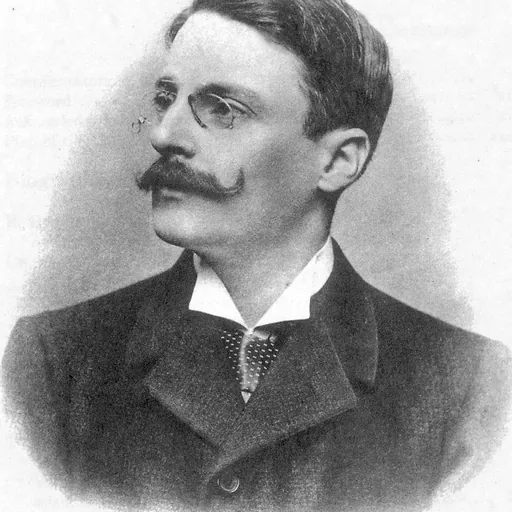
About Charles-Jean de la Vallée Poussin
Lived 1866 – 1962 (aged 95). Charles-Jean de la Vallée Poussin was a Belgian mathematician and university teacher.
Charles-Jean Étienne Gustave Nicolas, baron de La Vallée Poussin (; 14 August 18662 March 1962) was a Belgian mathematician. He is best known for proving the prime number theorem.
The King of Belgium ennobled him with the title of baron.
Biography De La Vallée Poussin was born in Leuven, Belgium. He studied mathematics at the Catholic University of Leuven under his uncle Louis-Philippe Gilbert, after he had earned his bachelor's degree in engineering. De La Vallée Poussin was encouraged to study for a doctorate in physics and mathematics, and in 1891, at the age of just 25, he became an assistant professor in mathematical analysis.
De La Vallée Poussin became a professor at the same university (as was his father, Charles Louis de la Vallée Poussin, who taught mineralogy and geology) in 1892. De La Vallée Poussin was awarded with Gilbert's chair when Gilbert died. While he was a professor there, de La Vallée Poussin carried out research in mathematical analysis and the theory of numbers, and in 1905 was awarded the Decennial Prize for Pure Mathematics 1894–1903. He was awarded this prize a second time in 1924 for his work during 1914–23.
In 1898, de La Vallée Poussin was appointed as the correspondent to the Royal Belgian Academy of Sciences, and he became a Member of the academy in 1908. In 1923, he became the President of the Division of Sciences.
In August 1914, de La Vallée Poussin escaped from Leuven at the time of its destruction by the invading German Army of World War I, and he was invited to teach at Harvard University in the United States. He accepted this invitation. In 1918, de La Vallée Poussin returned to Europe to accept professorships in Paris at the Collège de France and at the Sorbonne.
After the war was over, de La Vallée Poussin returned to Belgium, The International Union of Mathematicians was created, and he was invited to become its president. Between 1918 and 1925, de La Vallée Poussin traveled extensively, lecturing in Geneva, Strasbourg, and Madrid. and then in the United States where he gave lectures at the Universities of Chicago, California, Pennsylvania, and Brown University, Yale University, Princeton University, Columbia University, and the Rice Institute of Houston.
He was awarded the Prix Poncelet for 1916. De La Vallée Poussin was given the titles of Doctor Honoris Causa of the Universities of Paris, Toronto, Strasbourg, and Oslo, an Associate of the Institute of France, and a Member of the Pontifical Academy of Sciences, Nazionale dei Lincei, Madrid, Naples, Boston. He was awarded the title of Baron by King Albert I of the Belgians in 1928.
In 1961, de La Vallée Poussin fractured his shoulder, and this accident and its complications led to his death in Watermael-Boitsfort, near Brussels, Belgium, a few months later.
A student of his, Georges Lemaître, was the first to propose the Big Bang theory of the formation of the Universe.
Work Although his first mathematical interests were in analysis, he became suddenly famous as he proved the prime number theorem independently of his contemporary, Jacques Hadamard, in 1896.
Afterwards, he found interest in approximation theory. He defined, for any continuous function f on the standard interval , the sums ,
where
and
are the vectors of the dual basis with respect to the basis of Chebyshev polynomials (defined as
Note that the formula is also valid with being the Fourier sum of a -periodic function such that
Finally, the de La Vallée Poussin sums can be evaluated in terms of the so-called Fejér sums (say )
The kernel is bounded and obeys the property , if
Later, he worked on potential theory and complex analysis.
He also published a counterexample to Alfred Kempe's false proof of the four color theorem. The Poussin graph, the graph he used for this counterexample, is named after him.
Cours d’analyse The textbooks of his mathematical analysis course have been a reference for a long time and had some international influence.
The second edition (1909–1912) is remarkable for its introduction of the Lebesgue integral. It was in 1912, "the only textbook on analysis containing both Lebesgue integral and its application to Fourier series, and a general theory of approximation of functions by polynomials". Online: Cours d'analyse infinitésimale, Tome I Cours d'analyse infinitésimale, Tome II Intégrales de Lebesgue, fonctions d´ensemble, classes de Baire, 2nd edition 1934, Reprint by Jacques Gabay, Le potentiel logarithmique, balayage et représentation conforme, Paris, Löwen 1949 Recherches analytiques de la théorie des nombres premiers, Annales de la Societe Scientifique de Bruxelles vol. 20 B, 1896, pp. 183–256, 281–362, 363–397, vol. 21 B, pp. 351–368 (prime number theorem) Sur la fonction Zeta de Riemann et le nombre des nombres premiers inferieurs a une limite donnée, Mémoires couronnés de l Academie de Belgique, vol.59, 1899, pp. 1–74 Leçons sur l'approximation des fonctions d'une variable réelle Paris, Gauthier-Villars, 1919, 1952
Don’t just read it —
keep it.
Full-length biographies made to live with: read them, listen on the way to work, watch them tonight.
- E-book
- Audio
- Video
Instant download · yours to keep · every purchase keeps this site free
Important facts
People in Charles-Jean de la Vallée Poussin's life
Named in this biography and alive at the same time



Related people
Same field, nearest in time


Contemporaries
People whose lives overlapped Charles-Jean de la Vallée Poussin's



Frequently asked questions
Who was Charles-Jean de la Vallée Poussin?
Belgian mathematician (1866–1962)
When was Charles-Jean de la Vallée Poussin born?
Charles-Jean de la Vallée Poussin was born on 14 August 1866 in Leuven.
When did Charles-Jean de la Vallée Poussin die?
Charles-Jean de la Vallée Poussin died on 2 March 1962 in Leuven, Molenbeek.
What was Charles-Jean de la Vallée Poussin's occupation?
Charles-Jean de la Vallée Poussin was a mathematician and university teacher.
What nationality was Charles-Jean de la Vallée Poussin?
Charles-Jean de la Vallée Poussin was Belgian.
Sources & further reading
· Wikipedia: Charles-Jean de la Vallée Poussin
· DBpedia: Charles-Jean de La Vallée Poussin
Cite this page
APA: Biography.guide. (2026). Charles-Jean de la Vallée Poussin. https://biography.guide/charles-jean-de-la-vallee-poussin/
MLA: "Charles-Jean de la Vallée Poussin." Biography.guide, https://biography.guide/charles-jean-de-la-vallee-poussin/.
Chicago: "Charles-Jean de la Vallée Poussin." Biography.guide. https://biography.guide/charles-jean-de-la-vallee-poussin/.
Data last updated: 2026-09-23 · Spot an error? Report a correction.
Portrait: Wikimedia Commons · author & licence
Page generated 2026-09-27 05:08 UTC