
About Charles Husband
Lived 1908 – 1983 (aged 74). Charles Husband was a British architect, civil engineer and engineer.
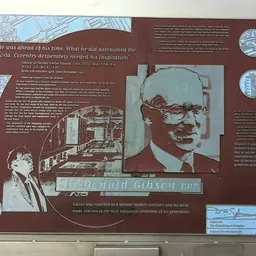
Sir Henry Charles Husband (30 October 1908 – 7 October 1983), often known as H. C. Husband, was a leading British civil and consulting engineer from Sheffield, England, who designed bridges and other major civil engineering works. He is particularly known for his work on the Jodrell Bank radio telescopes; the first of these was the largest fully steerable radio telescope in the world on its completion in 1957. Other projects he was involved in designing include the Goonhilly Satellite Earth Station's aerials, one of the earliest telecobalt radiotherapy units, Sri Lanka's tallest building, and the rebuilding of Robert Stephenson's Britannia Bridge after a fire. He won the Royal Society's Royal Medal and the Wilhelm Exner Medal.
Early life and education
Husband was born in Sheffield in 1908 to Ellen Walton Husband, née Harby, and her husband, Joseph (1871–1961), a civil engineer who had founded Sheffield Technical School's civil engineering department and subsequently served as the University of Sheffield's initial professor in the discipline.
Career His first job was with Barnsley Corporation Waterworks. After attempting to adapt military radar equipment to detect cosmic rays shortly after the Second World War, Lovell had realised that a much larger aerial would be required, and constructed a 66-metre diameter dish, limited by being static, before proposing the development of an even larger steerable telescope. The idea posed such formidable engineering challenges that the project had been declared "impossible" by other engineers, but Husband is reported to have concluded at their first meeting in September 1949, "It should be easy—about the same problem as throwing a swing bridge over the Thames at Westminster."
He began work on the project early the following year, creating the initial drawings in January 1950 and detailed plans just over a year later. He and Lovell selected a dish diameter of 250 feet (76 metres). Construction began in 1952; despite Husband's optimism the project was beset with delays and escalating costs, caused by multiple changes to Lovell's specifications and the rising price of steel, among other factors. Wind-tunnel studies with a scale model played an important role in the final design. It remains in service as of 2026. According to Lovell, the project was completed using "a desk calculator and slide rule", which led to a "sturdy" construction with "quite a lot of redundancy in the steelwork" which Lovell later credited for the telescope's longevity. and was voted Britain's top "unsung landmark" in a 2006 BBC poll.
Husband also helped to design the steerable radio aerials at the GPO's Goonhilly Satellite Earth Station in Cornwall, as well as radio telescopes in the UK and elsewhere.
He designed many road and rail bridges.
Outside the UK, Husband & Co. had an office in Colombo and undertook multiple projects in Sri Lanka.
Awards, honours and societies Husband was recognised with the CBE in 1964. he was the medal's first recipient in the applied sciences. the Gold Medal of the Institution of Structural Engineers (1973), and the Benjamin Baker Gold Medal (1959) and James Watt medal (1976) of the Institution of Civil Engineers. chaired the Association of Consulting Engineers (1967) and served on the board of the Council of Engineering Institutions from 1979 until his death. Husband died in 1983 at Nether Padley, just outside Sheffield in Derbyshire.
Selected publications H. C. Husband, R. W. Husband (1975). Reconstruction of the Britannia Bridge. Proceedings of the Institution of Civil Engineers 58: 25–49 Henry Charles Husband (1958). The Jodrell Bank Radio Telescope. Proceedings of the Institution of Civil Engineers 9: 65–86
Don’t just read it —
keep it.
Full-length biographies made to live with: read them, listen on the way to work, watch them tonight.
- E-book
- Audio
- Video
Instant download · yours to keep · every purchase keeps this site free
Important facts
People in Charles Husband's life
Named in this biography and alive at the same time



Related people
Same field, nearest in time
Contemporaries
People whose lives overlapped Charles Husband's



Frequently asked questions
Who was Charles Husband?
British engineer (1908-1983)
When was Charles Husband born?
Charles Husband was born on 30 October 1908 in Sheffield.
When did Charles Husband die?
Charles Husband died on 7 October 1983.
What was Charles Husband's occupation?
Charles Husband was an architect, civil engineer and engineer.
What nationality was Charles Husband?
Charles Husband was British.
Sources & further reading
Cite this page
APA: Biography.guide. (2026). Charles Husband. https://biography.guide/charles-husband/
MLA: "Charles Husband." Biography.guide, https://biography.guide/charles-husband/.
Chicago: "Charles Husband." Biography.guide. https://biography.guide/charles-husband/.
Data last updated: 2026-09-20 · Spot an error? Report a correction.
Page generated 2026-09-27 05:19 UTC