
About Charles Fussell
Born 1938. Charles Fussell is an American composer and music educator.
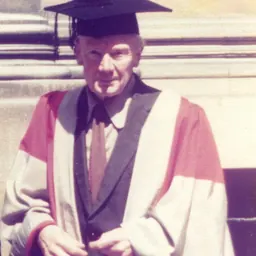
Charles Clement Fussell (born February 14, 1938, in Winston-Salem, North Carolina) is an American composer and conductor of contemporary classical music. He has composed six symphonies and three operas. His symphony Wilde for solo baritone and orchestra, based on the life of Oscar Wilde and premiered by the Newton Symphony Orchestra and the baritone Sanford Sylvan in 1990, was a finalist for the 1991 Pulitzer Prize for Music. He received a citation and award from the American Academy of Arts and Letters in 1992.
Fussell received advanced degrees in composition and conducting from the Eastman School of Music, where he studied with Thomas Canning and Bernard Rogers. He received a Fulbright grant to study at the Berlin Hochschule für Musik, where he worked with Boris Blacher. He also attended the Bayreuth masterclasses of Friedelind Wagner. He was an assistant and close friend of the composer Virgil Thomson. He served as the president of the Thomson Foundation for many years.
Fussell has served on the faculty of the University of Massachusetts at Amherst, the North Carolina School of the Arts (1976–1977), Boston University (1983–2003), and Rutgers University.
Catalogue of works Late 1950s
Essay for Orchestra Variations for Orchestra Six Dances for Orchestra
1962
Caligula, opera based on a play by Albert Camus Trio, for violin, cello, and piano
1963
Dance Suite, for flute, trumpet, viola, and two percussionists Symphony in One Movement [No. I], for large orchestra
1964
Sweelinck Liedvariationen Mein Junges Leben, for solo string trio, marimba, mandolin, harp, and small orchestra Saint Stephen and Herod, drama for speaker, chorus, and winds
1965
Poems for Chamber Orchestra and Voices after Hart Crane, text by Hart Crane Three Choral Pieces (rev. 1975), for chorus and piano I. Fancy's Knell (SA and piano) II. Three Epitaphs (TB and piano) III. I Saw a Peacock (mixed chorus and piano)
1967
Symphony No. II, for soprano and large orchestra
1968
Two Ballades (rev. 1976), for cello and piano The Blessed Virgin's Expostulation, realization after Henry Purcell for soprano and ten instruments
1970
Voyages, for soprano and tenor soloists, female chorus, piano, and solo wind instrument plus recorded speaker. Text by Hart Crane.
1971
Julian, drama in five scenes after the tale of Gustave Flaubert
1973
Three Processionals for Orchestra
1975
Eurydice, for soprano, flute, clarinet, violin, cello, and piano, with obligato trumpet, horn, trombone, and bass-drum
1976
Résumé, cycle of nine songs for soprano, clarinet, string bass, and piano. Text by Dorothy Parker. Greenwood Sketches, Music for String Quartet A Prophecy, for chorus and piano. Text by Allen Ginsberg.
1977
Etudes and Portraits, for solo organ
1979
Northern Lights, two portraits for chamber orchestra I. Leós Janacek, for two flutes, four solo violins, timpani, and strings II. Edvard Munch, for two flutes, string quartet, timpani, and string orchestra A Joyful Fugue, transcription for band of an orchestral score by Virgil Thomson
1981
Landscapes, Symphony No. III, for chorus and large orchestra I. A Prophecy (Allen Ginsberg) II. A Night Battle (Walt Whitman) III. Moment Fugue 1929 (Hart Crane) IV. Landscape (Alberta Phillips) Four Fairy Tales After Oscar Wilde, for orchestra I. The Young King II. The Nightingale and the Rose III. The Happy Prince A. Prelude B. Romance of the Sparrow and Reed C. Coda IV. The Remarkable Rocket
1982
Overture to Paul Bunyan, transcription for band of an orchestral score by Benjamin Britten
1983
Song of Return, for SATB chorus with piano. Text by W. H. Auden.
1985
Cymbeline, drama after Shakespeare for soprano and tenor soli, narrator, plus chamber ensemble (11 players)
1986
The Gift, for SATB chorus with soprano solo. Text by William Carlos Williams. Three Portraits for Chamber Orchestra I. Virgil Thomson (1981) Version for solo piano composed in 2015 II. Maurice Grosser (1983) III. Jack Larson (1986)
1988
Free-fall, for chamber ensemble (seven players)
1989
A Song of Return, cantata for small chorus and orchestra. Text by W. H. Auden. The Gift, for chorus, soprano solo, and orchestra
1990
Wilde [Symphony No. IV], for baritone and orchestra. Runner-up for the 1991 Pulitzer Prize for Music.
1991
Goethe Lieder, cycle of five songs with an epilogue 1. Soprano or tenor and piano 2. Version for seven players 3. Version for orchestra Last Trombones, for five percussionists, two pianos, and six (or twelve) trombones
1992
Specimen Days, cantata for baritone solo, chorus, and orchestra. Text by Will Graham, based on the life and writings of Walt Whitman.
1993
Being Music, for baritone solo and string quartet. Text by Walt Whitman. Song and Dance, for violin and piano Invocation, for chorus (SA and accompaniment or SATB). Text by May Sarton.
1994
Sonata-Duo, for flute and piano
1995
Symphony No. V, for orchestra Night Song, for solo piano
1996
Comrade and The Journey, two songs for baritone and piano
1997
The Astronaut's Tale, chamber opera. Text by Jack Larson. Mists, three pieces for a cappella chorus. Texts by Hart Crane.
1998
November Leaves, four songs for mezzo-soprano and orchestra. Texts by Alfred Corn. Sonnet, for baritone solo, flute, and organ. Text by Elizabeth Bishop. Trio, for violin, cello, and piano
1999
From A Pioneer Songbook, for a cappella chorus 2000
A Walt Whitman Sampler, for TTBB chorus and piano. Text by Will Graham. Venture, four songs for baritone and piano on poems by Toni Mergentime Levi Version for baritone and orchestra was composed in 2016 2002
Right River, Variations on an Original Theme for 'cello and string orchestra
2003
Infinite Fraternity, for SATB chorus, baritone solo, flute, and viola. Texts by Nathaniel Hawthorne, Herman Melville, and Will Graham. High Bridge (rev. 2008), A Choral Symphony [No. VI] after poems of Hart Crane, for soprano, alto, tenor, baritone solos, chorus and orchestra 2008
Moonshine, for double bass and vibraphone
2011
Marion in Memory, for flute, clarinet, horn, violin, cello, piano, and marimba
2018
K.G. in Space and Time, for flute, clarinet, horn, marimba (and vibraphone), piano (and celesta), violin, and cello
Don’t just read it —
keep it.
Full-length biographies made to live with: read them, listen on the way to work, watch them tonight.
- E-book
- Audio
- Video
Instant download · yours to keep · every purchase keeps this site free
Important facts
People in Charles Fussell's life
Named in this biography and alive at the same time



Related people
Same field, nearest in time


Contemporaries
People whose lives overlapped Charles Fussell's




Frequently asked questions
Who is Charles Fussell?
American composer
When was Charles Fussell born?
Charles Fussell was born on 14 February 1938 in Winston-Salem.
What is Charles Fussell's occupation?
Charles Fussell is a composer and music educator.
What nationality is Charles Fussell?
Charles Fussell is American.
Sources & further reading
Cite this page
APA: Biography.guide. (2026). Charles Fussell. https://biography.guide/charles-fussell/
MLA: "Charles Fussell." Biography.guide, https://biography.guide/charles-fussell/.
Chicago: "Charles Fussell." Biography.guide. https://biography.guide/charles-fussell/.
Data last updated: 2026-09-20 · Spot an error? Report a correction.
Page generated 2026-09-27 05:23 UTC