
About Charles Fergus Binns
Lived 1857 – 1935 (aged 78). Charles Fergus Binns was a British and American ceramicist.
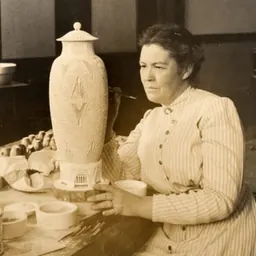
Charles Fergus Binns working on the potter's wheel. From The Potter's Craft Charles Fergus Binns (4 October 1857 in Worcester – 4 December 1934 in Alfred, New York) was an English-born studio potter. Binns was the first director of the New York State School of Clayworking and Ceramics at Alfred University, holding that position from 1900 until 1931.
His work included authorship of several books on the history and practice of pottery. Some of his more notable students included Arthur Eugene Baggs,
Biography Early life Charles Fergus Binns was born on 4 October 1857, in Worcester, England, the seventh of ten children. His father, Richard William Binns was art director and co-managing director of the Royal Worcester Porcelain Works.
Binns attended the Worcester Cathedral King's School from 1869 to 1872. At the age of 14, he was apprenticed at the Royal Worcester Porcelain Works, where he was exposed to every aspect of the pottery business. His education continued while he worked at the pottery and he studied art at the Worcester School of Design, and studied chemistry in nearby Birmingham. Binns worked for Royal Worcester for the next 25 years eventually becoming the head of the sales office, first in Worcester and beginning in 1884, in London. He became known as a popular lecturer on the subject of ceramics and began writing on the topic.
In 1893 he travelled to the United States, accompanying the Royal Worcester exhibit at the World's Columbian Exhibition in Chicago, Illinois. After returning to England he became technical director for the pottery, holding that position for four more years. Binns resigned his position at Royal Worcester in 1897 when his father retired. Binns threw each piece in three forms on a wheel, turning them on a lathe and piecing them together afterwards. One of the concepts Binns taught was 'dead ground', in which aspects of making that could not be precisely controlled, such as firing temperature or glaze calculations, were mitigated by control over glaze placement - e.g., glaze was to run to a certain point but not to encroach on the foot.
Binns wrote of the artistic limitations of china-painting, which many amateur artists, mainly women, practiced at the time. He argued that “no-one with a spark of artistic fire can be content to copy the design of another or to merely add the finishing touches to work begun in a factory”, and that this feeling has caused china-painting to give place to pottery-making, in which, from “the consciousness of honest effort”, the artist experiences liberation. His book The Potter's Craft (1910) may have given rise to the first use of the phrase “studio pottery”. In it Binns referred to "studio work" and the "artist potter", and a review of it in Adelaide Alsop Robineau's magazine Keramic Studio referred to “studio pottery”.
As a critic and influential educator in the ceramic field, his praise of utilitarian wares with artistic quality led the Arts and Crafts movement in American studio pottery.
Binns had had a significant effect on the development of the studio ceramics movement in the United States, and is thus known as the father of American studio ceramics. Los Angeles County Museum of Art, CA Metropolitan Museum of Art, New York, NY Museum of Contemporary Craft, Portland, OR Museum of Fine Arts, Boston, MA National Museum of American History, Smithsonian Institution, Washington, DC
Don’t just read it —
keep it.
Full-length biographies made to live with: read them, listen on the way to work, watch them tonight.
- E-book
- Audio
- Video
Instant download · yours to keep · every purchase keeps this site free
Important facts
People in Charles Fergus Binns's life
Named in this biography and alive at the same time

Related people
Same field, nearest in time



Contemporaries
People whose lives overlapped Charles Fergus Binns's



Frequently asked questions
Who was Charles Fergus Binns?
American studio potter (1857–1935)
When was Charles Fergus Binns born?
Charles Fergus Binns was born on 4 October 1857 in Worcester.
When did Charles Fergus Binns die?
Charles Fergus Binns died on 4 December 1935.
What was Charles Fergus Binns's occupation?
Charles Fergus Binns was a ceramicist.
What nationality was Charles Fergus Binns?
Charles Fergus Binns was British and American.
Sources & further reading
· Wikipedia: Charles Fergus Binns
· DBpedia: Charles Fergus Binns
Cite this page
APA: Biography.guide. (2026). Charles Fergus Binns. https://biography.guide/charles-fergus-binns/
MLA: "Charles Fergus Binns." Biography.guide, https://biography.guide/charles-fergus-binns/.
Chicago: "Charles Fergus Binns." Biography.guide. https://biography.guide/charles-fergus-binns/.
Data last updated: 2026-09-20 · Spot an error? Report a correction.
Page generated 2026-09-27 05:24 UTC