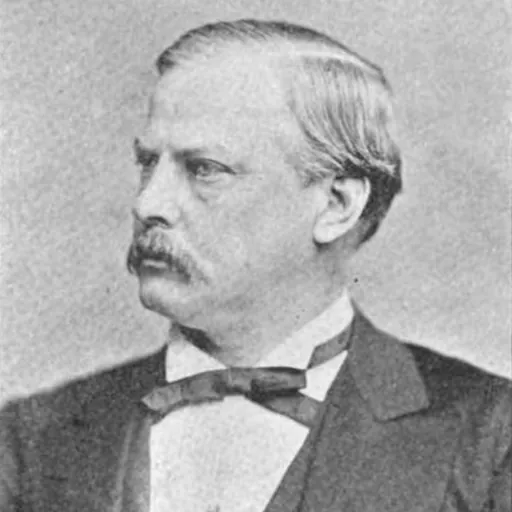
About Charles Erasmus Fenner
Lived 1834 – 1911 (aged 76–77). Charles Erasmus Fenner was a soldier.
Charles Erasmus Fenner (February 14, 1834 – October 24, 1911) was a Louisiana lawyer who captained a battery in the American Civil War, and later served as a justice of the Louisiana Supreme Court from April 5, 1880, to September 1, 1893. During his service on the court, he hosted a dying Jefferson Davis in his home, and wrote the infamous decision in Plessy v. Ferguson holding that "separate but equal" accommodations could be provided for whites and non-whites, which was upheld by the United States Supreme Court.
Early life, education, and military service Born in Jackson, Tennessee, Fenner was the only child of Dr. Erasmus Darwin Fenner, who moved to New Orleans in the early 1840s after the death of his wife in 1841, and soon became an editor of The New Orleans Medical and Surgical Journal. Fenner received instruction from his father, who hoped that Fenner would follow him into the medical profession. He studied at the University of Virginia for two years. He graduated from the Law Department of the University of Louisiana in 1855, and immediately entered into private practice, until the outbreak of the American Civil War. He initially enlisted as a first lieutenant, assisting in forming the military battalion of the Louisiana Guards, and later becoming captain of one of the companies. but Fenner was forced to resign from this position when it was discovered that a statute barred him from holding the office while also serving as a member of the Tulane Board of Administration. Fenner's father-in-law, J. M. Payne, was an old friend of Davis, who remained bedridden but stable in Fenner's home for two weeks, but took a turn for the worse in early December. According to Fenner, just when Davis again appeared to be improving, he lost consciousness on the evening of December 5 and died at 12:45 a.m. on Friday, December 6, 1889, holding the hand of his wife, Varina, and in the presence of several friends.
In 1892, Fenner wrote the decision of the Supreme Court of Louisiana in the state's portion of the case of Plessy v. Ferguson, holding that "separate but equal" accommodations could be provided for whites and non-whites. In speaking for the court's decision that Ferguson's judgment did not violate the Fourteenth Amendment to the United States Constitution, Fenner cited a number of precedents, including two key cases from Northern states. The Massachusetts Supreme Court had ruled in 1849—before the 14th amendment—that segregated schools were constitutional. In answering the charge that segregation perpetuated racial prejudice, the Massachusetts court famously stated: "This prejudice, if it exists, is not created by law, and probably cannot be changed by law." At the expiration of his second term in 1894, he returned to private practice. with whom he had three sons and one daughter. His oldest son, Charles P. Fenner, became a professor of law at Tulane Law School. His second son, Erasmus D. Fenner, became a professor of orthopedic surgery at Tulane Medical School.
Fenner died in New Orleans at the age of 78, following a bout of pneumonia.
Don’t just read it —
keep it.
Full-length biographies made to live with: read them, listen on the way to work, watch them tonight.
- E-book
- Audio
- Video
Instant download · yours to keep · every purchase keeps this site free
Important facts
People in Charles Erasmus Fenner's life
Named in this biography and alive at the same time

Related people
Same field, nearest in time


Contemporaries
People whose lives overlapped Charles Erasmus Fenner's




Frequently asked questions
Who was Charles Erasmus Fenner?
1834-1911 , soldier, jurist, and education leader
When was Charles Erasmus Fenner born?
Charles Erasmus Fenner was born in 1834.
When did Charles Erasmus Fenner die?
Charles Erasmus Fenner died in 1911.
What was Charles Erasmus Fenner's occupation?
Charles Erasmus Fenner was a soldier.
Sources & further reading
· Wikipedia: Charles Erasmus Fenner
· DBpedia: Charles Erasmus Fenner
Cite this page
APA: Biography.guide. (2026). Charles Erasmus Fenner. https://biography.guide/charles-erasmus-fenner/
MLA: "Charles Erasmus Fenner." Biography.guide, https://biography.guide/charles-erasmus-fenner/.
Chicago: "Charles Erasmus Fenner." Biography.guide. https://biography.guide/charles-erasmus-fenner/.
Data last updated: 2026-09-21 · Spot an error? Report a correction.
Portrait: Wikimedia Commons · author & licence
Page generated 2026-09-27 04:59 UTC