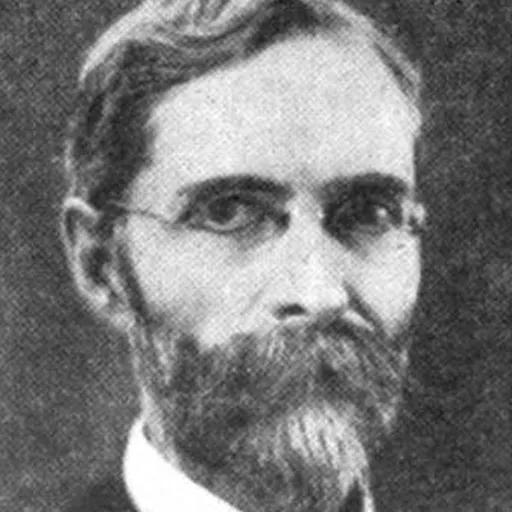
About Charles E. Saunders
Lived 1867 – 1937 (aged 70). Charles E. Saunders was a Canadian biologist, known for Wheat.
Sir Charles Edward Saunders, (February 2, 1867 – July 25, 1937) was a Canadian agronomist. He was the inventor of the 'Marquis' wheat cultivar. Saunders Secondary School in London, Ontario is named for him and other members of his prominent family, including his father, agriculturist William Saunders and naturalist brother William Edwin Saunders.
Early life and education Saunders was born in London, Canada West, on February 2, 1867, and his brother, Percy, had done considerable work in cross-breeding strains of wheat.
Saunders turned enthusiastically to his new tasks. Following up his brother's research, he completed development of 'Marquis' wheat in 1904, a cultivar which showed marked superiority in milling quality for bread flour over other varieties popular in western Canada. 'Marquis' had the advantage of maturing 10 days earlier than its competitors - a factor of great importance in the Canadian wheat belt. The Indian Head Experimental Farm in Saskatchewan raised 'Marquis' wheat for seed, and by 1909 its use was widespread. By 1920, 90% of the wheat grown in western Canada was 'Marquis'. However, 'Marquis' was not resistant to stem rust. In seeking newer and better varieties Saunders developed three other strains of wheat - 'Ruby', 'Garnet', and 'Reward' - specifically adapted to prairie conditions. He was also responsible for improved varieties of oats and barley.
In the search for a hardy wheat that would mature faster, he made hundreds of crosses, proceeding to test the yields. Tests included one called "chewing", whereby Saunders identified strains with strong gluten by chewing a few sample kernels. "I made more wheat into gum than was made by all the boys in any dozen rural schools of a generation ago."
Using a technique he devised himself, Saunders ground his own flour and baked his own bread in small loaves to measure volume.
Working with 'Red Fife', which had been imported and developed by David Fife from Ontario, Saunders crossed it with 'Hard Red Calcutta'. The new cultivar 'Markham' showed great promise, but its offspring were not uniform. After many trials at the Agassiz experimental farm, a winner emerged - 'Marquis'.
In 1906, surplus 'Marquis' seed was shipped to Indian Head, Saskatchewan, for additional testing.
In 1911, 'Marquis' won the Canadian Pacific Railway Prize of $1,000.00 for the best bushel of hard spring wheat grown in North America. This was the first of many prizes.
The only drawback of 'Marquis' was its susceptibility to rust. Not until 1947 was a rust-resistant variety developed at the Central Experimental Farm in Ottawa. It was named 'Saunders'.
1920–1922 By 1920, 90% of the wheat crop in western Canada was 'Marquis'.
Saunders also applied his methods to barley, oats, peas, beans, and flax, introducing several new cultivars of each.
He wrote extensively on the subject and many of his thoughts on cereals were presented to scientific conferences and societies and printed in scientific magazines.
Retirement In 1922, after suffering a physical breakdown, Saunders resigned his position and moved to Paris with his wife.
From 1922 to 1925, he studied French literature at the Sorbonne. In the latter year, he returned to Ottawa briefly, but in 1928 he moved to Toronto. Though retired, he continued to lecture on 'Marquis' wheat and the French language.
In 1928, Essais et vers, a collection of Saunders' French essays and poems, was published by Louis Carrier and Cie, Les Editions du Mercure, in Montreal and New York. The work received critical acclaim in the French press, especially in Quebec.
Death Saunders died in Toronto on July 25, 1937.
Don’t just read it —
keep it.
Full-length biographies made to live with: read them, listen on the way to work, watch them tonight.
- E-book
- Audio
- Video
Instant download · yours to keep · every purchase keeps this site free
Important facts
People in Charles E. Saunders's life
Named in this biography and alive at the same time

Related people
Same field, nearest in time



Contemporaries
People whose lives overlapped Charles E. Saunders's




Frequently asked questions
Who was Charles E. Saunders?
Canadian biologist (1867–1937)
When was Charles E. Saunders born?
Charles E. Saunders was born on 2 February 1867 in London.
When did Charles E. Saunders die?
Charles E. Saunders died on 25 July 1937 in Toronto.
What was Charles E. Saunders's occupation?
Charles E. Saunders was a biologist.
What was Charles E. Saunders known for?
Charles E. Saunders was known for Wheat.
What nationality was Charles E. Saunders?
Charles E. Saunders was Canadian.
Sources & further reading
· Wikipedia: Charles E. Saunders
· DBpedia: Charles E. Saunders
Cite this page
APA: Biography.guide. (2026). Charles E. Saunders. https://biography.guide/charles-e-saunders/
MLA: "Charles E. Saunders." Biography.guide, https://biography.guide/charles-e-saunders/.
Chicago: "Charles E. Saunders." Biography.guide. https://biography.guide/charles-e-saunders/.
Data last updated: 2026-09-20 · Spot an error? Report a correction.
Page generated 2026-09-27 05:09 UTC