
About Charles Buxton
Lived 1823 – 1871 (aged 47). Charles Buxton was a British politician.
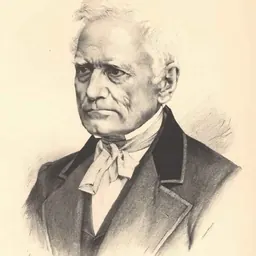
Charles Buxton (18 November 1822 – 10 August 1871) was an English brewer, philanthropist, writer and member of Parliament.
Personal life and architectural legacy Buxton was born on 18 November 1822 in Cromer, Norfolk, the third son of Sir Thomas Buxton, 1st Baronet, a notable brewer, MP and social reformer, and followed in his father's footsteps, becoming a partner in the brewery of Truman, Hanbury, Buxton, & Co in Brick Lane, Spitalfields, London, and then an MP. He served as Liberal MP for Newport, Isle of Wight (1857–1859), Maidstone (1859–1865) and East Surrey (1865–1871). His son Sydney Buxton was also an MP and governor of South Africa.
On 7 February 1850, he married Emily Mary Holland, the eldest daughter of physician Henry Holland (physician to Queen Victoria and later president of the Royal Institution).
Around 1850, he commissioned construction of a small detached, but ornate, house, Foxholm (Grade II-listed architecturally) on Redhill Road, then in Wisley but now in Cobham, for the Chaplain to Queen Victoria.
On 4 May 1860 he was commissioned Lieutenant in the part-time 3rd (Truman, Hanbury, Buxton) Tower Hamlets Rifle Volunteer Corps raised by his nephew Sir Fowell Buxton, 3rd Baronet from employees of the family brewery. The unit became part of the 1st Administrative Battalion, Tower Hamlets Rifle Volunteer Corps in which Charles Buxton became Major and then Lieutenant-Colonel on 1 June 1861. He left the unit in the later 1860s but was appointed Honorary Colonel of the 1st (Poplar) Tower Hamlets Artillery Volunteer Corps on 15 August 1870.
In 1860 he had his own house, Foxwarren Park, built on the neighbouring estate between a golf course and the Site of Special Scientific Interest which is Ockham and Wisley Commons. It is a Grade II* listed building. The building is stark Neo-Gothic: polychrome brickwork, red with blue diapering, and terracotta dressings, renewed plain-tiled roofs with crow-stepped gables.
He died on 10 August 1871. His probate was sworn in 1871 in a broad bracket of "under ".
His younger son was first and last Earl Buxton: Sydney Buxton, 1st Earl Buxton.
Anti-slavery parliamentary campaigners' memorial fountain Following his father's death, Buxton commissioned architect Samuel Sanders Teulon to design the Buxton Memorial Fountain to commemorate his father's role, with others, in the abolition of slavery. The fountain was initially erected in Parliament Square but was later moved to its current position in Victoria Tower Gardens, Westminster. It carries the dedication:
Published works He produced Memoirs of Sir Thomas Fowell Buxton, Baronet, with Selections from his Correspondence, first published in 1848. He later wrote a history, Slavery and Freedom in the British West Indies, published in 1860.
Don’t just read it —
keep it.
Full-length biographies made to live with: read them, listen on the way to work, watch them tonight.
- E-book
- Audio
- Video
Instant download · yours to keep · every purchase keeps this site free
Important facts
People in Charles Buxton's life
Named in this biography and alive at the same time



Related people
Same field, nearest in time




Contemporaries
People whose lives overlapped Charles Buxton's




Frequently asked questions
Who was Charles Buxton?
English brewer, philanthropist, writer and politician
When was Charles Buxton born?
Charles Buxton was born on 18 November 1823 in Cobham.
When did Charles Buxton die?
Charles Buxton died on 10 August 1871.
What was Charles Buxton's occupation?
Charles Buxton was a politician.
What nationality was Charles Buxton?
Charles Buxton was British.
Sources & further reading
Cite this page
APA: Biography.guide. (2026). Charles Buxton. https://biography.guide/charles-buxton/
MLA: "Charles Buxton." Biography.guide, https://biography.guide/charles-buxton/.
Chicago: "Charles Buxton." Biography.guide. https://biography.guide/charles-buxton/.
Data last updated: 2026-09-20 · Spot an error? Report a correction.
Page generated 2026-09-27 05:24 UTC