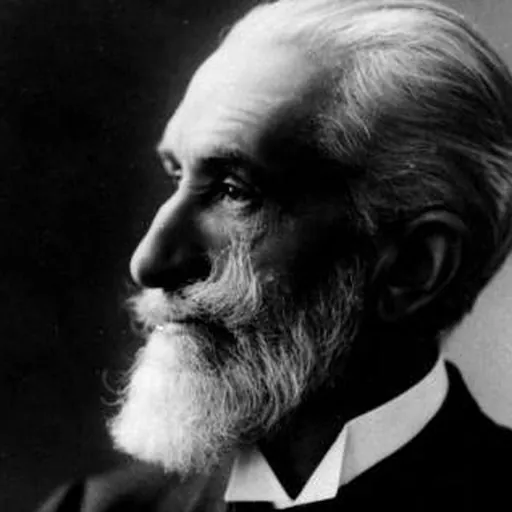
About Charles Buls
Lived 1837 – 1914 (aged 76). Charles Buls was a Belgian politician, goldsmith and architect.
Charles François Gommaire Buls (; 13 October 1837 – 13 July 1914) was a Belgian politician and mayor of the City of Brussels.
Early life Charles François Gommaire Buls was born in Brussels as the son of a goldsmith from the region of Mechelen. Buls received an artistic education, and spent a year in Paris, and nine months in Italy, studying fine arts. He also learned several languages including English, German, Italian and Latin, besides his mother tongue Dutch. He followed in his father's footsteps and worked as a goldsmith.
In 1862, he became a Freemason in Les vrais amis, and in 1871 joined La libre pensée. At the same time, he was a member of de Veldbloem and Vlamingen vooruit, two Flemish organisations of the Flemish movement. Together with his brother in law, Leo Van der Kindere, the later mayor of Uccle, he became a flamingant.
Politics
Buls entered politics in 1870 as a Flemish candidate on a radical list but he was not elected until 1877, when he was elected to the Brussels City Council on a liberal list. He became schepen or échevin of education in 1879. Buls was a supporter of progressive causes, especially in language issues and education, and the education of women, on which he wrote frequently. He was a supporter of Isabelle Gatti de Gamond's educational reforms. From 1879 on he played an important role in the development of Flemish education in Brussels. In particular, Buls was a steadfast defender and admirer of the Mont des Arts/Kunstberg and the Grand-Place/Grote Markt, now a UNESCO World Heritage Site, successfully proposing the 1883 city ordinance protecting the façades of the Grand-Place buildings and providing funds for their restoration, which took place between 1883 and 1923. In 1899, the architects of Brussels who had been involved in this restoration work paid for a memorial commemorating Buls, designed by Victor Horta and executed by Victor Rousseau, to be placed in the rebuilt guildhall on the Grand-Place. At the reopening of the restored Town Hall, Buls greeted Leopold II in Dutch, and the King replied in the same language, which was unusual at the time. In 1999, a new fountain with a larger-than-life-sized seated statue of Buls and his dog was erected at the Place Agoraplein, close to the Grand-Place.
Buls was an accomplished and prolific author, not merely on educational and artistic issues but also publishing accounts of his travels abroad.
Don’t just read it —
keep it.
Full-length biographies made to live with: read them, listen on the way to work, watch them tonight.
- E-book
- Audio
- Video
Instant download · yours to keep · every purchase keeps this site free
Important facts
People in Charles Buls's life
Named in this biography and alive at the same time

Related people
Same field, nearest in time






Contemporaries
People whose lives overlapped Charles Buls's




Frequently asked questions
Who was Charles Buls?
Belgian politician (1837-1914)
When was Charles Buls born?
Charles Buls was born on 13 October 1837 in Brussels.
When did Charles Buls die?
Charles Buls died on 13 July 1914 in Belgium, Ixelles.
What was Charles Buls's occupation?
Charles Buls was a politician, goldsmith and architect.
What nationality was Charles Buls?
Charles Buls was Belgian.
Sources & further reading
Cite this page
APA: Biography.guide. (2026). Charles Buls. https://biography.guide/charles-buls/
MLA: "Charles Buls." Biography.guide, https://biography.guide/charles-buls/.
Chicago: "Charles Buls." Biography.guide. https://biography.guide/charles-buls/.
Data last updated: 2026-09-22 · Spot an error? Report a correction.
Portrait: Wikimedia Commons · author & licence
Page generated 2026-09-27 05:00 UTC