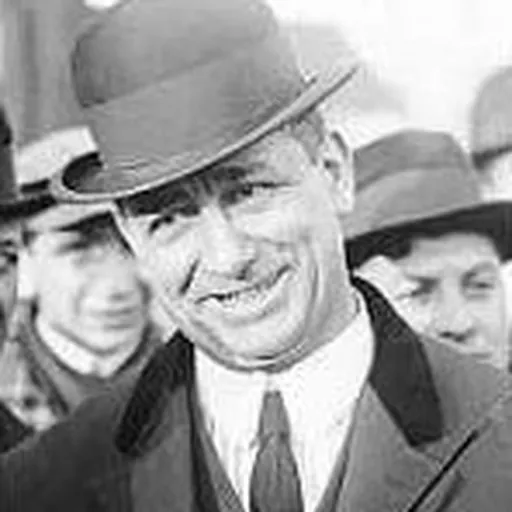
About Charles Becker
Lived 1870 – 1915 (aged 45). Charles Becker was an American police officer.
Charles Becker (July 26, 1870 – July 30, 1915) was a lieutenant in the New York City Police Department between the 1890s and the 1910s. He was convicted of first degree murder and executed for the killing of Herman Rosenthal, a bookmaker and gambler, in 1912 near Times Square.
Becker appealed and was retried but was convicted again. The day that Rosenthal was due to testify to a grand jury, he was murdered at 2 a.m. as he left the Hotel Metropole at 147 West 43rd Street, just off Times Square. Louis "Lefty Louie" Rosenberg, Jacob "Whitey Lewis" Seidenschner, Frank "Dago Frank" Cirofici, and Harry "Gyp the Blood" Horowitz were witnessed shooting him from their car, making no effort at disguise. The verdict was overturned on appeal on the grounds that Goff had been biased and that there was no independent corroborating witness to testify to the events since all of them had been involved in the crimes. and John Brennan (executed on December 2, 1926).
Becker continued to profess his innocence. The day before his execution, Becker told the warden, "Sure, I told them to put Rosenthal out of the way, but I didn't mean they should kill him. I wanted them to get him out of town so he wouldn't blab. Killing him was Rose's idea and the others. They wanted to save their own skins."
Jack Rose had served as a prosecution witness, as did Harry Vallon, Sam Schepps, and Bridgey Webber. They were underworld criminal figures who were believed to be involved in the crime but were promised immunity by the district attorney's office in exchange for testifying against Becker.
Charles Whitman, who was then Governor of New York, signed Becker's death warrant in 1915 and attended the execution. On July 30, 1915, Becker was executed in Sing Sing's electric chair by John Hulbert, New York's state electrician. The process took nine minutes, appearing to cause the man intense agony. For years afterward, it was described as "the clumsiest execution in the history of Sing Sing."
Becker was interred at Woodlawn Cemetery in the Bronx on August 2, 1915. He is buried next to his daughter.
Controversy Beginning with Henry Klein in 1927, a number of authors have suggested that Becker was wrongly convicted. Andy Logan wrote a thorough account of this position in her Against the Evidence (1970), as she became convinced of his innocence in the murder through her research. Allegedly, District Attorney Whitman manipulated the evidence to implicate the corrupt Lieutenant. Becker was known to have assets that far exceeded his salary. However, for Whitman, gaining a guilty verdict for Becker in the sensational murder case would help his own political aspirations, and he is thought to have been elected as governor largely based on his success in that goal.
In addition, the reporter Herbert Bayard Swope publicized the case mercilessly in the press, representing the power of the New York World. He devoted much space to the conduct of the trial and individuals' testimony. Later, he said his reporting on the trial catapulted his career. Lastly, as noted above, Judge John Goff showed his bias and played a major role in gaining a guilty verdict from the jury.
New York police historian Thomas A. Reppetto believes that Becker was guilty because of the testimony of people involved but also he had a strong motive and had shown reckless behavior. The consensus continues to favor Becker's active involvement in the murder.
The Becker-Rosenthal murder case was explored by historian Mike Dash in his Satan's Circus: Murder, Vice, Police Corruption and New York's Trial of the Century (2007). He made no conclusion as to Becker's guilt in the murder.
In popular culture The "Jack Rose" became a popular drink, named after the gambler who was a leading prosecution witness in the Becker trial after being given immunity by the district attorney. F. Scott Fitzgerald had his mob boss character Meyer Wolfsheim describe a fictionalized version of this murder in his novel The Great Gatsby. The Rosenthal murder case is featured in several novels, including: Harry Stein’s 1983 novel Hoopla Kevin Baker's 1999 novel Dreamland Michael Bookman's self-published novel God's Rat: Jewish Mafia on the Lower East Side (2000)
Don’t just read it —
keep it.
Full-length biographies made to live with: read them, listen on the way to work, watch them tonight.
- E-book
- Audio
- Video
Instant download · yours to keep · every purchase keeps this site free
Important facts
People in Charles Becker's life
Named in this biography and alive at the same time



Related people
Same field, nearest in time



Contemporaries
People whose lives overlapped Charles Becker's



Frequently asked questions
Who was Charles Becker?
American police officer (1870–1915)
When was Charles Becker born?
Charles Becker was born on 26 July 1870 in Callicoon.
When did Charles Becker die?
Charles Becker died on 30 July 1915 in Sing Sing.
What was Charles Becker's occupation?
Charles Becker was a police officer.
What nationality was Charles Becker?
Charles Becker was American.
Sources & further reading
Cite this page
APA: Biography.guide. (2026). Charles Becker. https://biography.guide/charles-becker/
MLA: "Charles Becker." Biography.guide, https://biography.guide/charles-becker/.
Chicago: "Charles Becker." Biography.guide. https://biography.guide/charles-becker/.
Data last updated: 2026-09-23 · Spot an error? Report a correction.
Portrait: Wikimedia Commons · author & licence
Page generated 2026-09-27 05:05 UTC