
About Céleste Mogador
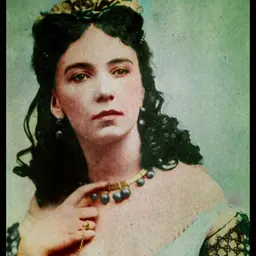
Lived 1824 – 1909 (aged 84). Céleste Mogador was a French dancer, playwright, novelist, writer, actor and courtesan.
Élisabeth-Céleste Vénard, countess of Chabrillan (27 December 1824 – 18 February 1909), better known by her stage name Céleste Mogador and often referred to simply as Mogador, was a French dancer, courtesan, and writer.
Life and career
Early life Élisabeth-Céleste Vénard, the daughter of Anne-Victoire Vénard, was born in Paris, France, on 27 December 1824. She states in her autobiography that her father died when she was six; her book's translator Monique Fleury Nagem states that Celeste's father left her mother while she was pregnant and went off to join the army. Céleste's autobiography recounts her earliest memories, dominated by her mother's various lovers. At one point, a violent assault by her mother's lover nicknamed Monsieur G. forced them to flee Paris for their safety. Her mother later became involved with another lover, Vincent, whom she described as temperamental. Vincent attempted to rape Céleste when she was just 15 years old.
In her autobiography she describes the hardships faced in the brothel and how she came to regret her decision to become a prostitute. During her short time there, she encountered many men who became both clients and lovers, including the poet Alfred de Musset who apparently humiliated her at a restaurant by dousing her with seltzer. Despite the rivalry between Pomare and Mogador, the two women ended up sharing the stage and a friendship, often dancing the quadrille together. Mogador also performed at the Théâtre Beaumarchais and as an equestrienne at the Cirque Olympique.
Mogador's newfound fame as a dancer and performer resulted in numerous admirers fighting for her attention. She became a mistress to a number of men, including the Duke of Ossuma and a Dutch baron. These men provided her with financial support, as they would often set her up in her own apartment or lavish her with gifts and money.
Countess, writer and director In 1847, she became the mistress of Lionel de Moreton, Count of Chabrillan. The two quickly fell in love with each other and remained in touch for years while he sailed to and from Australia. Prior to her marriage, she was officially dropped from the police register of prostitutes, with her pseudonym Céleste Vénard being struck from the record. Her novel, La Sapho (1858), is her only fictional work to address the injustices from which many demimondaines suffered. In the novel, Marie Laurent is seduced and then abandoned. After a suicide attempt, she resurfaces as La Sappho in the London demimonde and pursues revenge. Carol Mossman calls the novel a "vengeance fantasy" that allows de Chabrillan to work through the indignities she suffered as a prostitute: "If the justice sought by Céleste de Chabrillan in the course of her lifetime with respect to the social conditions leading her to her own prostitution remains elusive, she can at least mete it out in fiction." She was disappointed that she could not find a publisher for Les Deux Noms, her third set of memoirs which describe her struggles as a widow. Although lost for many years, Jana Verhoeven found these memoirs in France—and with the help of Alan Willey and Jeanne Allen, translated and annotated them. According to a review of these final memoirs, the widowed de Chabrillan confronted numerous difficulties: "There were powerful men who tried to crush Céleste's spirit with no concern for the dire financial consequences of their actions." Her memoirs painfully document her being denied a widow's pension even though her husband had worked as an important government employee. They also recount how the Chabrillan family tried to prevent her from publishing books, staging plays, and running her own theater. She usually managed to overcome such obstacles, but on several occasions, she encountered such obstacles that she attempted suicide.
While she emphasizes the personal hurdles she faced trying to prove herself to others, she also bears witness to the struggles of a female autodidact to achieve literacy and to improve her social standing in nineteenth-century France. Writing would buoy her through her darkest hours during the fifty years she soldiered on without her companion. Although Céleste took great pride in the twelve novels, thirty plays and operettas, and dozen poems and patriotic lyrics she authored, they never provided her with a stable income and, sadly, she struggled financially at several points in her life. Rich in ideas, however, Céleste boasts: "If my numerous works are not outstanding through their literary brilliance, they are so at least by their quantity. I have never imitated anyone and never borrowed from other writers. Maybe I was wrong, but what I wrote is truly mine."
Likely cognizant of the critics who doubted whether a courtesan could really write, and certainly angered by the tendency of male writers to "kill off" courtesans at the end of their novels and plays, Céleste proudly recounted her life beyond prostitution and was ultimately recognized as a writer by her peers. As she notes in the last line of her memoirs, her greatest joy was the memory of "my illustrious protectors from the Association of Stage Authors, who accepted me as one of their own and granted me a pension until the end of my life." Mossman in The Evolution of the French Courtesan Novel argues that de Chabrillan's writings inspired other courtesans like Cora Pearl and Liane de Pougy to protest their alienation in their own autobiographical fictions.
Death Mogador died at La Providence, an old people's home, at Montmartre, France, at the age of 84 on 18 February 1909. She was buried next to her mother at the family gravesite at Pré-Saint-Gervais, also next to her mother's lover Vincent.
Literary work Mogador wrote a series of novels: Les Voleurs d'or (1857) Sapho (1858) Miss Pewell (1859) Est-il fou? (1860) Un miracle à Vichy (1861) Mémoires d'une honnête fille (1865) Les Deux Sœurs (1876) Les Forçats de l'Amour (1881)
Don’t just read it —
keep it.
Full-length biographies made to live with: read them, listen on the way to work, watch them tonight.
- E-book
- Audio
- Video
Instant download · yours to keep · every purchase keeps this site free
Important facts
People in Céleste Mogador's life
Named in this biography and alive at the same time

Related people
Same field, nearest in time




Contemporaries
People whose lives overlapped Céleste Mogador's



Frequently asked questions
Who was Céleste Mogador?
French dancer, playwright and novelist (1824-1909)
When was Céleste Mogador born?
Céleste Mogador was born on 27 December 1824 in Paris.
When did Céleste Mogador die?
Céleste Mogador died on 18 February 1909 in 18th arrondissement of Paris.
What was Céleste Mogador's occupation?
Céleste Mogador was a dancer, playwright, novelist, writer, actor and courtesan.
What nationality was Céleste Mogador?
Céleste Mogador was French.
Sources & further reading
Cite this page
APA: Biography.guide. (2026). Céleste Mogador. https://biography.guide/celeste-mogador/
MLA: "Céleste Mogador." Biography.guide, https://biography.guide/celeste-mogador/.
Chicago: "Céleste Mogador." Biography.guide. https://biography.guide/celeste-mogador/.
Data last updated: 2026-09-20 · Spot an error? Report a correction.
Page generated 2026-09-27 05:20 UTC