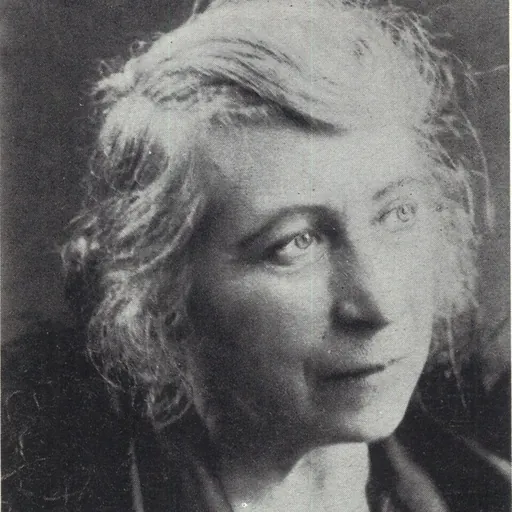
About Cécile de Jong van Beek en Donk
Lived 1866 – 1944 (aged 78). Cécile de Jong van Beek en Donk was a Dutch and French writer, women's rights activist, journalist and feminist.
Jkvr. Cécile Wilhelmina Elisabeth Jeanne Petronella de Jong van Beek en Donk (19 May 1866, in Alkmaar – 5 June 1944, in Méréville) was a Dutch feminist writer.
Personal life De Jong was born on 19 May 1866 as the daughter of the lawyer Sir Johan Jan François de Jong van Beek en Donk and Anna Cécile Wilhelmine Jeanne Jacqueline Nahuys, as the second of three children. She married Adriaan Eliza Goekoop on 25 August 1890. The couple did not have children and the marriage was dissolved on 20 November 1899. In 1900, she moved to France. She remarried in Paris on 28 May 1904, to Michel Frenkel and gave birth to a son, Pierre Michel, in 1905. Her earlier divorce had caused a break with her family, and her death in Méréville, France, on 15 June 1944 went mostly unnoticed in her native country, the Netherlands.
Career De Jong was a fervent feminist. Even though many historians dismissed her because she was from a higher class, she was one of the, if not the, most famous feminist authors in the Netherlands around the 1900s.
Her career as an author started in 1897. Her first published work was "Aan de vrouwen van Nederlandsch Oost-Indië" ("To the women in the Dutch East Indies"). This piece was written in honor of an exhibition about female workers. This piece was not given a lot of attention, unlike her next book "Hilda van Suylenburg" (1897) which is when her writing career really took off. This novel was a great success within the Netherlands and around it, but caused a lot of controversy. The novel encompasses a story about the first female lawyer (fictional) in the Netherlands, and also touches upon how women can build their own meaningful lives without having to depend on others. On top of that, it promotes marriages only when there is equality and love involved.
Her second novel is "Lilia" (1907) about an unmarried woman who becomes pregnant. It was not received as well as her other novel, even though there were positive reviews. Because of this pamphlet in novel form, the book did end up with the desired public, namely women from the bourgeoisie.
The novel also received positive reactions. Hilda was a role model for higher class women, because she was able to combine her career as a lawyer with a good marriage and motherhood, This prevented the readers from seeing Lilia like she really was. Moreover, Lilia is not ashamed of her immoral behavior and her illegitimate child. On the other hand, Smissaert says, she is a person of flesh and blood, in contrast to Hilda and Corona in Hilda van Suylenberg. Lilia's free love was seen as the demise of morality. Author Anna de Savornin Lohman argues that it is bad to exercise free love, because the change in morality would not lead to the liberation of women. In addition, Lilia is seen as egoistic, because she only thinks about herself and not about her child, who will now have to live with the backlog that Lilia has given him as an outcast. The story is also unbelievable, according to Lohman, because the novel ends where the struggle begins in real life.
Works
Aan de vrouwen van Nederlandsch Oost-Indië (1897); [To the women of the Dutch East Indies] Hilda van Suylenberg (1897) Lilia (1907) De geschiedenis eener bom (1912), translation with an introduction from the Polish Dzieje jednego pocisku by Andrzej Strug (1910) La Marchande de cierges (1929); Dutch publication: Bij de waskaarsen (1930)
Don’t just read it —
keep it.
Full-length biographies made to live with: read them, listen on the way to work, watch them tonight.
- E-book
- Audio
- Video
Instant download · yours to keep · every purchase keeps this site free
Important facts
People in Cécile de Jong van Beek en Donk's life
Named in this biography and alive at the same time


Related people
Same field, nearest in time



Contemporaries
People whose lives overlapped Cécile de Jong van Beek en Donk's



Frequently asked questions
Who was Cécile de Jong van Beek en Donk?
Dutch writer (1866–1944)
When was Cécile de Jong van Beek en Donk born?
Cécile de Jong van Beek en Donk was born on 19 May 1866 in Alkmaar.
When did Cécile de Jong van Beek en Donk die?
Cécile de Jong van Beek en Donk died on 15 June 1944 in Méréville.
What was Cécile de Jong van Beek en Donk's occupation?
Cécile de Jong van Beek en Donk was a writer, women's rights activist, journalist and feminist.
What nationality was Cécile de Jong van Beek en Donk?
Cécile de Jong van Beek en Donk was Dutch and French.
Sources & further reading
· Wikipedia: Cécile de Jong van Beek en Donk
· DBpedia: Cécile de Jong van Beek en Donk
Cite this page
APA: Biography.guide. (2026). Cécile de Jong van Beek en Donk. https://biography.guide/cecile-de-jong-van-beek-en-donk/
MLA: "Cécile de Jong van Beek en Donk." Biography.guide, https://biography.guide/cecile-de-jong-van-beek-en-donk/.
Chicago: "Cécile de Jong van Beek en Donk." Biography.guide. https://biography.guide/cecile-de-jong-van-beek-en-donk/.
Data last updated: 2026-09-22 · Spot an error? Report a correction.
Portrait: Wikimedia Commons · author & licence
Page generated 2026-09-27 04:59 UTC