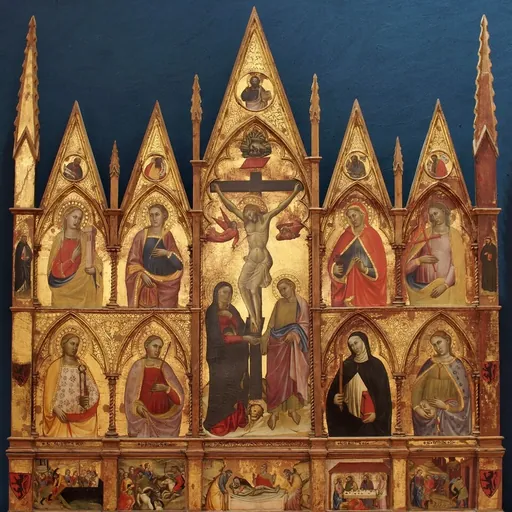
About Cecco di Pietro
Lived 1330 – 1402 (aged 71–72). Cecco di Pietro was a painter.
Cecco di Pietro was an Italian painter of the Pisan School. While his date of birth cannot be confirmed, there is some mention of a Cecco Pierri working with the painter Paolo di Lazzarino in 1350. If this was a reference to di Pietro, then his date of birth can be placed around 1330.
He was active starting from around 1370 and died sometime before 1402. Cecco is seen as an important figure in Trecento art because of his development of a style that incorporated elements of Pisan painting along with those of the Sienese School.
Life and work
Early documents indicate that some of Cecco di Pietro's first work as an artist was restoring frescoes. He is first mentioned in notices from around 1370 as having worked at the Campo Santo with five other painters working on restoring frescoes in the area. He is next mentioned in notices from 1372 concerning the restoration of the Story of Job fresco in the Campo Santo with Francesco Volterra. Records regarding his pay from the time show that it was a small sum of money when compared with other artists of the day, indicating that he was still inexperienced and learning the craft of the Pisan school from Volterra.
Following the restoration of the Story of Job, there is another notice of Cecco di Pietro being hired in 1379 to restore the Inferno from a trio of frescoes by Buonamico Buffalmacco which were also located in the Campo Santo and were apparently damaged by some untrained apprentices in a previous restoration attempt. Of the restoration of the Inferno, most scholars only attribute the 2nd circle of Hell and two figures to the side of the Devil as the portions restored by Cecco, with the other restoration work carried out by a separate, unknown artist.
One of his masterpieces is the Madonna and Child, signed and dated 1378, now at the Statens Museum for Kunst in Copenhagen in Denmark, which was the central compartment of Saint Rainerius polyptych made for the church of San Francesco in Pisa.
Cecco continued to receive a number of local commissions, painting many altarpieces. One such altarpiece is the Polyptych of Agnano, executed between 1386–1395 for the church and convent at Agnano, and is considered one of Cecco's most important pieces. He continued to work in the fresco style until his death around 1402
Style
During his career, Cecco worked on themes common to other artists of the Trecento period. Much of the artwork produced by Cecco was of the Virgin and Child, such as The Virgin and Child With Donors in 1386, which was part of a polyptych that has since been separated, and its various pieces are located in different museums around the world. In documents from 1380, we see that Cecco was referred to as anziano or “elder” in Italian. This classifies him as a representative of the “San Simoncino di Porta” parish that he belonged to in Pisa.
Initial evaluations by early art historians looked on Cecco di Pietro's work as not being historically or technically significant. Additionally, some early art historians did not critically consider the Pisan School as a whole. Later, Cecco's work has been reevaluated, and is now seen as one of the Pisan masters with his own unique style. His style evolved over his career, starting first as an example of the Pisan School of painting and eventually developing into a hybrid of Sienese and Pisan styles.
His earlier work such as The Madonna and Child with Donors is more naturalistic when compared with his later works, where his figures take on a more elongated and ethereal appearance similar to the Sienese style at the time. This is seen most prominently in the depiction of the head of the child. Another work that clearly displays this shift towards more ethereal figures is the recently restored Virgin and Child Playing with a Gold Finch.. In this painting, the Madonna's face and neck have taken on a longer, more drawn appearance, and the fingers of the Madonna are long and slender.
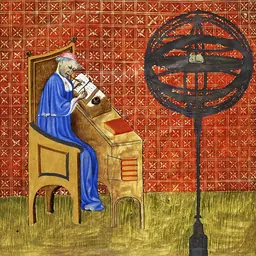
It is unknown what exactly brought about this shift in Cecco's style but there is some work that suggests that Sienese painter Luca di Tommè may have been an influence. Whether through direct mentorship or Cecco's admiration of his work, there are many similarities between the works of Tommè and the later works of Cecco. These similarities can be seen between Cecco's Polpytch of the Crucifixion from 1386 and a similar scene by di Tomme from 1366. Virgin and Child with Finch (v.1371), Statens Museum for Kunst, Copenaghue Saint Jerome in His Studio (v.1370), North Carolina Museum of Art, Raleigh The Baptism of Christ (compartment predella) St. Benedict, Musée du Petit Palais, Avignon Saint Barthelemy (1386), Musée du Petit Palais, Avignon Saint Nicolas (1386), Musée du Petit Palais, Avignon St. Peter (1386), Musée du Petit Palais, Avignon St. John the Baptist (1386), Musée du Petit Palais, Avignon
Frescoes
Camposanto Monumentale di Pisa San Martino in Kinzica, Pisa
Gallery of selected works
Don’t just read it —
keep it.
Full-length biographies made to live with: read them, listen on the way to work, watch them tonight.
- E-book
- Audio
- Video
Instant download · yours to keep · every purchase keeps this site free
Important facts
People in Cecco di Pietro's life
Named in this biography and alive at the same time

Related people
Same field, nearest in time




Contemporaries
People whose lives overlapped Cecco di Pietro's

Frequently asked questions
Who was Cecco di Pietro?
Italian painter (1330-1402)
When was Cecco di Pietro born?
Cecco di Pietro was born in 1330 in Pisa.
When did Cecco di Pietro die?
Cecco di Pietro died on 28 March 1402 in Pisa.
What was Cecco di Pietro's occupation?
Cecco di Pietro was a painter.
Sources & further reading
Cite this page
APA: Biography.guide. (2026). Cecco di Pietro. https://biography.guide/cecco-di-pietro/
MLA: "Cecco di Pietro." Biography.guide, https://biography.guide/cecco-di-pietro/.
Chicago: "Cecco di Pietro." Biography.guide. https://biography.guide/cecco-di-pietro/.
Data last updated: 2026-09-24 · Spot an error? Report a correction.
Portrait: Wikimedia Commons · author & licence
Page generated 2026-09-27 05:08 UTC