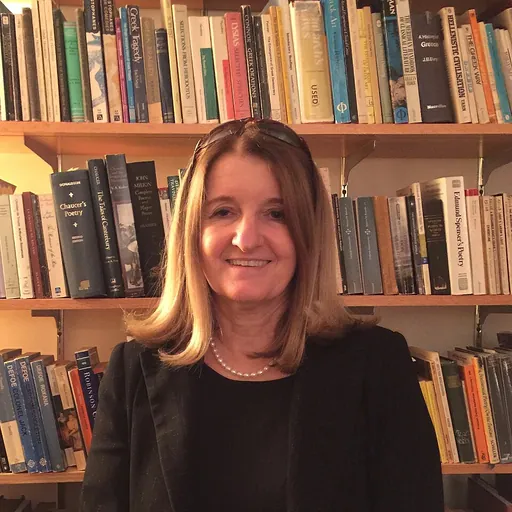
About Cathy Caruth
Born 1955. Cathy Caruth is an American writer.
Cathy Caruth (born 1955) is an American scholar and literary critic whose writings have been influential in trauma studies, a field that explores the impact of trauma in literature and society by analyzing its psychological, rhetorical, and cultural significance. Her research has explored how testimony and language survive historical trauma. Psychiatrist Robert Jay Lifton, M.D. has described her as one of the most innovative scholars in trauma studies, a field she has been credited with partly creating.
Early life and education Caruth's mother was Elaine J. Caruth, a psychoanalyst and Clinical Professor of Psychiatry at UCLA. Her mother was Jewish and her father was not. Despite her mother's heritage, her family was somewhat assimilated and they celebrated Christmas. She has noted that she only realized she was writing about Judaism when she was halfway through completing an essay on Sigmund Freud's Moses and Monotheism. While she does not point to a specific traumatizing event, she has stated that a personal experience from her childhood could be an underlying influence on her research into trauma and history.
When Caruth was young, she was involved in junior high school peace marches and war moratoria during the Vietnam War. She has suggested that this early exposure to the war and political protests may somehow be related to her later academic interest in trauma.
Career Caruth has held positions at Yale, Emory, and Cornell Universities. She is currently Class of 1916 Professor of English. her work has been translated into at least twelve languages.
From 1986 to 1995 Caruth was assistant professor of English at Yale, where she taught a course titled "Literature, Trauma and Culture," which was the subject of a 1991 New York Times article about her teaching. She continued to offer this curriculum throughout her subsequent appointments. She has said that she views the classroom as a dynamic space of interaction, and she has described the goal of engaging with students and global scholars as a continuous effort to find language for what hasn't been said.
In 1996 JHUP published Caruth's second monograph, Unclaimed Experience: Trauma, Narrative, and History, which has been incorporated into curricula across psychoanalysis, history, philosophy, and law. She argued trauma is not the event but the mind's failure to process it, producing "latency" where it returns belatedly as flashbacks or nightmares. She defines trauma as follows: Trauma describes an overwhelming experience of sudden, or catastrophic events, in which the response to the event occurs in the often delayed, and uncontrolled repetitive occurrence of hallucinations and other intrusive phenomena. This delay leaves traumatic histories "unclaimed," persisting through haunting. Caruth extended trauma beyond individuals, viewing history as interconnected traumas linking personal and collective memory. Unclaimed Experience was released in a 20th-anniversary edition in 2016.
Caruth's work is usually done "without any direct contact with people who are traumatized". Primarily a theorist rather than a clinical practitioner or scientist, she has influenced and collaborated with psychiatrists, such as Dori Laub and Robert Jay Lifton, shaping understanding of how the mind processes trauma and how history records it. In 2011 she held a Mellon Visiting Fellowship at the University of Cambridge, where she was based at the Centre for Research in the Arts, Social Sciences and Humanities and delivered a lecture titled "Lying and History" in March of that year. She joined Cornell as the Franklin H.T. Rhodes Professor of Humane Letters in 2011. She was the Whitney J. Oates Fellow at Princeton in 2013.
Caruth was elected to the American Academy of Arts and Sciences in 2026.
Other projects Caruth has maintained a research and teaching focus on Romanticism, John Milton, and philology. In her 2010 afterword for PMLA, she framed the future of literary criticism as a "turning back" that is essentially philological. Her engagement with these fields is reflected in her contributions to Studies in Romanticism, Romantic Circles, and Philological Quarterly, as well as her university teaching. She has taught seminars on Milton, exploring how parallelism is used in Paradise Lost to create ambiguity that troubles representation, in addition to courses that trace the influence of Milton on Romantic poets, examining how dreams and poems may provide a framework for understanding the human condition.
In 2017, Caruth co-launched The Ape Testimony Project, an interdisciplinary initiative considering the intersection of language and non-human experience. She participated in workshops and public forums at Cornell on the subject of primates and the ethics of cross-species communication and sustainability. In 2025, she gave a presentation on the intergenerational legacy of Kanzi the bonobo, in which she examined how the "encounter" between humans and bonobos creates a new language that cannot be the object of a single discipline.
International engagements
Caruth's study of trauma has brought her global distinction and recognition.
In 2018 she appeared on Ukrainian media in an interview for Hromadske in which she brought her academic theories into a real-world dialogue with a society actively undergoing a period of intense conflict and historical re-evaluation.
In 2020 she gave a virtual presentation at St Berchmans College Changanassery on Trauma Theory and the problem of address, drawing on Shoshana Felman and the Eichmann Trial to describe trauma's return as involuntary repetition which acts as a command to understand what was initially ungraspable, compelling survivors into a new mode of witness that bridges death and life. This built upon work published in Paragraph (journal) in 2017.
Caruth participated in a webinar hosted by the Centre for the Study of the Afterlife of Violence and the Reparative Quest (AVReQ) at Stellenbosch University in 2020 titled "The Future of Trauma: African Scholars Thinking with Cathy Caruth," which served as the inaugural event for a Trauma Studies Group series aimed at interrogating and expanding Western Trauma Theory through African perspectives. A group of early-career African scholars engaged with Caruth to examine the language and transmission of trauma, how the physical body registers trauma, new ways of expressing traumatic experiences in drama and performance, and transgenerational healing.
Responses and critiques Over the decades since its publication, Caruth's work in Trauma Theory has elicited a spectrum of scholarly critique, with some suggesting that Caruth's core arguments constitute a theoretical fiction that is unsupported by empirical neurobiology.
In her 2000 book Trauma: A Genealogy, as well as subsequent essays and interviews, Professor Ruth Leys (Johns Hopkins University) observed that elements of Caruth's framework introduce a certain fluidity in how victimhood is understood, potentially complicating distinctions between victims and those involved in acts of violence. Leys has reflected on whether Caruth's approach might, in certain interpretations, allow perpetrators to be viewed through the lens of their own unclaimed suffering. Leys argued that Caruth's model treated trauma as an unprocessed event that is stored in memory but not "remembered" in the normal way. It returns as flashbacks or nightmares exactly as it happened, without being integrated into the person's conscious understanding. Leys believed this idea comes more from theoretical frameworks than actual clinical observations. According to Leys, Caruth's theory produced an over-generalized, ahistorical picture of trauma as universal breakdown of meaning, conducive to speculation.
In his 2001 book Writing History, Writing Trauma, Professor Dominick LaCapra, a Cornell historian, argued that Caruth's writing on trauma often uses an indirect and disorienting style. According to LaCapra, Caruth's main ideas treat real historical events (such as the Holocaust or war) as if they are mostly about how words and stories always fail to describe what happened. LaCapra believed that this approach obfuscates the distinction between the actual past event and the present-day work of scholars, as well as that between the people who lived through trauma and the scholars who study it.
In 2008 Michelle Balaev, a researcher, questioned the degree to which Caruth's portrayal of trauma as fundamentally unrepresentable corresponds with clinical and empirical accounts from psychology, where many survivors describe fragmented yet accessible memories rather than a complete void of representation.
In 2014 Alan Gibbs, Ph.D., critiqued Caruth's approach as favoring a distinctive modernist style in representations of trauma—marked by fragmentation, temporal displacement, and narrative gaps—which may have quietly influenced prevailing expectations for how such experiences are conveyed in literature. According to Gibbs, Caruth's model may distance particular events from their immediate historical and political settings by emphasizing trauma's belated and "unclaimed" quality, framing them primarily as symptoms of an unrepresentable past.
Beyond her academic scholarship, Caruth faced criticism from the Cornell Graduate and Professional Student Assembly (GPSA), Cornell graduate student body, and other activists in 2018 after a private letter defending NYU professor Avital Ronell, who was found guilty of sexually harassing a doctoral student, was leaked to the public. The letter, whose primary goal was to urge NYU to protect Ronell during a Title IX investigation, was signed by Caruth and 50 other scholars. Caruth clarified her position in a letter to the editor published in The Cornell Daily Sun, but critics pointed out that her support of Ronell seemed inconsistent with her published writings regarding power dynamics and trauma, and she did not retract her name from the original letter.
Annotated bibliography Books
Journal Articles and Essays
Don’t just read it —
keep it.
Full-length biographies made to live with: read them, listen on the way to work, watch them tonight.
- E-book
- Audio
- Video
Instant download · yours to keep · every purchase keeps this site free
Important facts
People in Cathy Caruth's life
Named in this biography and alive at the same time





Related people
Same field, nearest in time

Contemporaries
People whose lives overlapped Cathy Caruth's
Frequently asked questions
Who is Cathy Caruth?
American academic
When was Cathy Caruth born?
Cathy Caruth was born in 1955.
What is Cathy Caruth's occupation?
Cathy Caruth is a writer.
What nationality is Cathy Caruth?
Cathy Caruth is American.
Sources & further reading
Cite this page
APA: Biography.guide. (2026). Cathy Caruth. https://biography.guide/cathy-caruth/
MLA: "Cathy Caruth." Biography.guide, https://biography.guide/cathy-caruth/.
Chicago: "Cathy Caruth." Biography.guide. https://biography.guide/cathy-caruth/.
Data last updated: 2026-09-21 · Spot an error? Report a correction.
Portrait: Wikimedia Commons · author & licence
Page generated 2026-09-27 05:00 UTC