
About Catherine Samba-Panza
Born 1954. Catherine Samba-Panza is a politician, lawyer and jurist.
Catherine Samba-Panza (; born 26 June 1954) is a Central African politician who served as Transitional President of the Central African Republic from 2014 to 2016. She was the first woman to serve as head of state in the Central African Republic. Prior to her tenure as acting president, she was the Mayor of Bangui from 2013 to 2014.
Samba-Panza began her career operating an insurance brokerage and working as a women's rights advocate. She was chosen in 2003 to serve as the vice president of a national reconciliation conference, and she was then chosen as president of the subsequent committee to implement the conference's recommendations. She was appointed mayor of Bangui in 2013 after the city was devastated by the Central African Republic Civil War. She was then appointed to serve as transitional president of the Central African Republic in 2014. She was tasked with restoring stability to the nation by disarming militant groups, and she emphasized the nation's economic recovery through employment and foreign aid. Her term ended in 2016. She was a presidential candidate in the 2020–21 election, but she was unsuccessful.
Early life and career Catherine Souga was born on 26 June 1954 in Fort Lamy, French Chad, as the second oldest of her parents' six children. Her mother, Henriette Waloma (also spelled Warouma when the family decided to move to Bangui, Central African Republic. She then moved to Paris to study journalism and law and graduated from a diploma of specialized higher studies (DESS) in insurance law from Panthéon-Assas University in 1981. Samba-Panza also founded her own brokerage firm, CSP Assurances-Conseils, In the late 2000s, she was hired by another brokerage, Gras Savoye, where she served as managing director until 2013. Cyriaque Samba-Panza has served as a government minister for several tenures under former Presidents André Kolingba and François Bozizé, beginning with Secretary of State for Planning, Statistics and International Cooperation in 1987. She placed particular emphasis on work as a women's rights advocate. She has said that she was able to escape some of the discrimination faced by women because she "was always a fighter", and she has lamented that many women in the CAR "don't know their rights so they can't defend them". She was then chosen as the president of the committee to implement the conference's recommendations. Though she was a Christian, her appointment was accepted by both the Muslim Séléka and the Christian Anti-balaka factions due to her reputation for neutrality. While serving as mayor, she insisted that she would step down as soon as elections were held.
As the interim mayor, Samba-Panza was tasked with rebuilding the city after it was devastated by the Central African Republic Civil War. All of the city's funds and supplies had been looted, and much of its infrastructure had been destroyed. Her strategy to address the city's funding problem included raising taxes and courting foreign aid.
Transitional president
Taking office
Following an escalation of the conflict in the CAR, Djotodia stepped down after nine months in power. Samba-Panza was chosen as the interim president, replacing acting president Alexandre-Ferdinand Nguendet. She was chosen from a list of eight candidates who had to prove they had no links to either the Séléka or the Anti-balaka. Samba-Panza later said that she accepted the position because she "couldn't stand by and do nothing while [her] country fell into chaos". After beating Désiré Kolingba in a second round ballot 75 to 53, she said: with a mandate to serve until the next election, which was scheduled for 2015. She suggested poverty and a failure of governance were the causes of the conflict. Upon taking office, Samba-Panza was the first woman to become the country's president. Her status as a female leader in a time of crisis was seen as symbolic among citizens, who felt that a woman and mother may be better equipped to bring peace between warring factions. Samba-Panza argued that she did not have a political bias because her experience was in civil society instead of politics, As the Séléka had no ties to Kamoun, it threatened to boycott the government and withdraw from the ceasefire. Samba-Panza authorized the creation of a Special Criminal Court in June 2015 to prosecute "grave international crimes committed since 2003" in conjunction with the United Nations. A surge of violence in September 2015 caused hundreds of protesters to demand Samba-Panza's resignation, and Human Rights Watch determined by the end of the year that Samba-Panza's administration had "struggled to establish security".
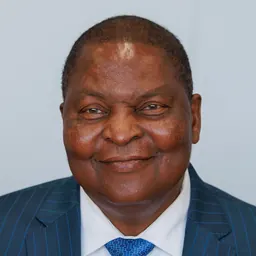
The 2015 general election was scheduled for February 2015. As the interim president, Samba-Panza was ineligible to run. The election was held in December 2015, but irregularities necessitated a second round of elections, which was held in February 2016. Samba-Panza served as president until 30 March 2016, when Faustin-Archange Touadéra was sworn in as her successor.
Post-presidency
Samba-Panza stayed in Bangui after leaving office, and she remained involved with the government as an advisor in areas such as peace mediation. and the Democratic Republic of the Congo. She also took on leadership roles in intergovernmental organizations after she left office, becoming president of the Pan African Women's Leadership Observatory and co-chair of the African Union Network for Conflict Prevention and Mediation.
On 28 August, Samba-Panza announced that she would be running in the 2020 presidential election. She justified her campaign by saying that "many appealed from all sides of the political spectrum" for her to run, and she touted her willingness to step down in 2016 as a reason to trust her. Samba-Panza campaigned on security and economic development, saying that her successor failed to bring these things about. She was the only woman to run in the election. Samba-Panza was unsuccessful, receiving 5,526 votes, only 0.86% of the total votes cast.
Samba-Panza was one of several political opposition figures who were barred from leaving the country in January 2021. She was not given an explanation at the time, but the government later stated that there were ongoing investigations into opposition leaders for alleged involvement with armed groups.
Don’t just read it —
keep it.
Full-length biographies made to live with: read them, listen on the way to work, watch them tonight.
- E-book
- Audio
- Video
Instant download · yours to keep · every purchase keeps this site free
Important facts
People in Catherine Samba-Panza's life
Named in this biography and alive at the same time



Related people
Same field, nearest in time




Contemporaries
People whose lives overlapped Catherine Samba-Panza's


Frequently asked questions
Who is Catherine Samba-Panza?
Central African politician
When was Catherine Samba-Panza born?
Catherine Samba-Panza was born on 26 June 1954 in N'Djamena.
What is Catherine Samba-Panza's occupation?
Catherine Samba-Panza is a politician, lawyer and jurist.
What nationality is Catherine Samba-Panza?
Catherine Samba-Panza's recorded nationality: Central African Republic.
Sources & further reading
· Wikipedia: Catherine Samba-Panza
· DBpedia: Catherine Samba-Panza
Cite this page
APA: Biography.guide. (2026). Catherine Samba-Panza. https://biography.guide/catherine-samba-panza/
MLA: "Catherine Samba-Panza." Biography.guide, https://biography.guide/catherine-samba-panza/.
Chicago: "Catherine Samba-Panza." Biography.guide. https://biography.guide/catherine-samba-panza/.
Data last updated: 2026-09-20 · Spot an error? Report a correction.
Page generated 2026-09-27 05:18 UTC