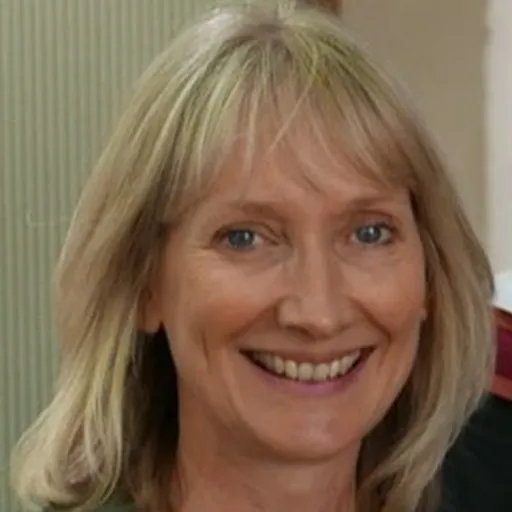
About Catherine Nobes
Born 1964. Catherine Nobes is a biologist.
Catherine D. Nobes (born 1 April 1964) is a Professor of Cell Biology and Head of School of Biochemistry at the University of Bristol. She studies the regulation of cell migration and invasion of cancer cells by Eph receptors.
Early life and education Nobes went to school at Windsor Girls' School and was a county level high jumper as a teenager. She studied biochemistry at the University of London. She completed a PhD at the University of Cambridge, working with Martin Brand. Nobes did brief Post-Docs in Helen Saibil and Aviva Tolkovsky's labs in Oxford before joining Alan Hall's laboratory at the University College London, where she identified the role of the GTPase CDC42 and effectors in forming actin-rich filopodial extensions. She investigated the regulation of actin polymerisation and how cell movement determines polarity and adhesion. She was awarded a Lister Institute of Preventive Medicine Fellowship in 2007, which allowed her to study cell migration in the context of axonal guidance and cancer metastasis.
Research and career Nobes was awarded a Medical Research Council Fellowship at University College London in 2001, where she worked in the Laboratory for Molecular Cell Biology (LMCB). Her work was featured in a Wellcome Trust exhibition of art and science, Growth and Form. She joined the University of Bristol as a Reader in 2006, and was promoted to a Professor of Cell Biology in 2012. Since 2014 she has been the head of the School of Biochemistry, the first woman to do so in the School's 50-year history.
Her work largely considers the social behaviour of tumor cells in the tumor microenvironment. She studies how colliding cells that come in to contact with each other stop migrating toward their partner, repolarise and move away from one another - a process known as contact inhibition of locomotion. Eph receptors are part of the receptor tyrosine kinases; with two main families - EphA and EphB. Nobes showed that in metastatic prostate cancer cells, EphB receptors are misregulated in ways that might lead to cancer cell invasion / metastasis. She was the editor of the British Society for Cell Biology newsletter. In 2018 she joined the Advisory Committee of the Lister Institute of Preventive Medicine.
Don’t just read it —
keep it.
Full-length biographies made to live with: read them, listen on the way to work, watch them tonight.
- E-book
- Audio
- Video
Instant download · yours to keep · every purchase keeps this site free
Important facts
People in Catherine Nobes's life
Named in this biography and alive at the same time



Related people
Same field, nearest in time


Contemporaries
People whose lives overlapped Catherine Nobes's

Frequently asked questions
Who is Catherine Nobes?
Professor of Cell Biology
When was Catherine Nobes born?
Catherine Nobes was born on 1 April 1964.
What is Catherine Nobes's occupation?
Catherine Nobes is a biologist.
Sources & further reading
Cite this page
APA: Biography.guide. (2026). Catherine Nobes. https://biography.guide/catherine-nobes/
MLA: "Catherine Nobes." Biography.guide, https://biography.guide/catherine-nobes/.
Chicago: "Catherine Nobes." Biography.guide. https://biography.guide/catherine-nobes/.
Data last updated: 2026-09-22 · Spot an error? Report a correction.
Portrait: Wikimedia Commons · author & licence
Page generated 2026-09-27 05:03 UTC