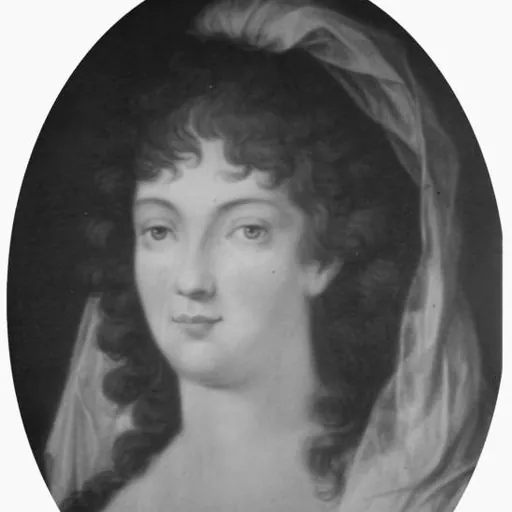
About Caroline von Briest
Lived 1773 – 1831 (aged 57). Caroline von Briest was a German poet and writer.
Caroline Philippine von Briest (better known as Caroline de la Motte Fouqué; 7 October 1773 – 20 July 1831) was one of the most prolific German women writers of the Romantic period.
She wrote novels, short stories, fairy tales, as well as essays, on Greek mythology, on the history of fashion, and travelogues. Her numerous works gained her a high degree of celebrity.
Early years
Caroline Philippine von Briest was born in Nennhausen in 1773 (1775 is also mentioned). She grew up at the Nennhausen estate, which belonged to her father, Philipp Friedrich August Wilhelm von Briest (1749–1822), who had served in the Prussian Army. Her mother was Caroline Wilhelmine Zinkow (or Zinnow), and she had a younger brother, August Jakob Friedrich von Briest (1789–1790). After her mother's death, her father married Marie Friederike Helene von Luck, and they had two children, Caroline Friederike Auguste von Briest and Clara Friederike Charlotte von Briest. The home was frequently visited by literary men from Berlin.
Career
Briest first married Friedrich Ehrenreich Adolf Ludwig Rochus von Rochow (1770–1799), a young officer, who possessed an estate in the neighbourhood, and was attached to a regiment quartered at Potsdam. None of her work during this period was published.
She married writer Friedrich de la Motte Fouqué in 1803. It was a second marriage for both. Together they had one daughter, Marie Luise Caroline de la Motte Fouqué (1803–1864). Fouqué retired from the army with claims of poor health and lived at the Nennhausen estate, publishing his first book in 1804; her first book was published two years later.
Several of Briest's novels, her Letters as to the Purpose and Tendency of Female Culture (Berlin, 1811), as well as her Letters on Greek Mythology (Berlin, 1812), are of note. Some of her narrative poems are distinguished for their insight into matters of the human, particularly the feminine, heart.
Regarding the literary quality of her works, Arno Schmidt in his authoritative biography of Friedrich de la Motte Fouqué, quotes E. T. A. Hoffmann as follows: "In the afternoon to see Frau Fouqué who bored and displeased me terribly by reading from one of her very bad novels" (30 January 1815) – followed by a second similarly dismissive statement. Schmidt continues by commenting: "After having read ten of her books I do have to agree with him; the best among them are the novels Roderich and the tale Der Delphin, although they do follow well-known models very closely; in addition, some pieces in her books, for example the poems in Frau des Falkenstein, were not written by her but by her husband."
She wrote approximately twenty novels and sixty stories, as well as poems, theoretical tracts and cultural historical essays; there were also romances and comedies. She sought anonymity for some of her work by referring to herself as "author of the Roderich novels", or using the pseudonym "Serena".
Drei Mährchen (1806), Feodora (1814), Frauenliebe (1818) and Die graue Maske (1829) are some of her works with Beytrag zur Geschichte der Zeit (1829/30) considered her most important. Her work has been criticized for abandoning her originality in favour of imitating Motte Fouqué's style, hoping to share in his popularity. Her writings continued until 1829 with her last publication, Resignation. Her letters and short essays were collected after her death under the title "The Writing Table, or Old Times and New" (Cologne, 1833). 1816, Das Heldenmädchen aus der Vendée 1818, Frauenliebe 1820, Ida 1820, Lodoiska und ihre Tochter 1821, Die blinde Führerin 1821, Heinrich und Maria 1821, Briefe über Berlin 1822, Vergangenheit und Gegenwart 1822, Die Herzogin von Montmorency 1823, Die Vertriebenen 1824, Neueste gesammelte Erzählungen 1825, Bodo von Hohenried 1826, Die Frauen in der großen Welt. Bildungsbuch beim Eintritt in das gesellige Leben 1829, Resignation
Don’t just read it —
keep it.
Full-length biographies made to live with: read them, listen on the way to work, watch them tonight.
- E-book
- Audio
- Video
Instant download · yours to keep · every purchase keeps this site free
Important facts
People in Caroline von Briest's life
Named in this biography and alive at the same time

Related people
Same field, nearest in time

Contemporaries
People whose lives overlapped Caroline von Briest's



Frequently asked questions
Who was Caroline von Briest?
German writer (1773-1831)
When was Caroline von Briest born?
Caroline von Briest was born on 7 October 1773 in Berlin.
When did Caroline von Briest die?
Caroline von Briest died on 21 July 1831 in Rathenow.
What was Caroline von Briest's occupation?
Caroline von Briest was a poet and writer.
What nationality was Caroline von Briest?
Caroline von Briest was German.
Sources & further reading
· Wikipedia: Caroline von Briest
· DBpedia: Caroline de la Motte Fouqué
Cite this page
APA: Biography.guide. (2026). Caroline von Briest. https://biography.guide/caroline-von-briest/
MLA: "Caroline von Briest." Biography.guide, https://biography.guide/caroline-von-briest/.
Chicago: "Caroline von Briest." Biography.guide. https://biography.guide/caroline-von-briest/.
Data last updated: 2026-09-20 · Spot an error? Report a correction.
Portrait: Wikimedia Commons · author & licence
Page generated 2026-09-27 04:58 UTC