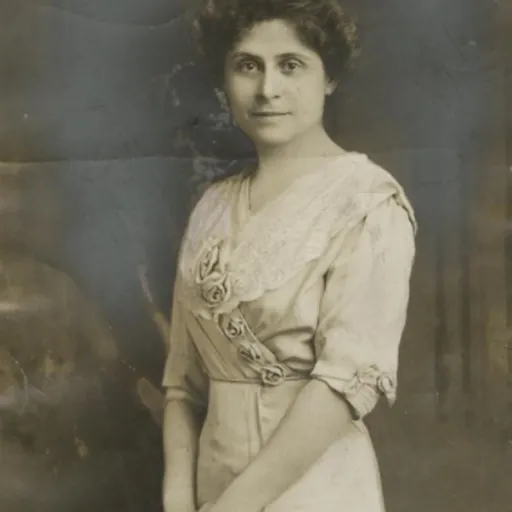
About Caroline Katzenstein
Lived 1888 – 1968 (aged 79–80). Caroline Katzenstein was an American writer, suffragist and women's suffrage.
Caroline Katzenstein (1888 – January 31, 1968) was an American suffragist, activist, advocate for equal rights, insurance agent, and author. She was active in the local Philadelphia suffragist movement through the Pennsylvania branch of the National American Woman Suffrage Association and the Equal Franchise Society of Philadelphia. She played a role in the formation of the Congressional Union for Women Suffrage, which later became the National Women's Party. Katzenstein was also active in the movement for equal rights, serving on the Women's Joint Legislative Committee with Alice Paul, and championing the cause for the Equal Rights Amendment. She was the author of Lifting the Curtain: the State and National Woman Suffrage Campaigns in Pennsylvania as I Saw Them.
Early life and education Caroline Katzenstein was born in 1888 in Warrenton, North Carolina. Her parents were Mr. and Mrs. Emil Katzenstein. In 1907, following the death of her father, Caroline's family moved to Philadelphia. She lived in the Philadelphia neighborhood of Powelton Village.
Activism
Women's right to vote Katzenstein became involved in the fight for women's suffrage in Philadelphia. In 1910, at the age of 22, Katzenstein began her first official role with the Women's Suffrage Movement in the United States, working as secretary for the Pennsylvania Woman Suffrage Association (the Pennsylvania branch of National American Woman Suffrage Association, or NAWSA) and the Women Suffrage Society of Philadelphia, whose joint headquarters were located in Philadelphia until 1912 when they were relocated to Harrisburg; the Philadelphia office was renamed the Headquarters of the Eastern District of Pennsylvania. The Equal Franchise Society of Philadelphia established its headquarters in the same Philadelphia building soon thereafter. The following year, in 1911, Katzenstein was asked to join the National American Woman Suffrage Association committee, on which she served for two years. Paul's methods were viewed as too militant for the NAWSA and as a result, Paul and her supporters – including Katzenstein – formed the Congressional Union for Woman Suffrage, later renamed the National Women's Party (NWP). One of the major differences in approach between the two major organizations was that the former (NAWSA and its affiliates) believed that women's right to vote should be granted at a state-wide level, whereas the latter (the group that would later become the NWP) advocated for a constitutional amendment. She served as executive secretary until early 1916, leaving shortly after the Philadelphia suffrage referendum was rejected. She concluded that state-wide amendments would not effect significant change. The women were on the road for 5 weeks and stopped in Illinois, Kansas, Colorado, Arizona, California, Oregon, Washington, Montana, Idaho, Utah, Colorado, and Missouri prior to their return to DC on May 16. In addition to Katzenstein, the following women were a part of this tour: Lillian Ascough, Abby Scott Baker, Harriot Stanton Blatch, Lucy Burns, Agnes Campbell, Anna Constable, Sarah T. Colvin, Edith Goode, Jane Goode, Florence Bayard Hilles, Julia Hurlbut, Winifred Mallon, Dorothy Mead, Agnes Morey, Katherine Morey, Gertrude B. Newell, Mrs. Percy Read, Ella Riegel, Elizabeth Rogers, Mrs. Townsend Scott, Helen Todd, and Margaret Whittemore. The "Suffrage Special" was successful, and the National Women's Party was formed in Chicago that June.
Katzenstein remained active in the Philadelphia suffrage movement when the Nineteenth Amendment to the United States Constitution was ratified on August 26, 1920.
Equal rights for women Katzenstein was still involved with the NWP following the ratification of the Nineteenth Amendment, and when the Women Teachers Organization of Philadelphia approached the party for aid in their fight for equal pay, she offered to help publicize their efforts. This victory launched Katzenstein into the campaign for equal rights nationwide, in particular the Equal Rights Amendment (ERA). As a representative of the World Woman’s Party, Katzenstein served on the Women’s Joint Legislative Committee with Alice Paul in 1943. During the 1950s Katzenstein poured her energy into writing, both formally and informally: in 1955 she published her first and only book, Lifting the Curtain: the State and National Woman Suffrage Campaigns in Pennsylvania as I Saw Them (1955), in which Alice Paul wrote the preface. Katzenstein also wrote essays and articles under the pseudonym Carol Stone.
Despite the efforts of Katzenstein and other champions for women's rights, the ERA was not passed in the House and Senate until 1971, three years after Katzenstein's death. The amendment is still not ratified today.
Later career Following the success of the suffrage movement, Katzenstein had a long and successful career as an insurance agent at various companies in Philadelphia, including: The Equitable Life Insurance Society of New York, the Philadelphia branch of the Massachusetts Bonding and Insurance Company, and the Philadelphia Life Insurance Company. She died there on January 31, 1968, at the age of 80.
Don’t just read it —
keep it.
Full-length biographies made to live with: read them, listen on the way to work, watch them tonight.
- E-book
- Audio
- Video
Instant download · yours to keep · every purchase keeps this site free
Important facts
People in Caroline Katzenstein's life
Named in this biography and alive at the same time




Related people
Same field, nearest in time



Contemporaries
People whose lives overlapped Caroline Katzenstein's


Frequently asked questions
Who was Caroline Katzenstein?
American suffragist
When was Caroline Katzenstein born?
Caroline Katzenstein was born in 1888 in Warrenton.
When did Caroline Katzenstein die?
Caroline Katzenstein died on 31 January 1968 in Philadelphia, Pennsylvania.
What was Caroline Katzenstein's occupation?
Caroline Katzenstein was a writer, suffragist and women's suffrage.
What nationality was Caroline Katzenstein?
Caroline Katzenstein was American.
Sources & further reading
· Wikipedia: Caroline Katzenstein
· DBpedia: Caroline Katzenstein
Cite this page
APA: Biography.guide. (2026). Caroline Katzenstein. https://biography.guide/caroline-katzenstein/
MLA: "Caroline Katzenstein." Biography.guide, https://biography.guide/caroline-katzenstein/.
Chicago: "Caroline Katzenstein." Biography.guide. https://biography.guide/caroline-katzenstein/.
Data last updated: 2026-09-22 · Spot an error? Report a correction.
Portrait: Wikimedia Commons · author & licence
Page generated 2026-09-27 05:02 UTC