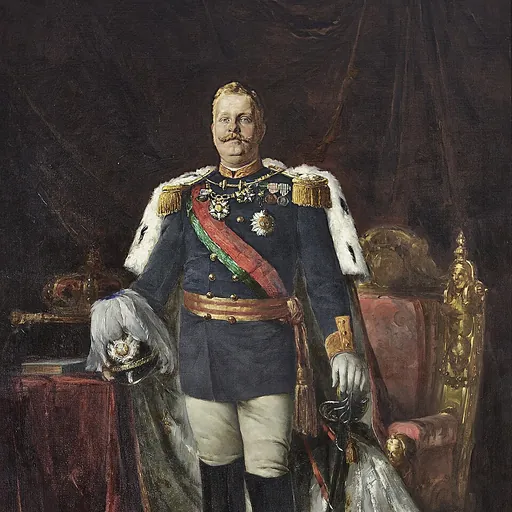
About Carlos I of Portugal
Lived 1863 – 1908 (aged 44). Carlos I of Portugal was a painter and diplomat.
Dom Carlos I (Anglicized: Charles I, ; 28 September 1863 – 1 February 1908), known as "the Diplomat" , "the Oceanographer" among many other names, was King of Portugal from 1889 until his assassination in 1908. He was the first Portuguese king to die a violent death since King Sebastian in 1578, the only one to be assassinated, and penultimate Portuguese head of state to die a violent death.
Early life
Carlos was born in Lisbon, Portugal, the son of King Luís and Queen Maria Pia, daughter of King Victor Emmanuel II of Italy, and was a member of the House of Braganza. He had a brother, Infante Afonso, Duke of Porto. He was baptised with the names Carlos Fernando Luís Maria Víctor Miguel Rafael Gabriel Gonzaga Xavier Francisco de Assis José Simão.
He had an intense education and was prepared to rule as a constitutional monarch. In 1883, he traveled to Italy, the United Kingdom, France and Germany, where he increased his knowledge of the modern civilization of his time. In 1883, 1886 and 1888, he ruled as Regent as his father was traveling in Europe, as had become traditional among the Portuguese constitutional kings. His father Luis I advised him to be modest and to study with focus.
His first bridal candidate was one of the daughters of German Emperor Frederick III, but the issue of religion presented an insurmountable problem, and diplomatic pressure from the British government prevented the marriage. He then met and married Princess Amélie of Orléans, eldest daughter of Philippe, comte de Paris, pretender to the throne of France.
Reign King Carlos I delivering the Crown speech at the opening of the Parliament in Lisbon, 1900. Carlos became king on 19 October 1889. After the 1890 British Ultimatum, a series of treaties were signed with the United Kingdom. One signed in August 1890 defined colonial borders in Africa along the Zambezi and Congo rivers, whereas another signed on 14 October 1899 confirmed colonial treaties dating back to the 17th century. These treaties stabilised the political balance in Africa, ending Portuguese claims of sovereignty on the Pink Map, a geographical conception of how Portuguese colonies would appear on a map if the territory between the coastal colonies of Angola and Mozambique could be connected with territory in central Africa. These central African territories became part of the British Empire with the Portuguese concession becoming a source of national resentment in the country.
Domestically, Portugal declared bankruptcy twice – on 14 June 1892, then again on 10 May 1902 – causing industrial disturbances, socialist and republican antagonism and press criticism of the monarchy. Carlos responded by appointing João Franco as prime minister and subsequently accepting parliament's dissolution. riding by the carriage. While the carriage was crossing the square at dusk, shots were fired from amongst the sparse crowd by two republican activists, Alfredo Luís da Costa and Manuel Buíça.
Buíça, a former army sergeant and sharpshooter, fired five shots from a rifle hidden under his long overcoat. The king died immediately, his heir Luís Filipe was mortally wounded, and Prince Manuel was hit in the arm. The queen escaped injury. The two assassins were killed on the spot by police, and an innocent bystander, João da Costa, was also shot dead in the confusion. The royal carriage turned into the nearby Navy Arsenal, where, about twenty minutes later, Prince Luís Filipe died. Several days later, the younger son, Prince Manuel, was proclaimed king of Portugal. He was the last of the Braganza-Saxe-Coburg and Gotha dynasty and the final king of Portugal.
Marriage and children Carlos I and Dona Maria Amélia with their firstborn son, 1888. Carlos I was married to Princess Amélie of Orléans on 22 May 1886. She was the daughter of Philippe, Count of Paris, and Princess Marie Isabelle of Orléans. They had three children: Luís Filipe, Prince Royal of Portugal (21 March 1887 – 1 February 1908) Infanta Maria Ana of Braganza (b/d 14 December 1887) Manuel II, King of Portugal between 1908 and 1910 (15 November 1889 – 2 July 1932)
Allegedly, Carlos I had several extramarital relationships, from which some bastards were born. He may have had a daughter from an American. By Grimaneza Viana de Lima, a Peruvian widow of a Brazilian diplomat, he possibly had a daughter called Maria Pia, born before 1902. Grimaneza was his last great passion. Allegedly, he also had, from the Brazilian Maria Amélia Laredó e Murça, another bastard daughter, born in 1907 and also called Maria Pia. During his life, Carlos I never officially recognized the paternity of any bastard child, despite the fact that he himself was responsible for fueling suspicions about his illegitimate offspring.
Honours Portuguese Grand Commander of the Three Military Orders of Christ, Aviz and St. James Grand Cross of the Tower and Sword Grand Cross of the Immaculate Conception of Vila Viçosa
Foreign Grand Cross of the Southern Cross, 1873 Denmark: Knight of the Elephant, 7 October 1883 Knight of the Black Eagle, 10 September 1883 Grand Cross of the Red Eagle Ernestine duchies: Grand Cross of the Saxe-Ernestine House Order, 1884 Hesse and by Rhine: Grand Cross of the Ludwig Order, 24 September 1883 Grand Cross of the White Falcon, 1883 Knight of the Rue Crown, 1883 Knight of the Annunciation, 31 December 1873 Grand Cross of Saints Maurice and Lazarus, 31 December 1873 Grand Cross of the Crown of Italy, 31 December 1873
Bailiff Grand Cross of Honour and Devotion Grand Cross of the Order of Carol I, with Collar, 1906 Siam: Knight of the Order of the Royal House of Chakri, 23 October 1897 Kingdom of Spain: Knight of the Golden Fleece, 11 December 1866 Grand Cross of the Order of Charles III, with Collar, 12 December 1902 Sweden-Norway: Knight of the Seraphim, 23 May 1873 Grand Cross of St. Olav, 11 October 1883 Stranger Knight Companion of the Garter, 9 November 1895 Recipient of the Royal Victorian Chain, 19 November 1902 Knight of St. Andrew Knight of St. Alexander Nevsky Knight of the White Eagle Knight of St. Anna, 1st Class Knight of St. Stanislaus, 1st Class
Ancestry
Don’t just read it —
keep it.
Full-length biographies made to live with: read them, listen on the way to work, watch them tonight.
- E-book
- Audio
- Video
Instant download · yours to keep · every purchase keeps this site free
Important facts
more
Carlos I, King of PortugalFamily & relationships
People in Carlos I of Portugal's life
Named in this biography and alive at the same time


Related people
Same field, nearest in time


Contemporaries
People whose lives overlapped Carlos I of Portugal's





Frequently asked questions
Who was Carlos I of Portugal?
King of Portugal from 1889 to 1908 (1863–1908)
When was Carlos I of Portugal born?
Carlos I of Portugal was born on 28 September 1863 in Palace of Ajuda.
When did Carlos I of Portugal die?
Carlos I of Portugal died on 1 February 1908 in Praça do Comércio.
What was Carlos I of Portugal's occupation?
Carlos I of Portugal was a painter and diplomat.
What nationality was Carlos I of Portugal?
Carlos I of Portugal's recorded nationality: Kingdom of Portugal.
Sources & further reading
· Wikipedia: Carlos I of Portugal
· DBpedia: Carlos I of Portugal
Cite this page
APA: Biography.guide. (2026). Carlos I of Portugal. https://biography.guide/carlos-i-of-portugal/
MLA: "Carlos I of Portugal." Biography.guide, https://biography.guide/carlos-i-of-portugal/.
Chicago: "Carlos I of Portugal." Biography.guide. https://biography.guide/carlos-i-of-portugal/.
Data last updated: 2026-09-22 · Spot an error? Report a correction.
Portrait: Wikimedia Commons · author & licence
Page generated 2026-09-27 05:02 UTC