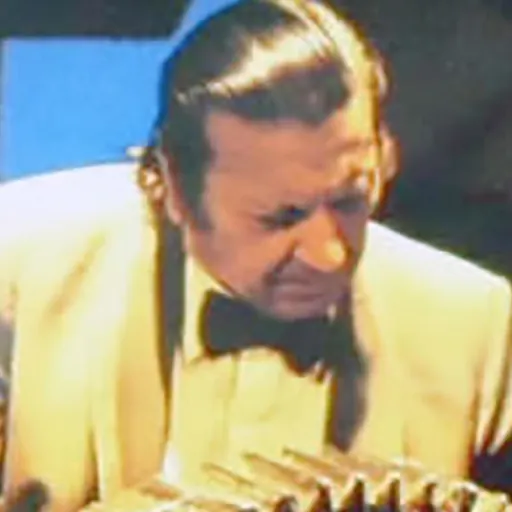
About Carlos Ángel Lázzari
Lived 1925 – 2009 (aged 83). Carlos Ángel Lázzari was an Argentine music arranger, bandoneonist, composer and conductor.
Carlos Ángel Lazzari (Buenos Aires, Argentina, December 9, 1925 – ibidem, June 7, 2009), also known by his pseudonym Palmer, was a bandoneonist, composer, arranger, and orchestra conductor dedicated to the tango genre. He spent 26 years in the bandoneon section of Juan D'Arienzo's orchestra.
He later joined Francisco Canaro’s orchestra, playing alongside the Uruguayan bandoneonist Minotto Di Cicco, where he learned the bandoneón cadenero technique —those signature flowing skills that helped define the sound of the great orchestras of the time. He then had brief stints with the ensembles of Juan Canaro and Domingo Federico.
In 1950, Héctor Varela and Alberto San Miguel, the first and second bandoneonists of Juan D’Arienzo’s orchestra, left the group. Francisco Canaro himself recommended Lazzari—then 25 years old—as a replacement. Lazzari, in turn, recommended Enrique Alessio, who became the first bandoneonist. The bandoneon section was completed by Aldo Junnissi, Felipe Ricciardi, and Eladio Blanco, while Fulvio Salamanca set the rhythm from the piano.
When Alessio and Salamanca left the ensemble, the role of cadenero fell to Lazzari, along with that of arranger. The ovations from an audience that faithfully followed D'Arienzo over the years—filling clubs, cabarets, and any venue where he performed (they sometimes played up to thirty dances a month, including matinées and evening shows in addition to cabaret performances)—testify to the success of Lazzari’s work. He was even the one who discovered the singer Jorge Valdez and brought him into the orchestra.
When D'Arienzo retired from performing, his musicians formed Los solistas de D'Arienzo, directed by Lazzari, who also organized and led La Juan D'Arienzo. With these groups, they traveled frequently to Japan, where they were idolized. The ensemble included pianist Normando Lazzara, violinist Milo Dojman, double bassist Enrique Guerra, and singers Osvaldo Ramos and Alberto Echagüe, in addition to Lazzari himself.
They also formed, with the proper authorization from D'Arienzo's heir, the Orquesta Símbolo Juan D'Arienzo, and made successful trips to Japan from the 1980s through the 2000s. One of the last lineups of the quartet included, besides Lazzari and his bandoneón, double bassist Héctor Guri, violinist Daniel Margenat (later replaced by Ricardo Buonvicino), pianist Raúl Monti (later replaced by Alfredo Montoya), and singer Walter Gutiérrez.
Notable works Among his more than two hundred works, notable ones include Castigo y pasión, with Ernesto Rodríguez and Juan Polito; Calla bandoneón, with Oscar Rubens; the waltz De vuelta, with Carlos Bahr, recorded twice by Carlos Di Sarli; Don Alfredo, with Ramón Montoya; Engañadora, with Enrique Alessio; Este es el rey, with Juan Polito; Glorioso Chantecler, with Juan Polito and Ángel Gatti; Hoy te quiero mucho más, with Horacio Sanguinetti; Julie, with Enrique Alessio, notably interpreted by Osvaldo Pugliese; Mechongue, with Juan Polito and Donato Racciatti; and Nuestro último vals, with Normando Lázara.
Don’t just read it —
keep it.
Full-length biographies made to live with: read them, listen on the way to work, watch them tonight.
- E-book
- Audio
- Video
Instant download · yours to keep · every purchase keeps this site free
Important facts
People in Carlos Ángel Lázzari's life
Named in this biography and alive at the same time




Related people
Same field, nearest in time




Contemporaries
People whose lives overlapped Carlos Ángel Lázzari's




Frequently asked questions
Who was Carlos Ángel Lázzari?
Argentinian composer
When was Carlos Ángel Lázzari born?
Carlos Ángel Lázzari was born on 9 December 1925 in Buenos Aires.
When did Carlos Ángel Lázzari die?
Carlos Ángel Lázzari died on 9 June 2009 in Buenos Aires.
What was Carlos Ángel Lázzari's occupation?
Carlos Ángel Lázzari was a music arranger, bandoneonist, composer and conductor.
What nationality was Carlos Ángel Lázzari?
Carlos Ángel Lázzari was Argentine.
Sources & further reading
· Wikipedia: Carlos Ángel Lázzari
Cite this page
APA: Biography.guide. (2026). Carlos Ángel Lázzari. https://biography.guide/carlos-angel-lazzari/
MLA: "Carlos Ángel Lázzari." Biography.guide, https://biography.guide/carlos-angel-lazzari/.
Chicago: "Carlos Ángel Lázzari." Biography.guide. https://biography.guide/carlos-angel-lazzari/.
Data last updated: 2026-09-20 · Spot an error? Report a correction.
Portrait: Wikimedia Commons · author & licence
Page generated 2026-09-27 04:58 UTC