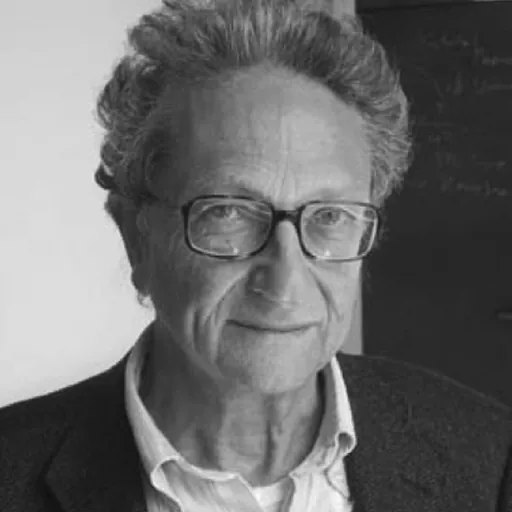
Carlo Di Castro
Italian theoretical physicist (born 1937)
About Carlo Di Castro
Born 1937. Carlo Di Castro is an Italian theoretical physicist and university teacher.
Carlo Di Castro (born 14 August 1937) is an Italian theoretical physicist in the field of statistical mechanics, superconductivity, and condensed matter physics. He is a patriarch of Italian theoretical condensed matter physics, founder of the condensed matter Rome group (together with Claudio Castellani), full member of the Accademia dei Lincei, and emeritus professor of Sapienza University of Rome. In 1969, Di Castro, in co-authorship with Giovanni Jona-Lasinio, introduced the renormalization group approach into the study of critical phenomena (almost two years before the celebrated papers by Kenneth G. Wilson, laureate of the Nobel Prize in Physics in 1982), providing a first example of complexity in physical systems.
Early life, education, and professional career
Carlo Di Castro was born in Rome to a Jewish family. ). With Roberto Raimondi, Carlo Di Castro authorised the volume Statistical Mechanics and Applications in Condensed Matter.
Research interests and highlights Carlo Di Castro's main research interest has been the understanding of collective properties of condensed matter and many-body systems, whose behavior cannot be explained in terms of single particle paradigms and whose emergent low energy properties are qualitatively different from those of non-interacting systems. Particular attention has been given to the phenomenology of superfluid Helium & superconductivity, criticality & quantum criticality, strongly correlated and disordered electron systems, metal-insulator transitions, and high-temperature superconductors. He has pioneered the renormalization group (RG) approach to critical phenomena providing the basis for the derivation of the scaling theory of critical phenomena in 1969. His approach was summarized in . In 1971 he developed the first field theoretical formulation of the famous ε-expansion by K. G. Wilson and M. E. Fisher to calculate critical exponents.
He extended the RG approach to quantum Bose and anomalous Fermi-Luttinger liquids. In the former problem he tackled the long-standing problem of three-dimensional infrared singularities in the calculation of the quasi-particle spectrum of superfluid Helium. For the Fermi case - in contradiction to Anderson's proposal for strange metal behavior in high-temperature superconductors - he studied the crossover between the one-dimensional Luttinger liquid to Landau-Fermi liquids in higher dimensions.
The interplay between Mott metal-insulator transition due to correlations and Anderson localization due to disorder was considered one of the main open problems in the 1980s. Di Castro used symmetry properties of the Hubbard Hamiltonian to characterize the order parameter of the Mott transition and, using renormalization group and symmetry properties, made key contributions to the theory of interacting disordered electron systems beyond Anderson localization. The achievements in this field are well represented in the proceedings of the International Symposium held in Tokio August 16–18, 1987. The problem of the existence of a disordered metallic phase in two-dimensions (which is still unresolved) was also addressed.
His research group proposed in the 1990s a scenario of high-temperature cuprate superconductors and of their anomalous metallic state based on phase separation and charge density wave order with quantum criticality, which was ahead of its time. Since 2012, charge density wave order has been observed routinely in cuprates and is now the most studied phenomenon among competing orders. Recently, Di Castro proposed that the violation of the Fermi liquid paradigm and the formation of the so-called strange metal state in cuprates and other materials near quantum critical points, arise from nearly overdamped charge fluctuations of the local order parameter.
Honors and awards Member of the IUPAP Condensed Matter Physics Commission (1993–1999). Presidential Gold Medal for services to education and culture (2003). Humboldt Research Award in recognition of his accomplishments in research and teaching (2004) Meritorious Member of the Italian Physical Society (2015).
Don’t just read it —
keep it.
Full-length biographies made to live with: read them, listen on the way to work, watch them tonight.
- E-book
- Audio
- Video
Instant download · yours to keep · every purchase keeps this site free
Important facts
People in Carlo Di Castro's life
Named in this biography and alive at the same time

Related people
Same field, nearest in time


Contemporaries
People whose lives overlapped Carlo Di Castro's



Frequently asked questions
Who is Carlo Di Castro?
Italian theoretical physicist (born 1937)
When was Carlo Di Castro born?
Carlo Di Castro was born in 1937 in Rome.
What is Carlo Di Castro's occupation?
Carlo Di Castro is a theoretical physicist and university teacher.
What nationality is Carlo Di Castro?
Carlo Di Castro is Italian.
Sources & further reading
Cite this page
APA: Biography.guide. (2026). Carlo Di Castro. https://biography.guide/carlo-di-castro/
MLA: "Carlo Di Castro." Biography.guide, https://biography.guide/carlo-di-castro/.
Chicago: "Carlo Di Castro." Biography.guide. https://biography.guide/carlo-di-castro/.
Data last updated: 2026-09-23 · Spot an error? Report a correction.
Portrait: Wikimedia Commons · author & licence
Page generated 2026-09-27 05:07 UTC