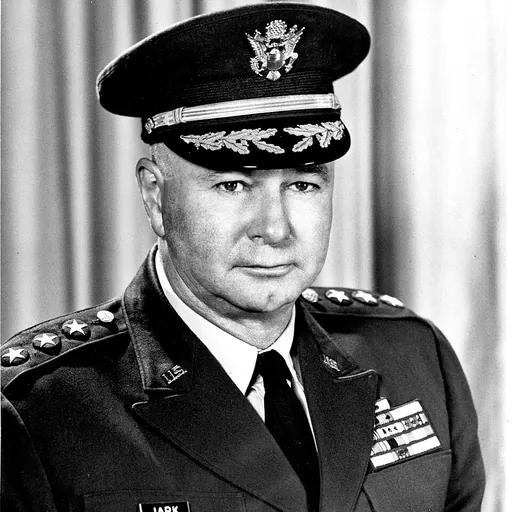
About Carl H. Jark
Lived 1905 – 1984 (aged 78). Carl H. Jark was an American military officer and athletics competitor.
Carl Henry Jark (June 13, 1905 – March 22, 1984) was a highly decorated officer in the United States Army with the rank of Lieutenant General. While Cadet at the United States Military Academy at West Point, New York he broke the world's discus throw record in 1929 at the Drake Relays.
A veteran of World War II, Jark distinguished himself as Executive officer of Artillery of the 63rd Infantry Division ("Blood and Fire") serving in the European theatre. He remained in the Army following a war and took part in the Korean War as Deputy Assistant Chief of Staff for Operations on the General Headquarters of Far East Command in Tokyo, Japan rising to the rank of Brigadier general.
Upon graduation with Bachelor of Science degree on his 24th birthday, he was commissioned second lieutenant in the Field Artillery and ordered to the Air Corps Primary Flying School at March Field, California for aviation training. He sought to be a pilot and his instructors included late generals Millard F. Harmon or Leo A. Walton, however he was not able to complete the training and was relieved from the in late January 1930. Jark with officers of 63rd Division Artillery at Gerstetten, Germany, April 25, 1945. Jark was subsequently assigned to the Department of Gunnery within the Army Field Artillery School and served as an Instructor until January 1943, when he was ordered to the Army Command and General Staff School at Fort Leavenworth, Kansas. He completed the twelve-week special course in May that year and joined the Plans and Operations at the headquarters of Army Ground Forces in Washington, D.C. While in this capacity, Jark was promoted to the temporary rank of Colonel in late January 1944 and ordered to the South Pacific as an Observer with 4th Marine Regiment participating in the unopposed landing on Emirau in late March 1944.
In early January 1952, Jark was transferred to the headquarters of 1st Cavalry Division under Major general Thomas L. Harrold and assumed duty as Commanding Officer of Divisional Artillery. He accompanied division to Hokkaido, the northernmost island in Japan, where it carried out combat training, electronic surveillance and defense of Japan from potential attacks by the Soviet Union or China. While in this capacity, Jark was promoted to the temporary rank of Brigadier general on May 15, 1952. Jark during inspection of Military Police detachment at Camp Wolters, Texas in January 1963. In February 1954, Jark was transferred to Camp Polk, Louisiana and joined one of these training units, 37th Infantry Division. He was appointed commanding general of Divisional Artillery under Major general Philip DeWitt Ginder and took part in the exercise Flash Burn, atomic maneuvers in North Carolina. Few weeks after that, it was decided that all division's equipment was to be transferred to 10th Infantry Division and 37th Division will be returned under control of Ohio National Guard. Jark moved to Fort Riley, Kansas in late May 1954 and supervised the transition of his staff to 10th Infantry Division. He then assumed duty as commanding general of 10th Infantry Division's Artillery and served in this capacity until the end of August 1954.
Upon his return to the United States in September 1957, Jark was assigned to the Office of the Secretary of Defense in Washington, D.C. and served as Deputy U.S. Representative on the Military Committee and Standing Group of NATO until December 1959 when he was transferred to France for duty as Director of J-3 (Operations), U.S. European Command under General Lauris Norstad with headquarters at Camp des Loges near Paris.
Jark was nominated and promoted to the rank of Lieutenant General by President John F. Kennedy on March 1, 1962 and assumed his final duty as Commanding general, Fourth United States Army at Fort Sam Houston, Texas. The Fourth Army area of responsibility was made up of Texas, Arkansas, Louisiana, Oklahoma and New Mexico. His command included III Corps which was half of the Strategic Army Corps (STRAC) which comprised 1st and 2nd Armored Divisions. Beside that his command also included overall command of multiple divisions and Army Posts, that included Army Artillery School at Fort Sill, Oklahoma; White Sands Missile Range; Army Air Defense Center at Fort Bliss; Fort Polk; Fort Chaffee, and Rotary-wing flight training center at Fort Wolters.
He completed 35 years of service and retired on July 31, 1964, receiving Army Distinguished Service Medal during his retirement ceremony. To honor his service, United States Representative from the Texas 20th congressional district Henry B. González read details of Jark's military career into the Congressional Record,
Decorations
Here is lieutenant general Jark's ribbon bar:
BadgesArmy Staff Identification BadgeSecretary of Defense Identification Badge
Don’t just read it —
keep it.
Full-length biographies made to live with: read them, listen on the way to work, watch them tonight.
- E-book
- Audio
- Video
Instant download · yours to keep · every purchase keeps this site free
Important facts
People in Carl H. Jark's life
Named in this biography and alive at the same time


Related people
Same field, nearest in time


Contemporaries
People whose lives overlapped Carl H. Jark's



Frequently asked questions
Who was Carl H. Jark?
US military personnel (1905–1984)
When was Carl H. Jark born?
Carl H. Jark was born on 13 June 1905.
When did Carl H. Jark die?
Carl H. Jark died on 22 March 1984 in San Antonio.
What was Carl H. Jark's occupation?
Carl H. Jark was a military officer and athletics competitor.
What nationality was Carl H. Jark?
Carl H. Jark was American.
Sources & further reading
Cite this page
APA: Biography.guide. (2026). Carl H. Jark. https://biography.guide/carl-h-jark/
MLA: "Carl H. Jark." Biography.guide, https://biography.guide/carl-h-jark/.
Chicago: "Carl H. Jark." Biography.guide. https://biography.guide/carl-h-jark/.
Data last updated: 2026-09-20 · Spot an error? Report a correction.
Page generated 2026-09-27 05:10 UTC