About Captain Costentenus
Born 1833. Captain Costentenus was a circus performer.
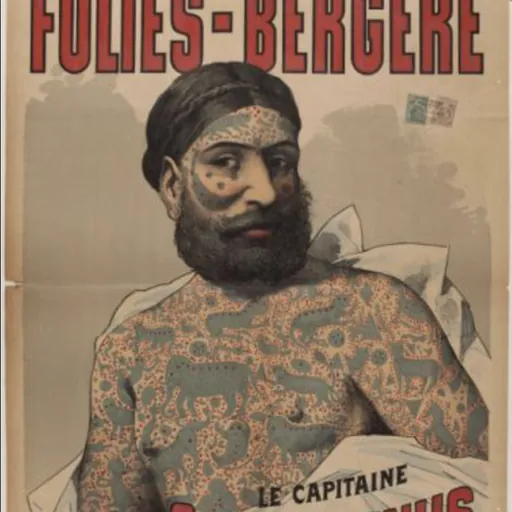
Captain George Costentenus, also known as "The Greek Albanian" or "The Tattooed Greek Prince", (April 17, 1833 – ?) was a circus performer in the late 1800s. A man who was tattooed over his entire body, he was a famous traveling attraction who claimed to have been kidnapped by Chinese Tartars and tattooed against his will. His surname was sometimes spelled as Constantenus and Constantinius. He was also known as Djordgi Konstantinus and Georgius Constantine.
Early life George Costentenus was born on April 17, 1833. He was a native of Albania, in the Ottoman Empire, however his family was ethnically Greek and they were Christians.
Career After being examined by the academic community, Costentenus began to exhibit himself in western Europe. In October 1874, Costentenus was exhibiting himself in Paris, France.
He came to United States around 1875 due to the coming Centennial Exposition.
He toured with P. T. Barnum's New and Greatest Show on Earth in 1876 and 1877.
In June 1878, while again on tour with Barnum a fight broke between Costentenus and the giant Colonel Routh Goshen. The fight was said to have originated after Costentenus insulted some ladies within Goshen's presence. Costentenus was injured during the fight. Costentenus toured the United States with Barnum again in 1879 and 1880.
In early 1882, he was exhibiting himself at the Royal Aquarium with an exhibition arranged by William Leonard Hunt. That same year, he became a resident of New York City.
In December 1883, Costentenus applied for United States citizenship. At the time, he was planning to go to Europe for treatment for his failing eyesight, but wanted to do so as an American citizen. At the time he was blind in one eye and losing his sight in the other. He claimed to have been in the country for seven years.
He became an American citizen on December 22, 1883. On February 16, 1884, he sailed for Europe aboard the SS Republic. In 1885 he was said to have gone blind and retired to a wealthy estate in Greece. By June 1889, he was exhibiting himself at the Folies Bergère in Paris, France. In October 1889, he returned to New York.
In 1890, he applied for a passport to travel to Europe and planned to return two years later. He applied for another passport in 1894. After that date he disappears from records.
Marketing and public image
From the time he began exhibiting in western Europe in the mid-1870s, Costentenus was marketed as both an exotic curiosity and an educated gentleman. Advertisements in Europe and the United States variously described him as "The Tattooed Greek Prince", "The Greek Albanian", and "The Arvanite Greek", emphasizing aristocratic and foreign identities that enhanced his appeal to audiences.
Footnotes
Don’t just read it —
keep it.
Full-length biographies made to live with: read them, listen on the way to work, watch them tonight.
- E-book
- Audio
- Video
Instant download · yours to keep · every purchase keeps this site free
Important facts
Related people
Same field, nearest in time


Frequently asked questions
Who was Captain Costentenus?
circus performer
When was Captain Costentenus born?
Captain Costentenus was born on 17 April 1833.
What was Captain Costentenus's occupation?
Captain Costentenus was a circus performer.
Sources & further reading
· Wikipedia: Captain Costentenus
· DBpedia: Captain George Costentenus
Cite this page
APA: Biography.guide. (2026). Captain Costentenus. https://biography.guide/captain-costentenus/
MLA: "Captain Costentenus." Biography.guide, https://biography.guide/captain-costentenus/.
Chicago: "Captain Costentenus." Biography.guide. https://biography.guide/captain-costentenus/.
Data last updated: 2026-09-20 · Spot an error? Report a correction.
Page generated 2026-09-27 05:10 UTC