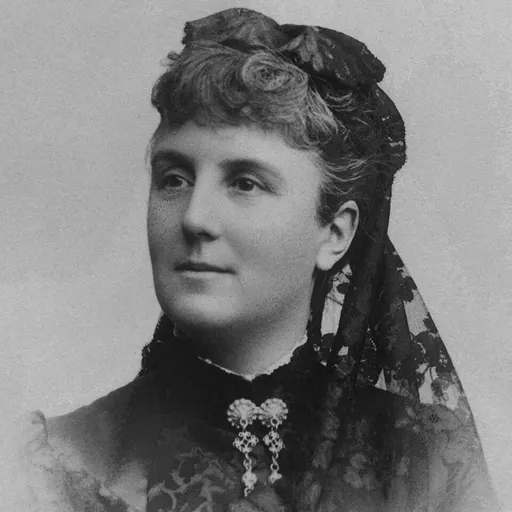
About Calla Curman
Lived 1850 – 1935 (aged 84). Calla Curman was a Swedish socialite, philanthropist and salonnière.
Curman with fan and two unknown men on the Alhambra palace grounds, in Granada, Andalusia, Spain. Calla Curman (; 12 November 1850 – 2 February 1935) was a Swedish writer, salon-holder and feminist. She was also the founder of Stångehuvud nature reserve and one of the five founders of the women's association Nya Idun.
Family Calla Lundström was born on 12 November 1850 in Jönköping, Sweden, the only child of wealthy industrialist and his wife Sofie Malmberg (1830–1897). She received in-home tutoring from a private tutor. At the age of 17, she married Adolf Liljenroth (1836–1874), a battalion physician, with whom she had two children, and .
A few years after she was widowed, Lundström's parents took her on a trip to Italy. The educated Carl Curman, whom she had met on a visit with her mother to Lysekil during a few summer weeks in 1864, was invited to join them as a guide for the Italian trip. In 1877, she returned to Lysekil, then as Professor Carl Curman's guest. The following year they were married. He had worked as a spa doctor in Lysekil since 1859. With Curman, she had children , Ingrid Fries, Nanna Fries and Carl G. Curman.
Activity Curman was the initiator of the founding of the Nya Idun women's society in 1885; it was founded together with Ellen Fries, Hanna Winge, Ellen Key, and Amelie Wikström.
Curman was also involved in several other issues. Among other things, she was a member of the board of the Friends of Handicraft, founded in 1874, a member of the Swedish Dress Reform Association, a member of the board of the Stockholm Reading Room on Kungsholmen 1898–1900, a member of the board of the ('Society for Unison Singing') 1908–1915, and was on the local board in Stockholm of the ('National Association for the Preservation of Swedishness Abroad') 1918–1924. She became honorary president of the latter association in 1928. She was also an accomplished pianist, publishing her booklet of compositions in 1897 and was one of those calling for the establishment of Mother's Day in 1919. She was awarded the Illis quorum and the Friends of Handicraft Medal.
The Curman villas and the Stångehuvud nature reserve
Curman indignantly points to petroglyphs mistreated by stonecutters in Brastad, Sweden ca. 1907.
In 1878–1880, the Curmans built two villas in the Dragestil style, also known as the , which are characteristic features of Lysekil's townscape.
Works
Don’t just read it —
keep it.
Full-length biographies made to live with: read them, listen on the way to work, watch them tonight.
- E-book
- Audio
- Video
Instant download · yours to keep · every purchase keeps this site free
Important facts
Family & relationships
People in Calla Curman's life
Named in this biography and alive at the same time

Related people
Same field, nearest in time

Contemporaries
People whose lives overlapped Calla Curman's





Frequently asked questions
Who was Calla Curman?
Swedish writer and feminist
When was Calla Curman born?
Calla Curman was born on 12 November 1850 in Jönköpings Kristina församling.
When did Calla Curman die?
Calla Curman died on 2 February 1935 in Varbergs parish, Engelbrekt church parish.
What was Calla Curman's occupation?
Calla Curman was a socialite, philanthropist and salonnière.
What nationality was Calla Curman?
Calla Curman was Swedish.
Sources & further reading
Cite this page
APA: Biography.guide. (2026). Calla Curman. https://biography.guide/calla-curman/
MLA: "Calla Curman." Biography.guide, https://biography.guide/calla-curman/.
Chicago: "Calla Curman." Biography.guide. https://biography.guide/calla-curman/.
Data last updated: 2026-09-23 · Spot an error? Report a correction.
Portrait: Wikimedia Commons · author & licence
Page generated 2026-09-27 05:07 UTC