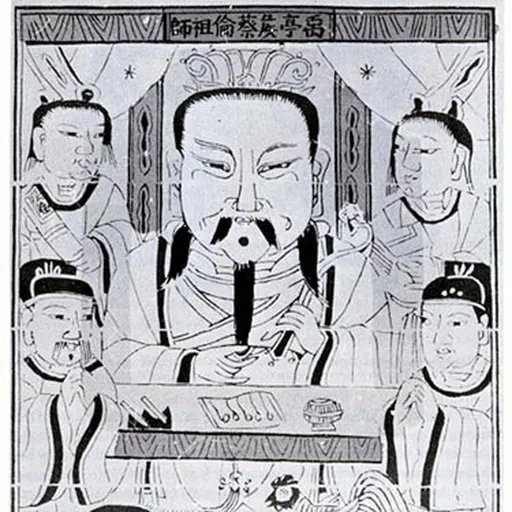
Cai Lun
Chinese official credited with inventing paper (died 121)
About Cai Lun
Lived AD 48 – 121 (aged 72–73). Cai Lun was a Chinese inventor, politician, eunuch and beamter.
Cai Lun (; courtesy name: Jingzhong ; – 121 CE), formerly romanized as Ts'ai Lun, was a Chinese eunuch court official of the Eastern Han dynasty. He occupies a pivotal place in the history of paper due to his addition of pulp via tree bark and hemp ends which resulted in the large-scale manufacture and worldwide spread of paper. Although traditionally regarded as the inventor of paper, earlier forms of paper have existed since the 3rd century BCE, so Cai's contributions were an innovation, rather than an invention.
Born in (in what is now Leiyang), Cai arrived at the imperial court in Luoyang by 75 CE, where he served as a chamberlain for Emperor Ming, and then as , an imperial messenger for Emperor Zhang. To assist Lady Dou in securing her adopted son as designated heir, he interrogated Consort Song and her sister, who then killed themselves. When Emperor He ascended the throne in 88 CE, Dou awarded Cai with two positions: , a political counselor to the emperor that was the highest position for eunuchs of the time, and also as , where Cai oversaw the production of instruments and weapons at the Palace Workshop.
Despite Emperor He's successful coup d'état against the Dou family in 92 CE, Cai was undisturbed by his former ally's downfall. His position in the Palace Workshop increased in scope; he became responsible for the production of ceremonial weapons, which the reports were of exemplary craftsmanship. However, Cai's most noted innovation was in 105 CE, when he substantially improved the papermaking process with the use of tree bark, hemp waste, old rags, and fishnets. His new type of paper quickly displaced the bamboo and wooden slips used until then, and Cai received wealth and fame throughout the empire. In 110 CE, Lady Deng, who had become the empress dowager to the young Emperor An, appointed Cai to oversee 100 scholars' new edition of the Five Classics. Cai was rewarded for his imperial service in 114 CE; he received the title of marquis, and was enfeoffed lord of , a small village. When his ally Deng died in 121 CE, Cai was ordered to the Ministry of Justice because of his involvement in the death of the emperor's grandmother, Consort Song. Ashamed at his predicament and expecting to be sentenced to death, he committed suicide that year and died in the capital city in which he had spent almost his entire adult life.
Cai's improvements to paper-making are considered to have had an enormous impact on human history, and of those who created China's Four Great Inventions—the compass, gunpowder, papermaking and printing—Cai is the only early figure whose name is known. Although in China he is revered in ancestor worship, deified as the god of papermaking, and appears in Chinese folklore, he is mostly unknown outside of East Asia. His hometown in Leiyang remains an active center of paper production.
Don’t just read it —
keep it.
Full-length biographies made to live with: read them, listen on the way to work, watch them tonight.
- E-book
- Audio
- Video
Instant download · yours to keep · every purchase keeps this site free
Important facts
Related people
Same field, nearest in time




Contemporaries
People whose lives overlapped Cai Lun's




Frequently asked questions
Who was Cai Lun?
Chinese official credited with inventing paper (died 121)
When was Cai Lun born?
Cai Lun was born in AD 48 in Leiyang.
When did Cai Lun die?
Cai Lun died in 121 in Luoyang.
What was Cai Lun's occupation?
Cai Lun was an inventor, politician, eunuch and beamter.
What nationality was Cai Lun?
Cai Lun was Chinese.
Sources & further reading
Cite this page
APA: Biography.guide. (2026). Cai Lun. https://biography.guide/cai-lun/
MLA: "Cai Lun." Biography.guide, https://biography.guide/cai-lun/.
Chicago: "Cai Lun." Biography.guide. https://biography.guide/cai-lun/.
Data last updated: 2026-09-23 · Spot an error? Report a correction.
Portrait: Wikimedia Commons · author & licence
Page generated 2026-09-27 05:05 UTC