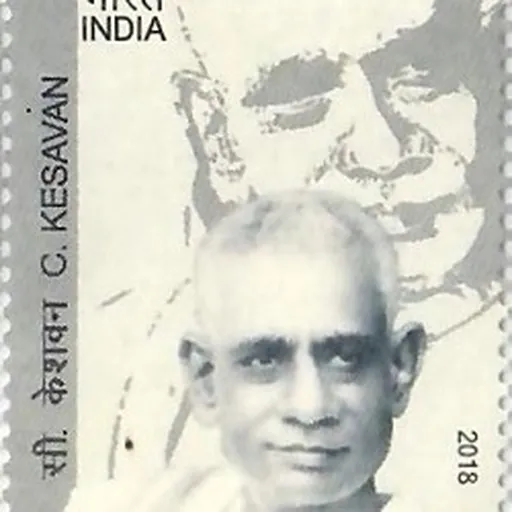
About C. Kesavan
Lived 1891 – 1969 (aged 78). C. Kesavan was an Indian lawyer, politician and freedom fighter.
C. Kesavan (23 May 1891 – 7 July 1969) was an Indian politician who served as the chief minister of Travancore-Cochin from 1950 to 1952. He began his public life as an activist in the Ezhava movement, and gained prominence through his leadership in the Nivarthana movement (abstension movement) in Travancore, demanding adequate representation for backward communities in the legislature.
Early life He was born in 1891 in the village of Mayyanad, near Kollam in the then princely state of Travancore. In 1930s, Kesavan argued that the Ezhavas should declare that they do not belong to the Hindu religion. Due to a speech he made at a public meeting in Kozhencherry he was arrested on 7 June 1935, tried for sedition, and sentenced to two years imprisonment.
As politician
Kesavan took an active part in organizing Travancore State Congress and became a member of its working Committee. During the agitation for responsible government in Travancore, he was arrested several times. During Quit India movement in 1942, Kesavan was sentenced to one year simple imprisonment and was released on 19 July 1943. After independence, Kesavan was elected to Travancore Assembly and became a member of the first cabinet headed by Pattom Thanu Pillai, but resigned after few months. Kesavan became Chief Minister of the erstwhile Travancore-Cochin (Thiruvithamkoor-Kochi) state in 1951 and was elected to State Assembly in 1952.
The Kollam Corporation Town Hall was named the C. Kesavan Memorial Municipal Town Hall in Kesavan's memory. It is on the National Highway passing through the Kollam Cantonment. He was instrumental in starting the Medical College at Thiruvananthapuram. He has also worked for establishing a Govt. Hospital in his home town Mayyanad which functioned well in its helm days and later shrank to a health center.
In May 1950, he made a controversial statement when a fire broke out at the Sabarimala Temple. He remarked: "If a temple is destroyed that much of superstition will be destroyed" ("ഒരു അമ്പലം നശിച്ചാല് അത്രയും അന്ധവിശ്വാസം നശിക്കും").
As chief minister
Kesavan was sworn in as Chief Minister of Travancore-Cochin on 3 March 1951. T. K. Narayana Pillai and A. J. John were the ministers. Both the ministers resigned in September 1951. After the declaration of general election of 1952, the Kesavan ministry relinquished power on 12 March 1952. The Land Reforms Bill was piloted by Kesavan, but failed to pass. The Trivandrum Medical College was opened by Prime Minister Jawaharlal Nehru during Kesavan's tenure.
+Ministry membersMemberRoleDates Mr. C. Kesavan Chief Minister Mr. Parur T.K. Narayana Pillai Food, Labour and Education Assumed office on 5 March 1951 Resigned with effect from 5 September 1951 Mr. A. J. John Finance, Revenue and Public Health Assumed office on 5 March 1951 and resigned with effect from 5 September 1951 Mr. K. M. Korah (Karivelithara Mathew Korah) Finance and Food (Assumed office on 6 September 1951) Mr. G. Chandrasekhara Pillai Public Works (Assumed office on 6 September 1951) Mr. L. M. Pylee Education and Revenue (Assumed office on 6 September 1951) Mr. P. K. Krishnan Kutty Menon Industries and Labour (Assumed office on 6 September 1951 and resigned with effect from 6 March 1952)
Personal life
Kesavan was married to Vasanthi who was the daughter of C. V. Kunhiraman, the founder of Kerala Kaumudi. His son K. R. Bhadran died in an Air India Dakota plane crash near Mettupalayam in December 1950. At that time Kesavan was living in Ross House at Thiruvananthapuram which was widely considered as a haunted house and bad omen among political class of Kerala.
Autobiography Kesavan wrote an incomplete autobiography titled Jeevitha Samaram . The preface to his book was written by his son K. Balakrishnan. The first volume was published in 1953, followed by second volume in 1965. He died before writing the third volume. Udaya Kumar says that his "early memories are tinged with two hues of injustice: the discrimination he suffered as a backward Ezhava boy on the streets and other public places, where he was forced to defer to upper-caste people, and the unjust exercise of authority by the elders and the upper sub-divisions within the Ezhava caste".
Don’t just read it —
keep it.
Full-length biographies made to live with: read them, listen on the way to work, watch them tonight.
- E-book
- Audio
- Video
Instant download · yours to keep · every purchase keeps this site free
Important facts
People in C. Kesavan's life
Named in this biography and alive at the same time


Related people
Same field, nearest in time


Contemporaries
People whose lives overlapped C. Kesavan's


Frequently asked questions
Who was C. Kesavan?
Indian politician
When was C. Kesavan born?
C. Kesavan was born on 23 May 1891 in Mayyanad.
When did C. Kesavan die?
C. Kesavan died on 7 July 1969 in India, Kerala, Mayyanad.
What was C. Kesavan's occupation?
C. Kesavan was a lawyer, politician and freedom fighter.
What nationality was C. Kesavan?
C. Kesavan was Indian.
Sources & further reading
Cite this page
APA: Biography.guide. (2026). C. Kesavan. https://biography.guide/c-kesavan/
MLA: "C. Kesavan." Biography.guide, https://biography.guide/c-kesavan/.
Chicago: "C. Kesavan." Biography.guide. https://biography.guide/c-kesavan/.
Data last updated: 2026-09-22 · Spot an error? Report a correction.
Portrait: Wikimedia Commons · author & licence
Page generated 2026-09-27 05:02 UTC