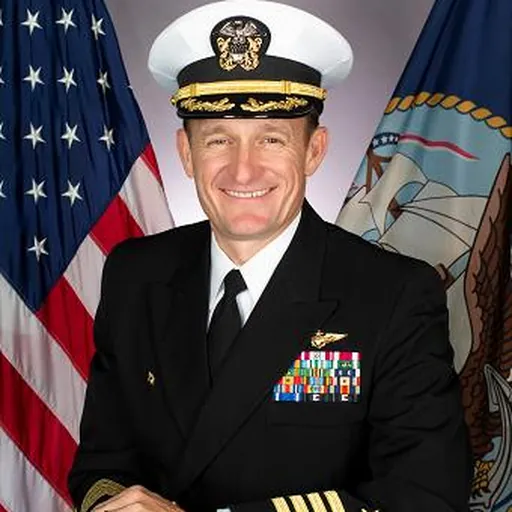
About Brett Elliott Crozier
Born 1970. Brett Elliott Crozier is an American naval officer.
Brett Elliott Crozier (born 1970) is a retired captain in the United States Navy. A United States Naval Academy graduate, he became a naval aviator, first flying helicopters and then switching to fighters. After completing naval nuclear training, he served as an officer on several aircraft carriers. In spring 2020, he was commanding officer of the aircraft carrier when COVID-19 broke out among the crew. He was relieved of command by then-acting Secretary of the Navy Thomas Modly after sending a letter to Navy leaders asking that most of the crew be taken ashore which was subsequently leaked to the press. Crozier himself was also later diagnosed with the virus. He was reassigned to a shore position and retired in March 2022.
Early life and education Brett Elliott Crozier grew up in Santa Rosa, California. He graduated from Santa Rosa High School in 1988 and then entered the United States Naval Academy in Annapolis, Maryland. He graduated from the academy in 1992. He received his master's degree in National Security and Strategic Studies from the Naval War College in Newport, Rhode Island in 2007, and completed Nuclear Power School in Goose Creek, South Carolina in 2014.
Naval career Crozier was designated a naval aviator in 1994 and was assigned as a Sikorsky SH-60 Seahawk pilot to the squadron HSL-37 at Barbers Point, Hawaii. He deployed on board and for operations in the Pacific Ocean and Operation Southern Watch in the Persian Gulf.
In 1999, Crozier served in Navy Personnel Command as an . He then shifted to flying the F/A-18 Hornet. In 2002, he reported to Strike Fighter Squadron 97 (VFA-97), the "Warhawks"; the following year, the squadron deployed with in support of Operation Iraqi Freedom (OIF).
COVID-19 outbreak onboard Theodore Roosevelt
Crozier was captain of Theodore Roosevelt, then deployed in the Pacific, on March 24, 2020, when three members of the crew tested positive for COVID-19. The next day, eight sailors were infected, and within a few days it was "dozens." The sailors became ill after more than two weeks at sea. The initial cases were airlifted to a military hospital. Theodore Roosevelt was ordered to Guam, where she docked on March 27, and all 4,865 aboard were ordered to be tested for the virus. About 100 affected sailors were offloaded, and the rest of the crew remained on board. Crozier wanted to have most of the crew immediately taken ashore, saying it was impossible to prevent the spread of the virus in the close quarters of the ship. However, his superior, Rear Admiral Stuart P. Baker, believed that to be impractical and too drastic.
On March 30, Crozier emailed a four-page memorandum to ten Naval officers. Three were admirals in his chain of command, including his immediate commander Rear Admiral Baker, Admiral John Aquilino, the commander of the Pacific Fleet, and Vice Admiral DeWolfe Miller III, commander of naval air forces in the Pacific. Crozier copied the message to seven other captains, five of whom were on board the Roosevelt and two who were executive assistants to the admirals. Crozier did not email Vice Admiral William R. Merz, who was higher than Baker in Crozier's chain of command. In the memorandum, Crozier pleaded for authorization to have most of the crew evacuated and quarantined ashore, citing the impossibility of following CDC recommendations on social distancing and quarantine procedures on the Roosevelt, a ship more crowded than the cruise ship Diamond Princess infected earlier. On March 31, the letter was leaked to the San Francisco Chronicle, which published it.
On April 2, 2020, Crozier was relieved of command by acting Secretary of the Navy Thomas Modly. At the time of his removal, 114 of 4,865 crew members had tested positive for the coronavirus. As he disembarked, sailors cheered him and chanted his name; videos of the scene were posted to Twitter and subsequently picked up by major news organizations.
After being relieved of command Crozier himself reportedly began showing symptoms of coronavirus before he was relieved, according to two of his Naval Academy classmates. He was placed in quarantine in Guam. Crozier was replaced by the interim commander Captain Carlos A. Sardiello. Modly mischaracterized the distribution list of the memorandum, inaccurately claiming that Crozier had copied 20 to 30 other people; Crozier in fact sent the memo to ten officers.
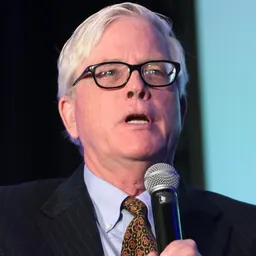
In an April 4 interview with radio host Hugh Hewitt, Modly criticized Crozier's decision to send the letter to what he characterized as "a large list of other people," adding "And that, to me, just represented just extremely poor judgment, because once you do that in this digital era, you know that there is no way that you can control where that information's going to go."
A joint statement from four Democrats on the House Armed Services Committee, including the committee chair, Representative Adam Smith of Washington, said that Crozier "did not handle the immense pressure appropriately" but that he "was justifiably concerned about the health and safety of his crew" and "relieving him of his command is an overreaction." President Donald Trump criticized Crozier's letter on April 4, saying "I thought it was terrible, what he did, to write a letter. This isn't a class on literature. This is a captain of a massive ship that's nuclear-powered." Joe Biden criticized Crozier's dismissal, saying: "I think it's close to criminal, the way they're dealing with this guy. ... he should have a commendation, rather than be fired."
Modly, Defense Secretary Mark Esper, and Chief of Naval Operations Admiral Michael Gilday each defended the decision to remove Crozier, although Gilday and General Mark A. Milley, the chairman of the Joint Chiefs of Staff, had each advised Modly not to proceed until a Navy investigation into the matter had been completed. Modly said that there was no White House pressure when the decision was made to remove Crozier. Later that day, Modly apologized for the comment. The following day, he resigned his position.
The Navy conducted an internal preliminary investigation into the Theodore Roosevelt affair, conducted by Admiral Robert P. Burke, the Vice Chief of Naval Operations. The investigation centered on the circumstances surrounding Crozier's firing and whether "a breakdown in communications" had taken place.
The findings of the Navy's preliminary investigation went to Gilday, and on April 15, it was reported that Gilday was considering reinstating Crozier as captain of the Theodore Roosevelt.
By April 17, 94% of the Theodore Roosevelts crew had been tested for COVID-19, with 660 sailors testing positive for the virus, The Theodore Roosevelt returned to sea on May 21, after being sidelined for nearly two months in Guam.
After the initial inquiry Gilday and the acting Secretary of the Navy, James E. McPherson, recommended on April 24 that Crozier be reinstated as captain of the Theodore Roosevelt. However, Defense Secretary Esper delayed a decision pending a "deeper review" of the situation. In the interim, Crozier was reassigned to San Diego, where he served as the special assistant to the Naval Air Forces chief of staff.
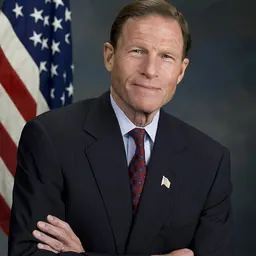
A second Navy inquiry, whose results were announced on June 19, concluded that Crozier and Baker made poor decisions regarding the coronavirus outbreak, so that Crozier would not be restored to command of the ship, and Baker's scheduled promotion would be put on hold. The remotely conducted investigation criticized Crozier for his planning of how to move sailors off the ship, waiting for hotel rooms to open up instead of fully using available base facilities, and not strictly following social distancing rules onboard a densely crewed ship. Democratic senators Richard Blumenthal and Chris Van Hollen questioned the conclusion, saying that the Navy was retroactively applying current anti-COVID-19 best practices to a situation at the start of the pandemic to justify the dismissal.
Crozier retired from the Navy in March 2022. He lives in California, and is currently the chief executive officer of LTA Research developing next generation airships.
Crozier also spoke to a video interview with Navy Times, discussing the book and his time in the Navy. Crozier has been interviewed by several media outlets.
Don’t just read it —
keep it.
Full-length biographies made to live with: read them, listen on the way to work, watch them tonight.
- E-book
- Audio
- Video
Instant download · yours to keep · every purchase keeps this site free
Important facts
People in Brett Elliott Crozier's life
Named in this biography and alive at the same time






Related people
Same field, nearest in time

Contemporaries
People whose lives overlapped Brett Elliott Crozier's





Frequently asked questions
Who is Brett Elliott Crozier?
United States Navy officer
When was Brett Elliott Crozier born?
Brett Elliott Crozier was born on 24 February 1970 in Santa Rosa.
What is Brett Elliott Crozier's occupation?
Brett Elliott Crozier is a naval officer.
What nationality is Brett Elliott Crozier?
Brett Elliott Crozier is American.
Sources & further reading
· Wikipedia: Brett Elliott Crozier
Cite this page
APA: Biography.guide. (2026). Brett Elliott Crozier. https://biography.guide/brett-elliott-crozier/
MLA: "Brett Elliott Crozier." Biography.guide, https://biography.guide/brett-elliott-crozier/.
Chicago: "Brett Elliott Crozier." Biography.guide. https://biography.guide/brett-elliott-crozier/.
Data last updated: 2026-09-23 · Spot an error? Report a correction.
Portrait: Wikimedia Commons · author & licence
Page generated 2026-09-27 05:05 UTC