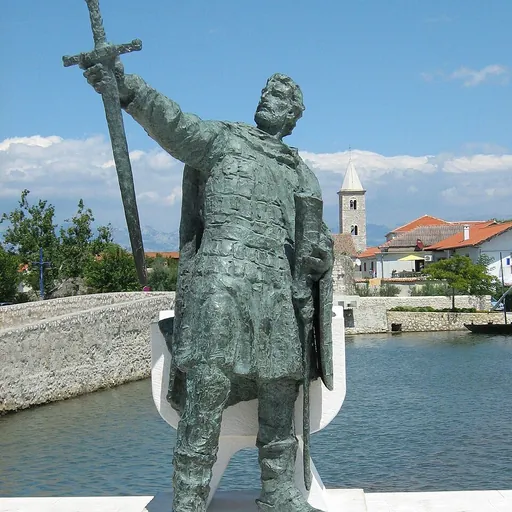
About Branimir of Croatia
Branimir of Croatia was a Croatian sovereign.
Branimir was Duke of Croatia, reigning from 879 to 892. His country received papal recognition as a state from Pope John VIII on 7 June 879. During his reign, Duchy of Croatia retained its sovereignty from both Carolingian and Byzantine rule and became de jure independent. His rule marks the first real peak of early medieval Croatia.
Reign
Rise to power In 879, a "certain Slav of the name Branimir" reportedly had the weak Duke Zdeslav, a supporter of the Byzantine Empire, killed near Knin in a rebellion that he led, per John the Deacon's Chronicon Venetum et Gradense (early 11th century).
Five papal letters sent between 879 and 882 are preserved in the Epistolae Ioannis VIII.
Throughout his reign, Duke Branimir worked on increasing the duchy's independence. According to the map of his contemporary, Anglo-Saxon king Alfred the Great (871–899), the territory of "Dalmatia" was between the Adriatic Sea, Danube, "desolate lands", Bulgars and Achaia.
Religious policy At the time pope's commitment with Branimir is obvious intention to connect Croatian Church with the Holy See and Diocese of Rome, but also affirm old organization in the province of Dalmatia in which ancient Salona (then Split) was the metropolitan centre of Dalmatia. However, the situation complicated until 887 during the time of pope Stephen V (information is found in few letters and preserved in Decretum Ivonis and Decretum Gratiani Collectio Britannica). The previous archbishop of Split, Marin, died and Theodosius was promoted to the position by Aquileian patriarch Walpert in 886, but did not abolish Diocese in Nin as wanted by the Holy See, however, eventually in 887–888 was confirmed as the archbishop of Split (with a pallium).
Under the influence of Methodius' baptising missions in 882 who made a stop in Croatia on his way from Moravia to Constantinople, Branimir possibly also endorsed parallel usage of Latin and Slavic in liturgy.
Epigraphs and sarcophagus Inscription of duke Branimir from Muć with engraved year 888. Up: part of the Branimir Inscription from Šopot near Benkovac as "Dux Cruatorum". Down: inscription of duke Branimir from Nin as "Dux Slcavorum". Today, there are six or eight known epigraphic inscriptions, mostly altar beams from old Croatian churches (from Muć, Nin, Ždrapanj, Šopot, Otres once located between Bribir and Ostrovica, and Lepuri near Benkovac), that bear the name of Duke Branimir. Recently were confirmed seventh from Bribir and eighth from Lepuri. In them Branimir is titled as "Dux Croatorum", "Commes Dux Cruatorum/Crvatorum", "Dux/Ducem Slcavorum/Clavitorum", and Dominus. They were rich in decorations and artifacts dated to the same period, The date of 21 May is marked today as Croatian Diplomacy Day.
Don’t just read it —
keep it.
Full-length biographies made to live with: read them, listen on the way to work, watch them tonight.
- E-book
- Audio
- Video
Instant download · yours to keep · every purchase keeps this site free
Important facts
Related people
Same field, nearest in time



Frequently asked questions
Who was Branimir of Croatia?
Duke of Croatia
What was Branimir of Croatia's occupation?
Branimir of Croatia was a sovereign.
What nationality was Branimir of Croatia?
Branimir of Croatia was Croatian.
Sources & further reading
· Wikipedia: Branimir of Croatia
· DBpedia: Branimir, Duke of Croatia
Cite this page
APA: Biography.guide. (2026). Branimir of Croatia. https://biography.guide/branimir-of-croatia/
MLA: "Branimir of Croatia." Biography.guide, https://biography.guide/branimir-of-croatia/.
Chicago: "Branimir of Croatia." Biography.guide. https://biography.guide/branimir-of-croatia/.
Data last updated: 2026-09-21 · Spot an error? Report a correction.
Portrait: Wikimedia Commons · author & licence
Page generated 2026-09-27 05:01 UTC