
About Brad Stevens
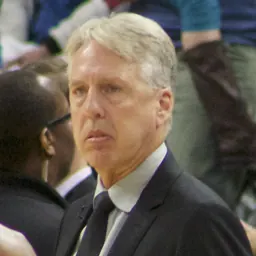
Born 1976. Brad Stevens is an American basketball player and basketball coach.
Bradley Kent Stevens (born October 22, 1976) is an American basketball executive and former coach who is the president of basketball operations for the Boston Celtics of the National Basketball Association (NBA).
Born and raised in Zionsville, Indiana, Stevens starred on the Zionsville Community High School basketball team, setting four school records. After high school, he attended DePauw University, where he played basketball and earned a degree in economics. Stevens made the all-conference team multiple times and was a three-time Academic All-America nominee. He transitioned into coaching after quitting his job at Eli Lilly and Company, joining the basketball program at Butler University as a volunteer prior to the 2000–01 season. Stevens was promoted to a full-time assistant coach the following season. After five seasons in the role, he assumed the position of head coach on April 4, 2007, after Todd Lickliter left to coach the Iowa Hawkeyes. In his first year, Stevens led Butler to 30 wins, becoming the third-youngest head coach in NCAA Division I history to have a 30-win season.
In 2010, his third year as head coach, Stevens broke the NCAA record for most wins in a coach's first three years, exceeding the previous record by eight wins. In the NCAA tournament, Stevens coached Butler to the first Final Four in school history, while also becoming the second-youngest head coach to make an NCAA national championship game, losing 61–59 to Duke. With the following season's team also making the Final Four, Stevens became the youngest coach to go to two Final Fours. Stevens coached the Bulldogs in their second consecutive national championship game on April 4, 2011, where the team again lost, this time to the Connecticut Huskies. Stevens was regularly named a finalist for Horizon League Coach of the Year award, winning twice, and was also a nominee for both the Hugh Durham Award and Jim Phelan Award in every year of his college career.
This success garnered Stevens the head coaching job with the Celtics in 2013, when he signed a six-year, $22 million contract. After undertaking a rebuild early in his tenure, Stevens led the Celtics to the NBA playoffs every season from 2014-15 to 2020-21, won a division championship in 2016–17, and appeared in the Eastern Conference finals in 2017, 2018, and 2020. He gained a reputation as one of the NBA's best coaches, with his motion offense and stingy defense earning plaudits from fans, peers, and players.
In June 2021, Stevens was named president of basketball operations of the Celtics, giving him the powers of general manager, following the resignation of Danny Ainge. In April 2024, Stevens was named the 2023–24 NBA Executive of the Year. Less than two months later, he won his first NBA championship with the Celtics as an executive, completing the rebuild that Stevens helped begin and oversee as the head coach. In April 2026, Stevens was named the 2025-26 NBA Executive of the Year, becoming the twelfth executive to win the award multiple times.
Early life Stevens grew up in Zionsville, Indiana, where he developed his love for basketball. Starting at age five, Stevens would watch taped basketball games "before he went to afternoon kindergarten". Stevens later stated, "It's hard not to be [in love with basketball] when you're a kid growing up in Indiana." When a friend, Brandon Monk, had a basketball court installed in his backyard, Stevens "appeared instantaneously." As a freshman, Stevens got up early to practice shooting at a local gym before school. Stevens was named to the all-conference team thrice. In 1995, he was the sectional MVP and the leading scorer in state sectional play (32.3 ppg). Stevens earned multiple all-conference and academic all-conference awards, and was a three-time Academic All-America nominee. He was a team captain during his senior year and averaged more than eight points per game three of his four years. He ran the idea of quitting his job at Eli Lilly by then-longtime girlfriend (and now wife) Tracy Wilhelmy. She thought about it for two hours before telling him to go for it. Stevens later remarked, "Now, it looks like a great idea. At the time, I thought it was something I really wanted to try."
Named head coach On April 2, 2007, Lickliter resigned in order to take the head-coaching position at the University of Iowa. He got off to a fast start, winning his first eight games before narrowly falling to Wright State 43–42. Legendary coach Bob Knight, whose Texas Tech team was an early victim, said: "I wish we played as smart as they do." Virginia Tech coach Seth Greenberg added: "they've got toughness about them and they expect to win." The Times went on to state that Stevens had the calm and composure of a seasoned veteran. In doing so, he became the third-youngest head coach in NCAA Division I history to lead a team to 30 wins in a season and became the fourth-winningest first-year coach. and a finalist for the Jim Phelan National Coach of the Year Award, losing to Bo Ryan.
At the end of the season, Butler signed Stevens to a seven-year contract. "We are extremely excited to reach this long-term agreement to have Brad continue to lead our program," Collier remarked.
2008–09 season Butler lost four starters after the 2007–08 season, and was picked to finish fifth in the Horizon league during the 2008–09 season. On February 5, Stevens notched his 50th win as Butler beat Detroit 66–61. In so doing, Stevens became the sixth head coach in NCAA history to reach 50 wins in 56 games or fewer. Butler finished first in the Horizon League with a 15–3 in conference record, defying preseason expectations. Butler lost the Horizon League tournament final 57–54 to Cleveland State, but made the NCAA tournament as an at-large selection. He was also named as a finalist for the Henry Iba Coach of the Year Award. Stevens was given a one-year contract extension at the conclusion of the season.
2009–10 season
Fueled in large part by Gordon Hayward's and Shelvin Mack's roles in leading Team USA to the gold medal in the FIBA Under-19 World Championship during the off-season, Butler began the season ranked 10th in the Coaches' Poll and 11th in the AP Poll. A few commentators picked the Bulldogs as a possible "sleeper team" to make the Final Four. Stevens was not so sure, privately telling his father, "We have a really good team, and I'm not sure how far we can go this year, but next year, we ought to go really far." After the tournament Butler's record stood at 4–2 and the team dropped to #23 in the AP Poll and #20 in the Coaches' Poll. Butler won its next two games before falling to 13th-ranked Georgetown 72–65 in the Jimmy V Classic. The team won its next two games beating #15 Ohio State 74–66 and narrowly edging out former conference rival Xavier 69–68, both at home.
Stevens rallied the team, and they proceeded to win 16 straight games before facing Siena in a BracketBusters game.
On February 26, 2010, Butler traveled to Valparaiso for their regular-season finale. Leading scorer Gordon Hayward was sidelined with lower back pain, but the team still won 74–69. In doing so, Stevens broke the coaching record he had tied the prior week and Butler completed an 18–0 undefeated conference schedule. It was Butler's first undefeated conference record since joining the Horizon League, and first since Joe Sexson led the 1978 team to a 6–0 record in the now-defunct Indiana Collegiate Conference. Stevens earned his third straight regular-season conference championship.
In the Horizon league tournament, Stevens' Bulldogs used their home-court advantage to beat Milwaukee 68–59 in the semifinals and to beat Wright State 70–45 in the finals. The win earned the team an automatic bid into the 2010 NCAA tournament, and completed a 20–0 run through league play. Stevens became the first coach to lead a Horizon League team to both an undefeated regular season and conference tournament since the league was formed in 1979. He was also the only coach in Division I to lead his team to an undefeated conference schedule during the 2009–10 season. On Selection Sunday, the Bulldogs were seeded fifth in the West regional of the NCAA tournament and given a first-round match-up with twelfth-seeded UTEP on March 18.
Many basketball commentators picked UTEP to pull the upset, and at halftime it looked like they might be right, as UTEP led 33–27. Stevens made a number of halftime adjustments, and the Bulldogs came out firing on all cylinders in the second half. The team dominated the second half and won the game 77–59. Butler next faced off with 13th-seeded Murray State. The game was close throughout, but Butler emerged victorious 54–52 when Hayward deflected a Murray State pass into the back court with less than five seconds on the clock. The win gave Stevens the first Sweet Sixteen appearance of his career.
On March 25, 2010, Butler faced top-seeded Syracuse. The Bulldogs got off to a good start, jumping out to a 12–1 lead and a 35–25 halftime advantage. Syracuse rallied in the second half, taking its first lead of the game, 40–39, off a Wes Johnson three-pointer. Stevens called timeout and Butler regained the lead on its next possession, stopping the run. At the 5:32 mark, Syracuse got a rare fast-break opportunity that ended with a dunk and 54–50 lead. Stevens again called time out and re-focused the team. Butler responded by holding Syracuse scoreless for the next five minutes, taking a 60–54 lead with 0:59 to go. Butler held on to win 63–59, advancing to the Elite Eight for the first time in school history.
Two days later, Stevens' Bulldogs met second-seeded Kansas State in the regional finals. Perhaps feeling the effects of their 101–96 double-overtime win two days prior, Kansas State got off to a slow start, scoring just 20 points in the first half to trail 27–20. Butler kept the lead in the upper single digits for most of the second half, before Kansas State went on a 13–2 run and took a 52–51 lead. Stevens immediately called time out and re-focused the team. "Play your game. Just play your game," he told them. In the postgame celebration, Stevens and walk-on forward Emerson Kampen connected on a flying back-bump that became one of the iconic images of the tournament.
Final Four On April 3, Stevens and the Butler Bulldogs faced off with Michigan State in the national semi-finals. Michigan State took an early 14–7 lead, and Matt Howard got in early foul trouble, sitting most of the first half. Stevens kept the team focused with a "next man up" attitude and the game was tied at 28 at halftime. The second half was dominated by tight defense for both sides. With 2:45 to go in the game, the score was 47–44 Butler. Michigan State called a time out to set up a play. Stevens correctly anticipated the play call and had Ronald Nored, the team's best defender, switch onto Korie Lucious off a screen. Nored stole the ball and Shawn Vanzant got fouled on the resulting run out, hitting 1 of 2. Trailing 50–49 with under 30 seconds remaining, Michigan State came up empty and was forced to foul. Nored hit both foul shots, giving Butler a 52–49 lead. After a Michigan State time-out, Stevens had his team foul Lucious with two seconds remaining to prevent a potentially game tying three-pointer. After making the first, Lucious intentionally missed the second free throw. Hayward came down with the rebound to seal the victory.
On April 5, 2010, Butler and Duke faced off in what The New York Times called "the most eagerly awaited championship game in years." Late in the first half, Duke went on an 8–0 run to take a 26–20 lead. Stevens called a timeout, and with starters Matt Howard and Ronald Nored on the bench in foul trouble, Stevens was forced to call on backup center Avery Jukes who came up big for Butler. Jukes scored 10 first half points, tying his season high. At half time, Duke's lead stood at 33–32.
The second half was played closely, with neither team taking a substantial lead. With 3:16 to play, Duke took a 60–55 lead on two made free throws by Nolan Smith. Butler cut the lead to one point in the final minute and, after a missed Kyle Singler jump shot with 36 seconds remaining, got a chance to retake the lead. Butler was unable to initiate their offense, and Stevens called a timeout to set up a play. A failed inbounds attempt and a timeout later, Hayward missed a baseline fade-away jumper and Brian Zoubek came down with the rebound for Duke. He was quickly fouled with less than four seconds remaining. Hayward narrowly missed a desperation half-court shot as time expired, making the final margin 61–59. Stevens was named as both a Hugh Durham and Jim Phelan Award finalist for the third consecutive year, losing to Mike Young and Jamie Dixon, respectively. He was also a finalist for the Skip Prosser Man of the Year Award, which was won by Bob Marlin.
Butler finished the year ranked #2 in the Coaches' Poll, the highest ranking in school history. The school was ranked for 19 consecutive weeks, tying the school record. Stevens was even invited to throw the ceremonial first pitch before the Chicago Cubs versus Florida Marlins game in Chicago on May 10. "It's all been very surreal," Stevens said. "If you are the runner-up, you don't expect to talk to the president." Asked if the increased fame would change things, Stevens said it better not spoil him or the university. Stevens stated: "I look at this new challenge of not changing and sticking to your core values and making sure you remain humble as a great coaching opportunity." Duke coach Mike Krzyzewski agreed, saying Butler would be "right up there, No. 1 or No. 2... They'll be a favorite next year." Financial terms of the contract were not disclosed; however, Butler president Bobby Fong had publicly stated that the university could afford to increase Stevens' base salary to approximately US $1 million a few days prior. He had previously made US$395,000 plus benefits in base salary, a relatively low figure for a successful Division I head basketball coach. Stevens' total compensation for 2009–10 was estimated at US$750,000. He had received a raise after each of his three seasons at Butler and his contract contains a buyout clause estimated in the high-six or low-seven figures.
1=What Butler is, Butler is a great school. We're in a great city. We have a niche from the standpoint of basketball with a good tradition of basketball and a fieldhouse that really embraces the history of the game. So we're very unique. I think being unique is a good thing, too. I think Butler, certainly you always want to improve the facilities you have. We need to do that. There's no question about that. But we also need to remember who we are. I think that's why we're here, because we've got unselfish guys. They have a great passion for history, tradition, team, things like that. So we've been able to recruit to that.|4=Brad Stevens|5=responding to a question about his future and Butler University
In March 2013, UCLA reportedly offered Stevens between $2.5 and $3 million a year to leave Butler. Rumors circulated that he was in contract negotiations with UCLA, but ultimately the rumors proved false and Stevens stayed at Butler. A few days later, Stevens reiterated that he was happy at Butler and had no intentions to leave as long as he had the support of the university to continue running the program the "right way."
NBA coaching career On July 3, 2013, Stevens was hired as the head coach of the Boston Celtics. In his second season as head coach, Stevens led the team to the 2015 playoffs as the #7-seed in the Eastern Conference with a 40–42 record. In his third season, Stevens led the Celtics to their second consecutive playoff appearance as the #5-seed in the 2016 playoffs, finishing the season with a 48–34 record. On February 28, 2016, Stevens was named the Eastern Conference Coach of the Month for February. He guided his squad to an Eastern Conference-best 9–3 record during the month, including a perfect 6–0 mark at home. The Celtics (36–25 overall) finished the month in sole possession of third place in the East behind the Cleveland Cavaliers and Atlantic Division foe the Toronto Raptors.
On June 1, 2016, Stevens received a contract extension. In his fourth season as head coach, Stevens led the Celtics to the playoffs as the top seed in the Eastern Conference with a 53–29 record. They reached the Eastern Conference Finals, where they lost to the defending champion Cleveland Cavaliers in five games.
On July 4, 2017, Stevens was reunited with his former college player Gordon Hayward when Hayward signed a contract to play for the Celtics. In the 2017–18 season, the Celtics' roster saw a massive change, as two-time All-Star Isaiah Thomas was traded to the Cleveland Cavaliers in exchange for Kyrie Irving. Stevens and the Celtics went 55–27, finishing the season as the second seed in the Eastern Conference, despite losing Hayward for the season to a broken ankle in the first game of the season and Irving missing significant playing time due to knee injuries. Despite Irving missing the playoffs, Stevens led the Celtics on a deep playoff run, losing to the Cleveland Cavaliers in seven games during the Eastern Conference Finals. Stevens was considered a front-runner for the NBA Coach of the Year Award, but lost to Dwane Casey of the Toronto Raptors.
Executive career
2021–22 season On June 2, 2021, the Celtics named Stevens as the new president of basketball operations and de facto general manager, replacing Danny Ainge, who announced his retirement, though Ainge later joined the Utah Jazz as their alternate governor in December 2021. On June 18, Stevens made his first transaction in his new position by trading away Kemba Walker, the 16th pick in the 2021 NBA draft (later Alperen Şengün), and a 2025 second-round pick (later Kobe Sanders) in exchange for Al Horford, Moses Brown, and a 2023 second-round pick (later Amari Bailey). The deal gave the Celtics a bit more financial flexibility with Horford due about $20 million less than Walker over the next two years. The Celtics also improved their depth in the frontcourt by adding Horford and Brown, who recorded 21 points and 23 rebounds, which included 19 rebounds in the first half, in a March 27 game between the Celtics and the Thunder.
On June 23, it was reported that Stevens made the decision to hire Brooklyn Nets assistant coach Ime Udoka as his own replacement as head coach of the Celtics. The hiring became official five days later. Stevens later stated that he hired Udoka because the latter had "a great approachability." In Udoka's first year as head coach and Stevens' first year as an executive, the Celtics overcame an 18–21 start and ended up finishing as the #2-seed in the Eastern Conference with a 51–31 record. During the turnaround, Stevens and the Celtics traded Josh Richardson, Romeo Langford, a 2022 first-round pick (which turned into Blake Wesley), and the rights to swap 2028 first-round picks to the San Antonio Spurs in exchange for Derrick White, who became a key contributor for the Celtics. In the playoffs, the Celtics swept the Brooklyn Nets during the first round and then went on to beat the Milwaukee Bucks in seven games during the Eastern Conference Semifinals. After defeating the Miami Heat in seven games during the Eastern Conference Finals, the Celtics made their first NBA Finals appearance since 2010. However, the Celtics lost the 2022 NBA Finals to the Golden State Warriors in six games despite a 2–1 lead.
2022–23 season On July 9, 2022, Stevens and the Celtics traded Aaron Nesmith, Daniel Theis, Nik Stauskas, Malik Fitts, Juwan Morgan, and a 2023 first-round draft pick to the Indiana Pacers in exchange for Malcolm Brogdon. On September 22, Stevens and the Celtics suspended Udoka for the entire 2022–23 season for violating team policies pertaining to an improper intimate relationship with a female Celtics staff member. Assistant coach Joe Mazzulla replaced Udoka as the interim head coach. On February 16, 2023, Stevens and the Celtics named Mazzulla the team's permanent head coach and signed him to an extension after Mazzulla led the Celtics to a league-best 42–17 record at the NBA All-Star break. The Celtics entered the playoffs as the #2-seed in the Eastern Conference with a 57–25 record. They went on to beat the Atlanta Hawks in six games during the first round and the Philadelphia 76ers in seven games during the Eastern Conference Semifinals. However, the Celtics lost to the #8-seed Miami Heat during the Eastern Conference Finals in seven games.
2023–24 season Stevens and the Celtics retained Mazzulla as head coach for the 2023–24 season, with Stevens calling Mazzulla "a terrific leader" and "accountable." On June 22, 2023, Stevens and the Celtics traded Marcus Smart to the Memphis Grizzlies as part of a three-team deal that sent Kristaps Porziņģis to the Celtics and Tyus Jones to Washington. The trade also involved the Grizzlies sending a 2023 first-round pick (pick No. 25) and a top-four-protected 2024 first-round pick (via Golden State Warriors) to the Celtics. A few months later on October 1, Stevens and the Celtics traded Robert Williams III, Malcolm Brogdon, and two future first-round draft picks to the Portland Trail Blazers in exchange for Jrue Holiday.
On April 30, 2024, Stevens was awarded the NBA Executive of the Year Award for the 2023–24 season. The Celtics went on to beat the Miami Heat and Cleveland Cavaliers in five games during the first round and Eastern Conference Semifinals, respectively. After completing a 4–0 sweep of the Indiana Pacers in the Eastern Conference Finals, the Celtics advanced to the 2024 NBA Finals. They went on to beat the Dallas Mavericks in five games, giving Stevens his first NBA Championship.
Coaching style According to Stevens, in one of his first games as head coach, he was nervous and "felt like our team played on edge" because of it. For example, when Butler was slumping in late 2010, Stevens challenged his team: "this [46% defensive field goal percentage] is where we are. This isn't acceptable to get to where we want to go. But what does that really mean? It's not just get better defensively, it is, if we give up three less baskets a game, then we will be at 40 percent field goal percentage defense which will be top 20 in the country."
Stevens' teams are built around solid basketball fundamentals and good teamwork rather than individual basketball skill. He also states, "Win the next game. Win the next possession. That's our focus. It's boring. It's also the way championships are won." In short, Stevens is a strong believer in "The Butler Way"—doing all the little things that transform a group of good basketball players into a great basketball team. but is not interested in self-promotion. Stevens instead prefers to deflect the praise he receives to the players, athletic department, and his mentors.
The New York Times, USA Today, ESPN, and other commentators attributed Butler's success against teams with superior athletes to Stevens' coaching style. Wooden agreed, saying, "I enjoy watching [Stevens] and very much enjoy [Butler's] style of play."
Personal life Stevens is known for projecting a professional, "corporate" look from the sidelines. Stevens met his wife, Tracy (née Wilhelmy), while attending DePauw University. Tracy, who played soccer for DePauw, quickly learned of Brad's love for basketball; on their third date, he drove her an hour and a half to attend a high school basketball game. Tracy graduated from Rocky River High School in 1995, and from DePauw in 1999. Stevens and his wife have two children, Kinsley and Brady. Brady plays basketball at Notre Dame.
Brad and Tracy are involved with the American Cancer Society's Coaches vs. Cancer. Stevens says that the cause really hit home for them after Tracy's mother died of the disease in June 2004. The day before Butler's 2010 Final Four appearance, they hosted a fundraiser for the organization. Stevens remains in close contact with the Butler basketball family; he notably took a one-game leave from the Celtics in January 2016 to visit with Andrew Smith, a player on both of Butler's Final Four teams who was dying of cancer; Smith died less than a week later. At the request of Andrew's widow, Sam, Stevens delivered the eulogy at the memorial service on January 17, 2016.
Stevens' father, Mark, is an orthopedic surgeon in Indianapolis who played college football for Indiana. who has previously taught at Butler.
Head coaching record
College
NBA
Awards and honors NBA 2017 NBA All-Star Game Head Coach 2024 NBA Executive of the Year 2024 NBA Champion (as Boston Celtics President of Basketball Operations) 2026 NBA Executive of the Year
NCAA Two-time Horizon League Coach of the Year (2009, 2010) Three-time Undisputed Horizon League Champion (regular season and conference tournament - 2008, 2010, 2011 as head coach at Butler)
Don’t just read it —
keep it.
Full-length biographies made to live with: read them, listen on the way to work, watch them tonight.
- E-book
- Audio
- Video
Instant download · yours to keep · every purchase keeps this site free
Important facts
People in Brad Stevens's life
Named in this biography and alive at the same time



Related people
Same field, nearest in time


Contemporaries
People whose lives overlapped Brad Stevens's
Frequently asked questions
Who is Brad Stevens?
American coach and executive
When was Brad Stevens born?
Brad Stevens was born on 22 October 1976 in Indianapolis.
What is Brad Stevens's occupation?
Brad Stevens is a basketball player and basketball coach.
What nationality is Brad Stevens?
Brad Stevens is American.
Sources & further reading
Cite this page
APA: Biography.guide. (2026). Brad Stevens. https://biography.guide/brad-stevens/
MLA: "Brad Stevens." Biography.guide, https://biography.guide/brad-stevens/.
Chicago: "Brad Stevens." Biography.guide. https://biography.guide/brad-stevens/.
Data last updated: 2026-09-20 · Spot an error? Report a correction.
Page generated 2026-09-27 05:25 UTC