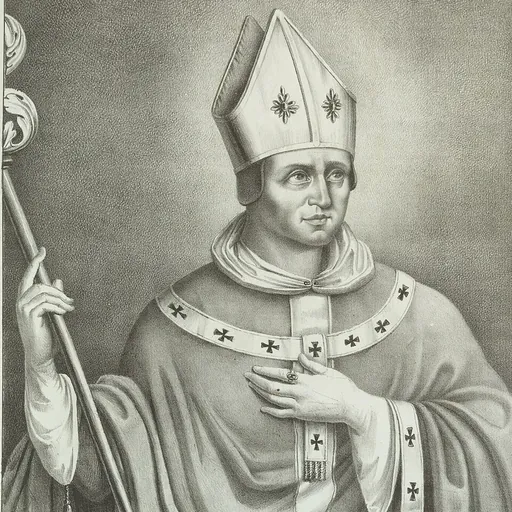
About Boniface of Savoy
Boniface of Savoy was a catholic priest and catholic bishop.
Ecclesiastical career Henry III of England landing in Aquitaine. Boniface was the uncle by marriage of the king. Boniface was the Prior of Nantua in 1232 along with the bishopric of Belley in Burgundy. When his father died, he received the castle of Ugine as his inheritance, and he surrendered any entitlement to any other inheritance in 1238. After the marriage of his niece, Eleanor of Provence to King Henry III of England, he came with a number of her relatives to England.
Henry attempted to have Boniface elected Bishop of Winchester but was unable to get the cathedral chapter to elect Boniface. at Lyons, but it was only in 1249 that he returned to England and was enthroned at Canterbury Cathedral on 1 November 1249. Before he returned in 1249, he helped arrange the marriage another of his nieces, Beatrice of Provence, the sister of Queen Eleanor, to Charles of Anjou, the brother of King Louis IX of France. He showed little concern for the spiritual duties of his office. His exactions and his overbearing behaviour, combined with the fact that he was a foreigner, offended the English. He was heavily involved in advancing the fortunes of his family on the continent and spent fourteen of the twenty-nine years he was archbishop outside England. He made strenuous efforts to free his office from debt, as he had inherited a see that was in debt over 22,000 marks, but managed to clear the debt before his death. He did this by securing the right to tax his clergy, for seven years, from the papacy. When a number of bishops refused to pay, they were suspended from office. He also worked for the canonisation of Edmund of Abingdon while he was at the papal court-in-exile at Lyon from 1244 to 1249. Boniface held church councils to reform the clergy, in 1257 at London, in 1258 at Merton, and in 1261 at Lambeth.
During his archiepiscopate, a provincial court was established in the archdiocese of Canterbury, with a presiding Officialis appointed by Boniface.
Controversies Boniface was energetic in defending the liberties of his see, and clashed with King Henry over the election of Henry's clerk Robert Passelewe to the see of Chichester. Robert Grosseteste, the Bishop of Lincoln, had examined Passelewe, and found him unfit for episcopal office, and Boniface then quashed the election in 1244. He was also involved in disputes with the king's half-brothers, especially Aymer de Valence, who was Bishop of Winchester. He also quarrelled with his suffragan bishops, who resented his attempts to supervise their affairs closely. After the visitation, Boniface left England again and only returned in 1252, after the pope had decided the bishops' appeal in Boniface's favour. After his return, he continued to assert his rights and settled a number of disputes with his bishops. He secured professions of obedience from all but three of the 37 bishops consecrated during his time as archbishop. He also set up a court at Canterbury that heard appeals from the ecclesiastical courts of his suffragan bishops. One of the actions of this council was to send the Lusignans into exile. But in 1261 Boniface held a church council at Lambeth, where a series of ecclesiastical laws were published which denounced any royal limitations on ecclesiastical courts. These decrees were done without royal consent and thus was tantamount to an ecclesiastical revolt against royal authority similar to the baronial opposition movement that had begun in 1258.
During the Second Barons' War, Boniface seems to have sided first with the English bishops against King Henry, but later he sided with Henry. In 1262, he went to France, excommunicating the barons opposing the king. He was not summoned to the Parliament at London in January 1265 because he was abroad. On the triumph of the king's party in 1265, he returned to England, arriving there in May 1266. Boniface left England in November 1268 and never returned. His will had differing provisions for his burial depending on whether he died in England, France, or near the Alps. Oddly enough, his official seal included a head of the pagan god Jupiter Serapis along with the usual depiction of the archbishop in full vestments.
After his death, Boniface's tomb was the center of a cult, and when the tomb was opened in 1580, his body was found to be perfectly preserved. The tomb and effigy were destroyed in the French Revolution, his remains were reburied and a new tomb built in 1839. He was beatified by Pope Gregory XVI in 1839,
Although Matthew Paris disapproved of Boniface, modern historians have seen him as a responsible archbishop. The historian D. A. Carpenter says that Boniface "became a respected and reforming archbishop". His episcopal registers do not survive.
Don’t just read it —
keep it.
Full-length biographies made to live with: read them, listen on the way to work, watch them tonight.
- E-book
- Audio
- Video
Instant download · yours to keep · every purchase keeps this site free
Important facts
Family & relationships
Related people
Same field, nearest in time
Frequently asked questions
Who was Boniface of Savoy?
Archbishop of Canterbury
When did Boniface of Savoy die?
Boniface of Savoy died on 14 July 1270 in Château de Sainte-Hélène-sur-Isère.
What was Boniface of Savoy's occupation?
Boniface of Savoy was a catholic priest and catholic bishop.
Sources & further reading
· Wikipedia: Boniface of Savoy
· DBpedia: Boniface of Savoy (bishop)
Cite this page
APA: Biography.guide. (2026). Boniface of Savoy. https://biography.guide/boniface-of-savoy/
MLA: "Boniface of Savoy." Biography.guide, https://biography.guide/boniface-of-savoy/.
Chicago: "Boniface of Savoy." Biography.guide. https://biography.guide/boniface-of-savoy/.
Data last updated: 2026-09-26 · Spot an error? Report a correction.
Portrait: Wikimedia Commons · author & licence
Page generated 2026-10-04 10:46 UTC