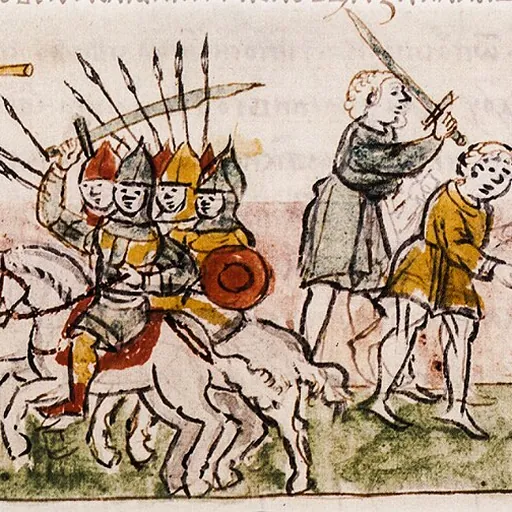
Boniak
Cuman khan
About Boniak
Born 1050. Boniak was a khan.
Boniak, Bonyak or Maniac, also known as Boniak the Mangy (Old Church Slavonic: Бонякъ Шолудивый; ; ), was "one of the most prominent Cuman chieftains" in the late and the early . He headed a powerful Cuman tribe or clan that inhabited the steppes to west of the Dnieper River. He supported the Byzantines against the Pechenegs in the Battle of Levounion in 1091. He defeated Coloman, King of Hungary in 1097 or 1099.
Origins
Boniak's descent is uncertain. Svetlana Pletneva associates him with the Burch tribe, Peter B. Golden with the Ölberli tribe of the "Wild Cumans", and Omeljan Pritsak with the Qay clan. Boniak's nicknamethe Mangymay show that he was born with the caul, according to the Hungarian historian Szilvia Kovács. In Anna Komnene's Alexiad, he is called Maniac.
Boniak's exact position cannot be determined, but his career shows that he must have been the head of powerful Cuman tribal federation, tribe, or clan. When pursuing Boniak, Sviatopolk II of Kiev and Vladimir II Monomakh "advanced to the Bug and later beyond the , according to Vladimir's Testament, which suggests that Boniak's people dwelled between the rivers Dnieper and Southern Bug or Dniester. His participation in military campaigns in the Balkan Peninsula also shows that his people lived near the Lower Danube.
Career
First records
Along with Tugorkan, Boniak, or Maniak, was one of the Cumans' "outstanding leaders", named by Anna Komnene, who came to assist the Byzantine Emperor Alexios I Komnenos against the Pechenegs. The united Byzantine and Cuman army annihilated the Pechenegs in the Battle of Levounion on 29 April 1091. Historian Florin Curta writes that the two Cuman chieftains plundered the eastern regions of the Kingdom of Hungary on their return to the Desht-i Kypchak, or Cuman steppes. Pletneva says that Boniak and Tugorkan together supported the pretender Pseudo-Diogenes against Emperor Alexios I in 1094, but Anna Komnene did not refer to Boniak's participation in the fights.
Wars in Rus'
The Russian Primary Chronicle recorded two events connected to Boniak under the year 6604, that is 1095 or 1096 AD. First Boniak and his Cumans "appeared before and while ravaging the environs, they burned the prince's palace at Berestovo" around 24 May. On 20 July, "Boniak, that godless, mangy thief and bandit, came suddenly to Kiev for the second time" and plundered three monasteries, including the Cave Monastery. During the second campaign, the Cumans "planted two standards before the monastery gates", according to the Russian Primary Chronicle. On his return, Boniak predicted to David Igorevich that they would defeat the Hungarians in the battle. The Cumans annihilated the Hungarian army and seized the royal treasury. According to the Hungarian Illuminated Chronicle, "arely did Hungarians suffer such slaughter as in this battle". However, David Igorevich could not reconquer Volhynia and was again forced to seek refuge among the Cumans. Boniak again joined them and their united armies seized Lutsk and Volodymyr-Volynskyi. According to the Russian Primary Chronicle, these events occurred in 1097, but many historians (including Kovács and Martin Dimnik) say that the fights took place two years later.
The Russian Primary Chronicle recorded that five Rus' princesSviatopolk II of Kiev, Vladimir Monomach, Davyd Sviatoslavich, Oleg Sviatoslavich and Yaroslav Sviatoslavichassembled on the left bank of the Dnieper near Kiev in 1101. On learning of the princes' meeting, all Cuman chieftains sent envoys to them "with propositions of peace". The princes and the Cuman chieftains met at Sakov on the Dnieper and made peace on 15 September. Two years later Sviatopolk II of Kiev, Vladimir Monomach and Davyd Sviatoslavich invaded the Cuman steppes and routed a large Cuman army, killing 20 Cuman chieftains.
According to the Hypatian version of the Russian Primary Chronicle, Boniak made an incursion into the region of Zarub in the Principality of Pereyaslavl, fighting with the Torks and Berendei in the winter of 1105 and 1106. The Russian Primary Chronicle recorded that Boniak "raided and seized many horses in the vicinity of in May 1107. During the summer, he returned accompanied by Sharukan and other Cuman chieftains and laid siege to Lubno on the Sula River. Vladimir Monomach, Prince of Pereyaslavl, persuaded Svyatopolk II of Kiev and other Rus' princes to come to fight against the invaders. Their unified armies unexpectedly crossed the Sula, forcing the terrified Cumans to lift the siege and leave their camp on 12 August. According to an alternative narration, recorded in Vladimir Monomach's Testament, the united forces of the Rus' princes routed Boniak and his Cuman allies on the banks of the Sula in summer, and Monomach alone defeated Boniak at Lubno alone only in 1108.
Svyatoplok II of Kiev died on 16 April 1113 or 1114. After the Cumans learned of Svyatopluk's death, the Cumans marched as far as Vyr' River. The Cumans were under the command of Aepa and Boniak, according to the Testament of Vladimir Monomach who succeeded Svyatopolk in Kiev. Monomach wrote that he "advanced to meet them as far as" Romny with his sons and Oleg Sviatoslavich, forcing the Cumans to flee.
Boniak is often represented as a sorcerer in Rus' folklore.
Don’t just read it —
keep it.
Full-length biographies made to live with: read them, listen on the way to work, watch them tonight.
- E-book
- Audio
- Video
Instant download · yours to keep · every purchase keeps this site free
Important facts
Related people
Same field, nearest in time



Frequently asked questions
Who was Boniak?
Cuman khan
When was Boniak born?
Boniak was born in 1050.
What was Boniak's occupation?
Boniak was a khan.
Sources & further reading
Cite this page
APA: Biography.guide. (2026). Boniak. https://biography.guide/boniak/
MLA: "Boniak." Biography.guide, https://biography.guide/boniak/.
Chicago: "Boniak." Biography.guide. https://biography.guide/boniak/.
Data last updated: 2026-09-24 · Spot an error? Report a correction.
Portrait: Wikimedia Commons · author & licence
Page generated 2026-09-27 05:09 UTC